
Milan gets 500 Folgore paratroopers under Strade Sicure after the 18 October clashes
The Italian Government is sending 500 Folgore paratroopers to Milan with public security powers until 31 December 2026. The move follows the violent clashes of 18 October and exposes differences inside the ruling majority.

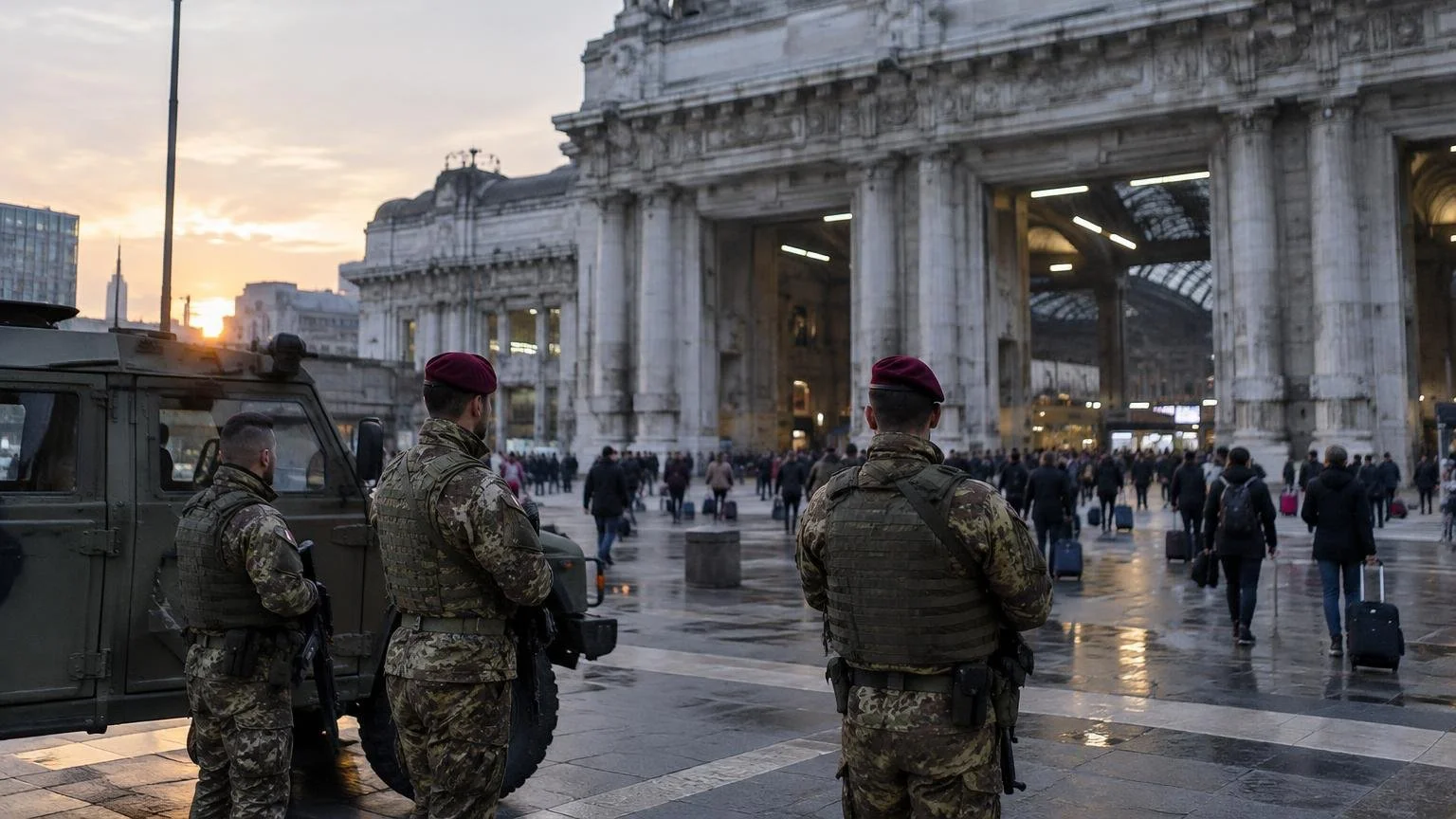
- 01On 20 October the Council of Ministers approved a decree-law that sends 500 Folgore Parachute Brigade soldiers to Milan under Strade Sicure.
- 02The paratroopers are to stay operational until 31 December 2026, with the status of public security officers.
- 03About 6,800 soldiers are currently deployed in 58 provinces under Strade Sicure, of whom 6,630 are from the Army.
- 04The Lombardy, Trentino-Alto Adige group counts 950 soldiers; the 500 paratroopers will serve in Milan alone.
The Italian Government has decided to send 500 paratroopers of the Folgore Parachute Brigade to Milan under the "Strade Sicure" operation, after the serious clashes in the city centre on 18 October. The measure is contained in a decree-law approved by the Council of Ministers on Tuesday 20 October.
The deployment matters because it brings military personnel with public security powers into the streets of Italy's financial capital, and because it comes with a wider package against urban violence and juvenile crime. It also shows how the three parties of the majority differ on the role of soldiers in cities.
What happened
The Council of Ministers approved on 20 October the decree-law "Disposizioni urgenti in materia di sicurezza pubblica e contrasto alla criminalità minorile", designed to strengthen tools against violence and what the text calls urban guerrilla warfare. It provides for 500 additional soldiers in Milan within Strade Sicure.
The troops come from the Folgore Parachute Brigade and, according to reports, from Siena. They will operate from the coming days until 31 December 2026, alongside the State Police and the Carabinieri. They are in addition to the soldiers already supporting law enforcement.
According to the Defence Ministry's statement, Minister Guido Crosetto will make them available immediately to strengthen the security system on the territory. The ministry said the 500 soldiers will reinforce posts, intensify surveillance of sensitive sites and raise territorial control capacity.
The ministry added that their use will let the State Police and the Carabinieri concentrate more personnel on prevention, intervention, crime fighting and public order services. The soldiers will act within Strade Sicure tasks, in coordination with the police and respecting their respective competences.
Who decides how they are used?
The Prefect of Milan will order their use after hearing the police chief, who will set the methods according to needs, from patrolling to static surveillance. There will be no fixed proportion between paratroopers and police forces, which also hold judicial police powers. The use of soldiers trained to operate drones is also reportedly possible.
What can the soldiers do?
Military personnel act as public security officers and can carry out the immediate identification and search of people and vehicles, including to prevent behaviour that may endanger people or the security of the places under watch. This follows Article 7-bis of Decree-Law 92/2008, converted into Law 125/2008.
They do not have the general powers of a police officer or a Carabiniere. Judicial police functions are excluded: for further checks and for any judicial police act, they must take the people concerned to the nearest State Police or Carabinieri office.
The law allows a deployment plan for six months, renewable once, for a contingent of no more than 3,000 personnel. The plan is adopted by a decree of the Interior Minister, together with the Defence Minister, after consulting the National Committee for Public Order and Security and informing the Prime Minister.
The numbers of Strade Sicure
- Total deployed: 6,800 soldiers in 58 provinces, divided into 11 groups.
- Army personnel: 6,630; the rest come from the Navy and the Air Force.
- Lazio, Umbria, Abruzzo and Marche: 1,680, of whom over 90% are in Rome and its province.
- Lombardy, Trentino-Alto Adige: 950, plus the 500 paratroopers in Milan alone until year-end.
- Campania: 960; Veneto and Friuli Venezia Giulia: 620; Sicily: 600.
Strade Sicure began on 4 August 2008 and is described as the most widespread and longest-running operation of the Armed Forces on national territory alongside law enforcement, against crime and terrorism.
Why it matters
The deployment matters because it turns a long-running support operation into the government's first answer to the 18 October violence, and because it tests the majority's unity on security policy. The tension is not new.
At the beginning of October the Defence Committee of the Chamber approved a resolution to raise the contingent from about 6,800 to 10,000 soldiers, and in the end the whole majority backed the text. Earlier, in September, the League had filed its own resolution aiming at 10,000 soldiers guarding squares and stations, calling a postponement "inexplicable".
The parties differ on approach. The League pushed to strengthen the soldiers' presence immediately, while Brothers of Italy proposed doing it on the basis of an overall reorganisation. Forza Italia stressed the need for more security while avoiding soldiers becoming permanent substitutes for the police. The differences emerged in particular between Defence Minister Crosetto, of Brothers of Italy, and Deputy Prime Minister Matteo Salvini, of the League.
What are the risks and open questions?
The main open questions are the long-term role of soldiers and the limits of their powers. Soldiers cannot carry out judicial police functions, so every case beyond identification and search depends on the police and Carabinieri. The three parties agreed to strengthen the operation, but differences remain on how to use the troops and on their role over time.
Earlier in the year the government had already moved on security: on 6 February Prime Minister Giorgia Meloni announced light Puma army vehicles at Milan's Rogoredo station, and said the security decree included rules to speed up hiring thousands of new officers, while Crosetto worked on about 12,000 auxiliary Carabinieri.
Reporting after the clashes also notes that the youngest person identified was 11 years old, and that Interior Minister Matteo Piantedosi said there was no evidence that the minors had been manipulated. The government also approved measures to make the detention of minors easier, according to Meloni.
What to watch next
The next steps concern the arrival of the troops and the parliamentary passage of the decree.
- The paratroopers' arrival and first patrols in Milan, in the coming days.
- The Prefect's orders, after consulting the police chief, on patrolling or static surveillance, and any use of drone specialists.
- The parliamentary conversion of the decree-law on public security and juvenile crime.
- 31 December 2026, when the deployment is due to end.
- Whether the majority moves toward the 10,000-soldier ceiling set out in the Chamber resolution.
Sources:ansa.itilsole24ore.comilsole24ore.comen.ilsole24ore.comgoverno.ittg24.sky.itansa.it
UCapital Asset Management LLP or group companies may have commercial relationships with the companies mentioned. This content is not financial advice.
Sign up for free to ask the AI about this article.
Elections, tariffs, sanctions and reforms: what changes for markets, countries and supply chains.