
Italy's 2027 budget: mini Irpef for under-30s, middle-class tax cut dropped, pension flexibility deferred
Giorgia Meloni's government is building its last budget before the elections around a tax break for young workers. The middle-class relief is out, and pension flexibility moves to a new fund.

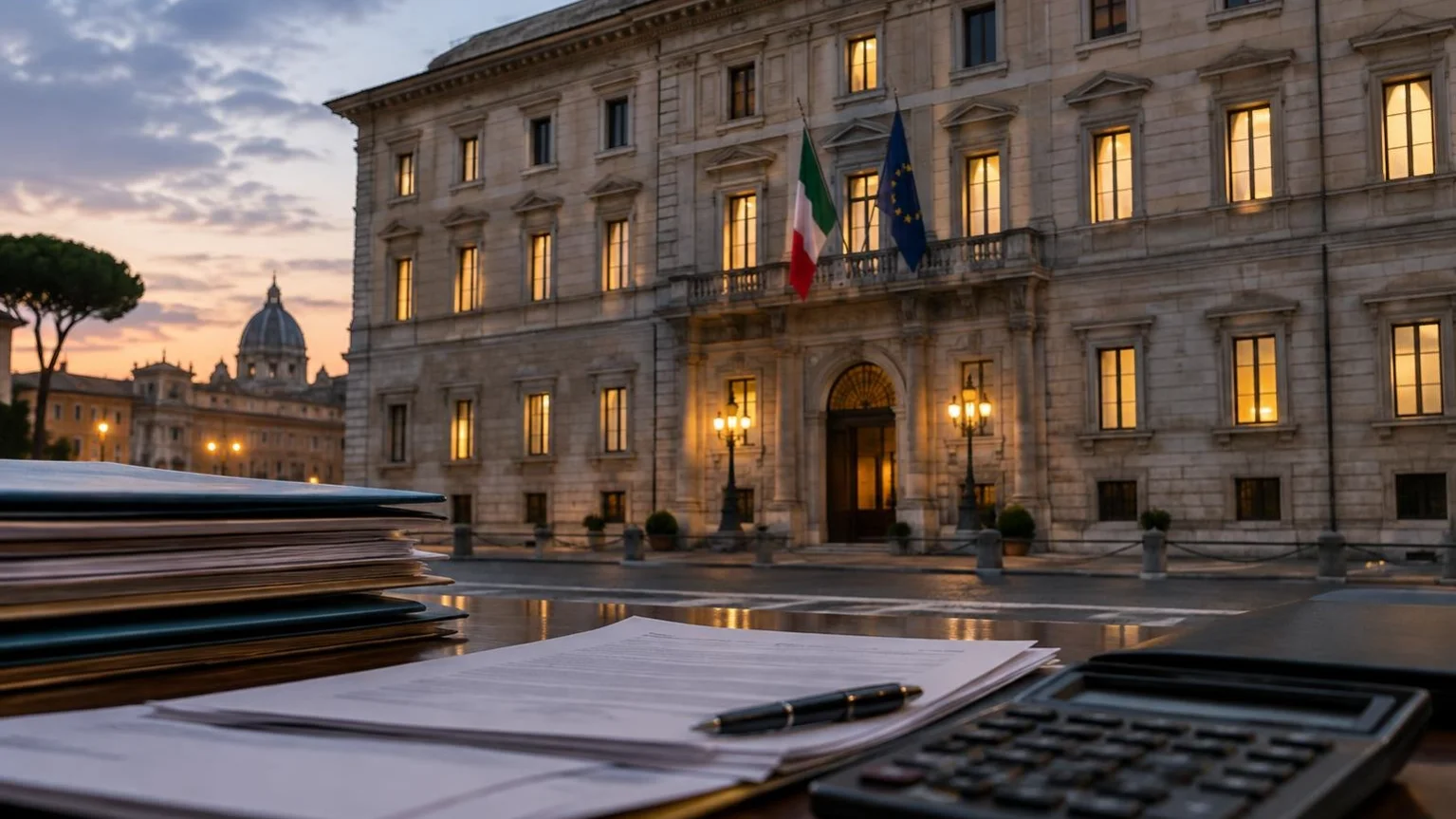
- 01The Meloni government's 2027 budget law is set to give under-30s a mini Irpef, while the middle-class tax cut and the extension of the 33% bracket to 60,000 euros are dropped.
- 02Economy Minister Giancarlo Giorgetti said almost all components of the package had been settled and that talks with the European Union continue.
- 03On 2 October the government set the 2027 deficit target at 3.4% of GDP, up from 2.8%, and growth at 0.8%.
Italy's government led by Prime Minister Giorgia Meloni is shaping the Italian budget law 2027 around a reduced-rate Irpef for workers under 30, according to the draft measures under discussion. The middle-class income tax cut has been dropped, as has the extension of the 33% bracket up to 60,000 euros of income.
The choices matter for taxpayers and for investors watching Rome's public finances, because they show how the Economy Minister, Giancarlo Giorgetti, is rationing limited resources in the last budget before national elections due next year. Pensions flexibility, the Lega's priority, is being pushed to a new dedicated fund.
What happened
The budget package took shape around a mini Irpef for young people entering the workforce, while the relief for middle incomes did not make it. Also reported as dropped is the extension of the 33% rate to 60,000 euros of income. Changes are also planned for the group eligible for the car tax exemption.
Giorgetti said that almost all components of the package had been worked out ("quasi tutte le componenti sono andate a punto"), and that the negotiation with the European Union is moving forward. Understandings were also reached on the flat tax and on the cedolare secca, the flat tax on rental income.
On pensions, the Lega asked to lower the threshold for leaving work to 64 years. The allocation would only be available from next year, and a later decree would set it.
- Under-30s: a mini Irpef is in, with the exact design still debated.
- Middle class: the planned tax cut is out.
- 33% bracket: extension to 60,000 euros of income dropped.
- Car tax: the group eligible for the exemption changes.
- Pensions: new flexibility fund, funded from next year by a later decree.
How would the under-30 tax break work?
The exact mechanism is not settled in the material available, but earlier proposals show the direction. On 10 September 2026 Giorgetti floated a flat tax on pay rises granted to young workers, in agreement with employers who commit to raising salaries.
Speaking at the Lega event "A tua difesa - verso la Finanziaria 2027", he said:
«È di assoluta evidenza il problema che, all’ingresso nel mondo del lavoro, gli stipendi dei giovani sono troppo bassi.»
Giancarlo Giorgetti, at the Lega event "A tua difesa" in September 2026. He recalled that the previous budget applied a 5% flat tax to sums paid after contract renewals.
At that stage the rate, the income cap and the age limit were still undefined, according to the reconstruction of the proposal. Forza Italia's Senate leader Stefania Craxi had separately proposed cutting Irpef for under-30s and a merit-based income for top students. Labour Minister Marina Calderone said the budget would include specific measures for young people and for those returning to Italy.
What is happening on pensions?
The pension dossier is the most politically charged, because the Lega wants a route out of work at 64 against the 67 set by the Fornero law. Deputy Prime Minister Matteo Salvini said the priority was to overcome that law, adding that the Economy Ministry and the social security institute Inps were estimating the cost.
Salvini said there was an agreement and that financing would be found so that workers could recover at least the contributions they paid. Earlier, a Lega proposal for a three-year experimental scheme was described as requiring a budget commitment of around 5 billion euros.
Under the solution now described, the money is not spent in the budget itself. A new fund would be created, and a subsequent decree would set the allocation, available from next year.
What is the fiscal backdrop and the EU talks?
The budget is being drawn up under tight constraints, as Giorgetti himself has warned. On 2 October the government raised its growth forecast to 1% for 2026 from 0.6%, and to 0.8% for 2027 from 0.6%.
It also said this year's deficit would be 2.9% of GDP, inside the EU's 3% ceiling, after 3.1% last year. The 2027 deficit target rises to 3.4% of GDP from a previous 2.8%, as Italy uses the EU national escape clause for higher defence and energy spending.
- Escape clause: Italy will ask for leeway worth 0.6% of GDP in both 2027 and 2028.
- 2028 deficit: now set at 3.2% of GDP.
- Extra spending: about 29 billion euros over two years, according to the government's figures.
- Public debt: expected to start falling only in 2028, a year later than planned in April.
Giorgetti said he was in talks with the European Commission so that the higher deficit does not stop Italy leaving the EU excessive deficit procedure in mid-2027. He argued that once defence and energy outlays are excluded, the deficits are below 3%.
Why it matters
The budget shows how much room the Meloni government has for electoral promises. Surging fuel prices are pushing up inflation, borrowing costs are climbing, and public debt is expected to overtake Greece's as the highest in the euro area this year.
In that setting, the choice to fund a targeted measure for under-30s while dropping a broader middle-class cut points to a narrow margin. Giorgetti's reported remark that "la coperta è corta", the blanket is short, summarises the problem. A parallel line from the Treasury, reported by the press, is that the budget balances are not to be changed despite party requests.
The pension fund solution also shifts a cost beyond the first budget text. That lets the coalition claim progress on the Lega's flagship demand without a large immediate outlay.
What are the risks and counterpoints?
The first uncertainty is the design of the under-30 measure: rate, income threshold and eligible raises were not defined in earlier proposals. Without them, the number of beneficiaries and the size of the benefit cannot be measured.
Second, the EU answer is not yet final. Italy's request for deficit leeway depends on Brussels, and Giorgetti said he was monitoring the situation day by day and favoured a cautious approach. A report in September said the Commission's reply on about 36 billion euros of extra spending over two years was expected within a month.
Third, the coalition is not fully aligned. Salvini has pressed Quota 64 and a flat tax at 100,000 euros for the self-employed, up from the current 85,000 euros, a change that would require action on EU constraints. Press accounts also describe an election campaign effectively already under way.
What to watch next
The next steps are the Council of Ministers approval of the budget and the parliamentary passage, with long sessions expected in the Budget Committee. Salvini said on the day before that the government was working towards a Council of Ministers meeting the following day, without confirming the date.
- Cabinet approval of the budget law 2027 and publication of the final text on the under-30 Irpef.
- The decree setting the allocation of the new pension flexibility fund, available from next year.
- The European Commission's response on Italy's escape clause request and on the deficit path.
- Parliamentary debate in the Budget Committee, where parties are pressing for changes.
- Mid-2027: the target date for ending the EU excessive deficit procedure.
Sources:ilsole24ore.comlive.euronext.comtg24.sky.itadnkronos.comagi.itcorriere.itmilanofinanza.itcorriere.it
UCapital Asset Management LLP or group companies may have commercial relationships with the companies mentioned. This content is not financial advice.
Sign up for free to ask the AI about this article.
Elections, tariffs, sanctions and reforms: what changes for markets, countries and supply chains.