
Wall Street Opens on October 8 as Oil Surges, Yields Rise and Fed Speaks
Brent crude above $104 a barrel, Treasury yields near multi-decade highs and a fresh Federal Reserve speech set the tone as US equity markets begin trading on October 8, 2026.

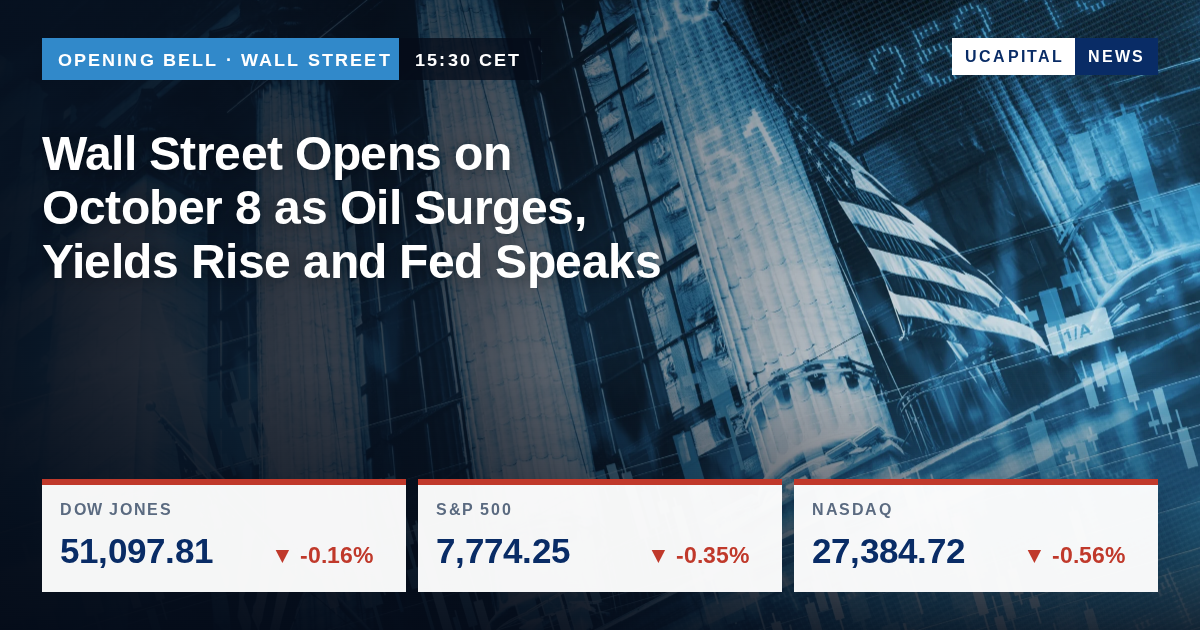
- 01Brent crude futures rose nearly 4% on October 8, trading above $104 a barrel after fresh attacks on a ship in the Middle East.
- 02US Treasury yields are at or near multi-decade highs as of the morning of October 8, 2026.
- 03Initial jobless claims fell to 197,000 in the week to October 8, down from a revised 199,000 the prior week.
- 04Federal Reserve Governor Christopher Waller delivered remarks on the US economy and central bank communication at the Istanbul Economic Forum on October 8, 2026.
Wall Street opened on October 8, 2026 against a backdrop of surging oil prices, Treasury yields hovering near multi-decade highs and a fresh round of Federal Reserve commentary, as investors assessed a cluster of macro catalysts capable of driving market direction through the session and beyond.
The confluence of geopolitical risk in the Middle East, a resilient labour market and an active week of central bank communication has placed the S&P 500 (INDEX:SP500), the Nasdaq Composite (INDEX:IXIC) and the Dow Jones Industrial Average (INDEX:DJI) at a crossroads, with each catalyst pulling in a different direction on risk appetite and the rate outlook.
What happened
Brent crude futures climbed nearly 4% in early trading on October 8, pushing above $104 a barrel, after fresh attacks on at least one ship in the Middle East reignited supply-disruption fears. Reports also emerged that President Trump is considering striking Iran before the midterms, adding a further geopolitical premium to energy prices.
At the same time, benchmark and longer-dated US Treasury yields were at or near multi-decade highs as of the early morning hours of October 8. The rise in the US Treasury 10-year yield (BOND:US10Y) has been a persistent headwind for equities in recent sessions, compressing valuations and raising the cost of capital across the market.
- Brent crude: up nearly 4%, above $104/bbl as of the morning of October 8, driven by Middle East shipping attacks
- US Treasury 10Y (BOND:US10Y): at or near multi-decade highs as of October 8
- Initial jobless claims: 197,000 for the week, down from a revised 199,000 the prior week
- US trade deficit (August 2026): $105.6 billion, up $12.7 billion from July's revised $92.8 billion
What are the key macro drivers today?
The labour market data released on the morning of October 8 offered a stabilising signal. The Labor Department reported that initial jobless claims fell to 197,000 from a revised 199,000 the prior week, confirming that layoffs remain low and that most American workers continue to enjoy job security. A resilient jobs picture complicates the Federal Reserve's calculus on the pace of any future rate adjustments.
The trade balance for August 2026, released on October 6, showed the goods and services deficit widening to $105.6 billion, up $12.7 billion from July's revised $92.8 billion. Exports rose 1.4% to $315.2 billion while imports climbed 4.3% to $420.8 billion, a combination that points to robust domestic demand but also to potential pressure on the current account and the US dollar (USD).
Geopolitical risk is the wildcard. The spike in Brent crude above $104 a barrel feeds directly into inflation expectations at a moment when the Federal Reserve is still navigating its dual mandate. Higher energy costs risk re-accelerating headline inflation, potentially delaying any pivot in monetary policy and keeping upward pressure on Treasury yields — a dynamic that weighs on both growth and rate-sensitive sectors of the equity market.
What is the Federal Reserve signalling?
Federal Reserve Governor Christopher Waller delivered remarks titled "The Signaling Value of the Summary of Economic Projections" at the Istanbul Economic Forum, hosted by the Central Bank of the Republic of Türkiye, on October 8, 2026. The speech, released at 4:30 a.m. EDT, offered an update on the US economy alongside thoughts on central bank communication — a topic of acute market interest given the current uncertainty around the rate path.
Earlier in the week, Federal Reserve Vice Chair Philip N. Jefferson spoke at the Darden School of Business, University of Virginia on October 1, 2026, covering economic activity, the labour market, inflation and monetary policy. His remarks noted that real GDP growth ran at 2.5% in the first half of 2024 and 2.8% in the second half, providing context for the trajectory the economy has followed into 2026.
Governor Michael S. Barr addressed economic conditions and monetary policy at the Detroit Economic Club on September 29, 2026, while Vice Chair for Supervision Michelle W. Bowman and Governor Lisa D. Cook also spoke on October 1. The breadth of Fed communication in the days leading up to October 8 underscores the institution's effort to manage market expectations at a sensitive juncture.
How did markets react?
The rise in oil prices and the persistence of elevated Treasury yields created a mixed pre-market environment for US equities. Energy-linked names stood to benefit from the crude rally, while rate-sensitive sectors — technology, utilities and real estate — faced renewed pressure from the move in the US Treasury 10-year yield. The USD (USDCHF) was also in focus, given the interplay between the trade deficit data, the rate outlook and the geopolitical backdrop.
Bond markets reflected the tension between a still-solid labour market and the inflationary impulse from energy prices. Treasury yields at or near multi-decade highs signal that fixed-income investors are pricing in a higher-for-longer rate environment, a view that the Federal Reserve's recent communication has done little to dispel.
Why it matters
The October 8 session crystallises a broader tension that has defined markets through the autumn of 2026: a US economy that remains fundamentally resilient — as evidenced by sub-200,000 weekly jobless claims — but that is being buffeted by external shocks, from Middle East geopolitics to a widening trade deficit, that complicate the Federal Reserve's path and keep long-end yields elevated.
For the S&P 500, the Nasdaq Composite and the Dow Jones Industrial Average, the direction of Treasury yields remains the single most important variable. A further leg higher in the 10-year yield would compress equity multiples and raise the hurdle rate for corporate earnings, while any de-escalation in the Middle East that pulls crude lower could provide relief on the inflation front and ease pressure on bonds.
The International Monetary Fund's World Economic Outlook is scheduled for release on October 13, 2026, and will offer a fresh read on global growth and risk — a potential catalyst for the week ahead. The next US trade data release is scheduled for November 4, 2026, according to the Bureau of Economic Analysis.
What to watch next
- October 13, 2026: IMF World Economic Outlook publication — a key read on global growth forecasts and downside risks
- November 4, 2026: Next US International Trade in Goods and Services release (Bureau of Economic Analysis), covering September data
- Ongoing: Middle East developments and any further escalation affecting oil tanker routes and Brent crude pricing
- Ongoing: Federal Reserve speeches and any guidance on the rate path, particularly in light of the energy price shock and the labour market resilience signalled by the October 8 jobless claims print
Sources:federalreserve.govwsj.comfederalreserve.govbea.govapnews.comimf.orgfederalreserve.gov
UCapital Asset Management LLP or group companies may have commercial relationships with the companies mentioned. This content is not financial advice.
Sign up for free to ask the AI about this article.
Multiples, financials, sentiment and risks in 60 seconds, with live data.