
US Pre-IPO, October 2026: the window reopens, but not for everyone
US IPOs are up 18% and the pre-IPO activity index has climbed back to 83 points, twice its 2023 low. But with multiples at 8–12x, one unicorn in six facing a down-round and an exit window tied to the Fed and the VIX, risk at 62/100: only AI infrastructure and revenue-generating biotech…


The US pre-IPO market is ending 2026 in recovery, but it only rewards companies with real numbers. The risk score compiled by UCapital Research stands at 62 out of 100: a "moderate" level that nonetheless translates into a clear operating signal, selective with high risk. The message is simple: past growth is no longer enough, the forward outlook is what counts.
The data point to a genuine recovery. The pre-IPO deal activity index has risen to 83 points (base 100 = 2021 peak), up from 41 in 2023. US IPOs in the first nine months total around 140, up 18% year on year. Yet multiples remain far from the excesses of 2021, and geopolitics continues to weigh on price discovery.
This article walks through the report's key figures: macro context, valuations, sectors, exit routes and the deals to watch.
The macro picture: rates on hold, volatility up, IPOs recovering
The Federal Reserve is holding Fed Funds in the 4.25–4.50% range, unchanged. The market is pricing in one or two cuts by June 2027. This scenario moderately supports growth valuations, but does not remove pressure on the cost of capital. The report rates it as a neutral factor.
Implied volatility is the first warning sign. The VIX is hovering around 22 points, 3 points above where it started the year. Persistent tensions in the Taiwan Strait and the Middle East are compressing exit multiples in public markets. For pre-IPO candidates, this makes it harder to agree on a price: it is the only factor the report openly rates as negative.
On the listings front, however, the numbers are improving:
~140 US IPOs year to date, +18% on the first nine months of 2025, but still below the 2021 peaks.
~$28 billion raised in total, +12% year on year. Proceeds are growing more slowly than deal count: transactions remain selective and concentrated in tech and healthcare.
The median discount between the last pre-IPO valuation and the IPO price is ~22%, 4 points lower than a year ago. The gap between private and public pricing is narrowing.
The only clearly positive signal comes from the news flow. Several late-stage unicorns, mainly in AI infrastructure and B2B fintech, have announced confidential roadshows for Q4 2026. After the summer lull, the autumn IPO window could reopen.
The activity index: back up to 83 points
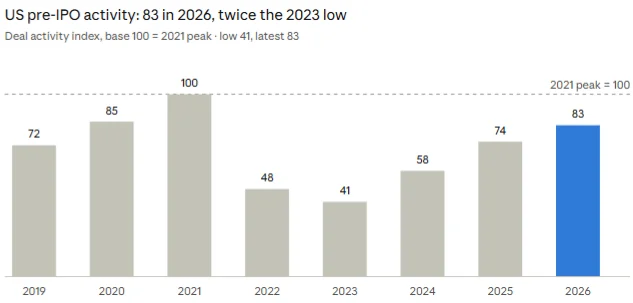
After the 2022–2023 slump, the index has risen for three consecutive years and recovered more than half of the lost ground. The report describes a structural recovery, driven by institutional demand for AI, cloud infrastructure and advanced biotech. The liquidity window, however, remains dependent on macro volatility and on underwriters' selectivity.
Valuations: normalisation is only halfway done
Late-stage round multiples have halved since the excesses of 2021. The median EV/Revenue for pre-IPO tech companies now sits between 8x and 12x, compared with more than 20x at the peak. For an investor with an 18–36 month horizon, this means far more defensible entry points.
Normalisation, however, is not painless. Down-round risk remains real for companies with high burn rates and revenue below the projections they made in 2024. According to the report's estimates, 15% to 20% of US unicorns saw their valuation cut in their latest funding round: roughly one in six.
The secondary market is the barometer of this phase. On platforms such as Forge and Nasdaq Private Market, volumes are up around 30% year to date. The figure cuts both ways:
Opportunity: more trading means more price discovery, i.e. real reference prices for companies that are not yet listed.
Risk: rising volumes signal that insiders (founders, employees, early investors) are seeking early liquidity. This supply puts downward pressure on pre-IPO valuations.
The median pre-IPO/IPO discount of 22%, down 4 points, completes the picture. Investors entering late-stage deals today pay less than in the past, but the margin between private and listing prices is getting thinner.
Where the capital goes: AI takes a third of the market
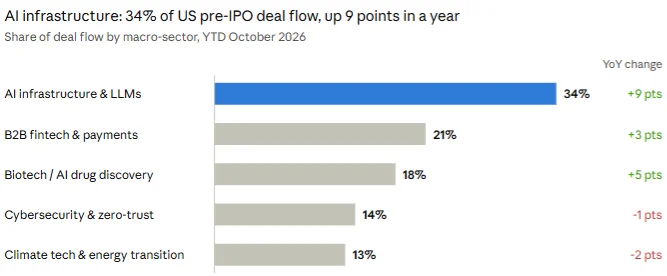
AI infrastructure and large language models alone attract a third of deal flow and are the fastest-growing segment. B2B fintech remains the second hub, supported by IPO candidates in payments. Biotech carries a risk premium, but an active FDA pipeline and Big Pharma M&A offer alternative exits; AI applied to drug discovery is the sub-segment most sought after by lead investors. Cybersecurity and climate tech, by contrast, are losing ground.
Exit routes: public markets are back, private equity steps back
The IPO exit propensity indicator stands at 61%: listing is once again the preferred exit for US pre-IPO companies. The estimated optimal window is the first half of 2027 (Q1–Q2).
The exit mix confirms the shift:
Exit route | Share | YoY change |
|---|---|---|
Traditional IPO | 45% | +8 pts |
Strategic M&A | 33% | −3 pts |
Secondary / SPAC | 14% | +2 pts |
Buyout / PE take-private | 8% | −7 pts |
Traditional IPOs gain 8 points and account for almost half of all exits. The sharpest drop is in private equity buyouts and take-privates, down to 8%, a fall of 7 points: with rates still at 4.25–4.50%, leverage is expensive. Strategic M&A remains the second route (33%) and is decisive above all in biotech, where Big Pharma acts as an alternative to the IPO. Secondary and SPAC rise to 14%, in line with growing volumes on trading platforms.
Deals to watch
Five transactions, cited in the report as representative cases, show the different stages of the cycle: from confidential roadshow to post-listing performance.
Date | Company | Sector | Status and valuation |
|---|---|---|---|
Oct 2026 | Klarna | Fintech | NYSE IPO expected in Q4 2026; indicative valuation $15–18bn after a re-rating driven by its return to profit |
Oct 2026 | Chime | Neobank | S-1 filing expected by end-2026; secondary-market valuation ~$8bn, versus $25bn at the 2021 peak (−68%) |
Sep 2026 | Cerebras Systems | AI chips | Confidential roadshow under way; IPO candidate for H1 2027, built on wafer-scale chips for LLM training |
Mar 2026 | CoreWeave | AI cloud | IPO completed, the benchmark for GPU-as-a-service infrastructure; ~$23bn valuation at debut |
Jun 2024 | Tempus AI | Healthcare AI | Listed; +38% since IPO, tracked as a proxy for the clinical AI segment |
The Chime case sums up the normalisation phase: a valuation down by roughly two thirds since 2021 on the secondary market. CoreWeave and Tempus AI, by contrast, are the reference points for how public markets reward AI infrastructure and clinical AI with visible revenue.
Outlook: positive but uneven momentum
The US pre-IPO market enters the last quarter of 2026 with momentum, but not evenly spread. The best opportunities are concentrated in AI infrastructure and biotech with visible revenue. Consumer names and late-stage companies with inflated valuations remain under pressure.
The Q1–Q2 2027 window is the most likely one for the largest transactions. The report, however, ties it to two specific conditions:
the VIX stabilising below 20, compared with ~22 today;
a confirmed first Fed rate cut.
For investors, the recommendation is a selective approach, with three filters:
ARR above $100 million;
a clear path to profitability;
tier-one lead investors on the cap table.
This is the practical meaning of the report's risk signal: in this cycle capital is not scarce, but it only flows where future growth can be demonstrated.
Source: UCapital Research, "US Pre-IPO Market – Institutional Overview"
UCapital Asset Management LLP or group companies may have commercial relationships with the companies mentioned. This content is not financial advice.
Sign up for free to ask the AI about this article.
Multiples, financials, sentiment and risks in 60 seconds, with live data.