
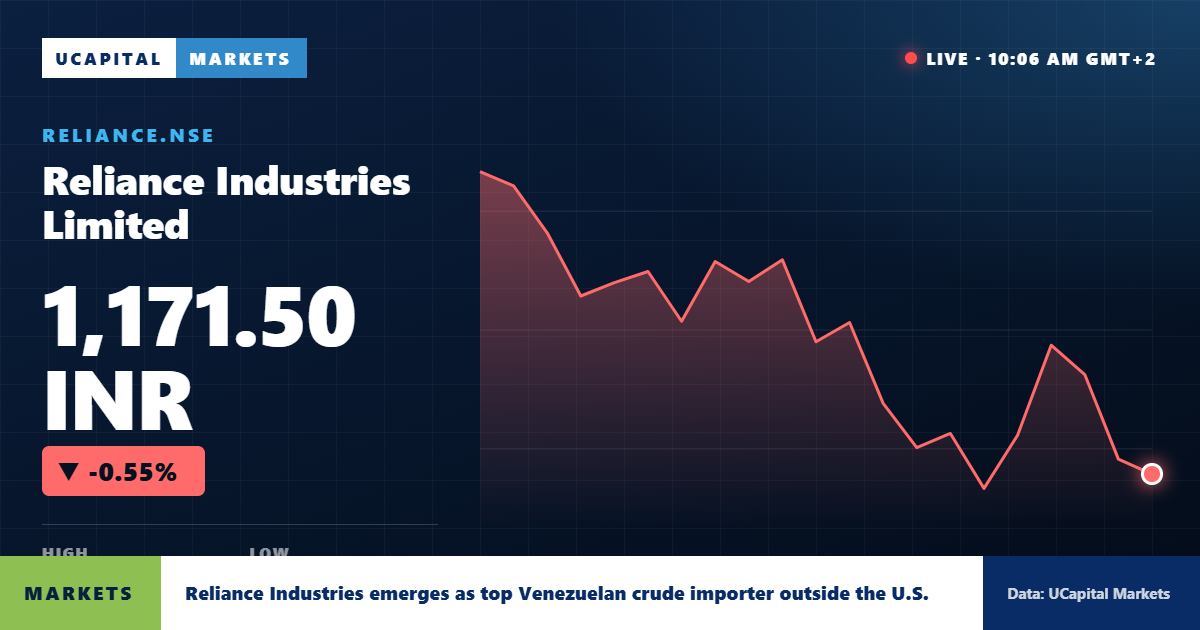
Reliance Industries emerges as top Venezuelan crude importer outside the U.S.
India's deliveries of Venezuelan oil are set to hit a seven-year high in October, with Reliance Industries driving the surge as Russian supplies grow costlier and the Strait of Hormuz remains disrupted.

- 01Venezuelan crude deliveries to India are expected to more than double to about 465,000 barrels a day in October 2026, from 196,000 in September, according to Kpler estimates.
- 02If all scheduled cargoes arrive on time, October volumes would be the highest since December 2019.
- 03Reliance Industries (RELIANCE.NSE) has begun loading a 2-million-barrel cargo of Venezuelan heavy crude purchased directly from state-run PDVSA.
- 04Venezuela's total oil exports fell to 1.08 million barrels per day in September from 1.19 million bpd the previous month, as traders pressed PDVSA for price discounts to offset rising freight rates.
Reliance Industries Ltd. (RELIANCE.NSE) has emerged as the largest importer of Venezuelan crude oil outside the United States, with India's deliveries of that oil set to more than double in October 2026 to roughly 465,000 barrels a day — the highest level since December 2019 — according to estimates from maritime analytics firm Kpler.
The surge reshapes global crude trade flows at a pivotal moment: the Strait of Hormuz, through which roughly half of India's crude imports pass, has been effectively closed by the Iran conflict, while Russian oil has grown costlier, pushing Indian refiners toward discounted heavy barrels from South America. Reliance's deepening role in sanctioned-oil markets adds a geopolitical dimension to what began as a straightforward search for cheaper feedstock.
What happened
Venezuelan crude deliveries to India stood at 196,000 barrels a day in September 2026, according to Kpler, before a sharp ramp-up in October bookings driven primarily by Reliance Industries. The conglomerate has begun loading a 2-million-barrel cargo of Venezuelan heavy crude purchased directly from state-run Petróleos de Venezuela S.A. (PDVSA), marking a significant step in the bilateral energy relationship.
Outside the United States, India is the single largest destination for Venezuelan oil, with Reliance accounting for the bulk of those flows. In May 2026, Venezuela was India's fifth-largest crude source, supplying about 266,000 barrels a day, or roughly 5.3% of India's total crude imports, with only Russia, the UAE, Saudi Arabia and Brazil supplying more, according to Kpler data.
Indian refiners had resumed Venezuelan imports in February 2026 following a sanctions-easing agreement between Washington and Caracas, ending a nine-month hiatus. Kpler data show India imported around 280,000 barrels a day of Venezuelan crude in April and May — the first cargoes after the interruption — with June arrivals expected to rise above 300,000 barrels a day before the October surge.
Why Venezuelan crude is attractive to Indian refiners
Venezuelan crude is a heavy, sulphur-rich oil that is relatively cheaper to procure but challenging to process. India's sophisticated refineries, including those operated by Reliance, are among the few globally capable of refining it efficiently into fuels such as diesel and jet fuel, giving Indian buyers a structural advantage over less complex competitors.
The appeal is compounded by the current supply environment. Russia, which had become India's dominant crude supplier after Western sanctions redirected its barrels eastward, has seen freight and insurance costs rise, eroding the discount that made it attractive. Venezuelan barrels, offered at steep discounts by PDVSA, have stepped into that gap.
"However, the timing of the initial cargoes suggests they were likely secured well before the recent disruptions, highlighting a longer-term sourcing strategy rather than a purely reactive response."
— Sumit Ritolia, lead research analyst at Kpler
India imports about 90% of its oil, and roughly 2.5–2.7 million barrels a day of that total passes through the Strait of Hormuz. With that chokepoint now effectively closed by the Iran conflict, Venezuela's importance to Indian energy security has grown well beyond what its share of trade statistics would suggest. Bilateral trade between India and Venezuela was worth just $679 million in 2024–25, a fraction of India's global commerce, yet the oil relationship commands outsized strategic attention.
The sanctions backdrop
Venezuela's oil sector has operated under a layered set of U.S. sanctions since 2017. Executive Order 13808 prohibited U.S. persons from engaging in certain new debt transactions with PDVSA and the Government of Venezuela, while a subsequent determination under Executive Order 13850 designated PDVSA directly, extending restrictions to entities majority-owned by the state oil company. Those measures historically made Venezuela one of the primary destinations prohibited from petroleum trade with the United States.
The sanctions-easing agreement reached between Washington and Caracas earlier in 2026 reopened the door for Indian refiners, who had halted imports for nine months after U.S. measures targeted buyers of Venezuelan crude. The resumption of flows — and their subsequent acceleration — reflects both the easing of that legal risk and the structural incentives that make Venezuelan heavy crude attractive to complex refineries.
Washington's posture toward India's Venezuelan imports appears, for now, to be permissive. U.S. Analysts say Washington is attempting to reshape global energy supply chains while tightening its grip over Venezuela's oil sector.
Diplomatic backdrop: Rodríguez visits New Delhi
Venezuela's acting president Delcy Rodríguez visited India for talks with Prime Minister Narendra Modi, her sixth such visit, covering trade, investment, healthcare and renewable energy. The Indian government described Venezuela as "an important partner" in energy and investment, noting that Indian state-owned firms already hold significant stakes in Venezuela's oil sector and are keen to deepen their presence.
Michael Kugelman, a senior fellow for South Asia at the Atlantic Council, said Venezuela offers India a path to diversify energy supplies beyond the Middle East while potentially aligning with Washington's preference that India reduce its reliance on Russian oil.
"Ramping up imports from Venezuela could also give a boost to India's ties with Washington."
— Michael Kugelman, senior fellow for South Asia, Atlantic Council
Kugelman cautioned, however, that Venezuela's political volatility could complicate any new energy partnership, and that New Delhi "will also need to be careful not to appear to be seeking energy alternatives to Russia at the behest of Washington." Analysts at Kpler echoed the structural limits: Venezuelan output has risen by roughly 400–500 thousand barrels per day in 2026 but remains far below historic levels, constraining its ability to replace major suppliers at scale.
Why it matters
Reliance Industries' emergence as the dominant non-U.S. importer of Venezuelan crude signals a broader reorientation of global oil trade. The Indian conglomerate — which reported revenue of ₹3,155.87 billion in its latest quarter against an estimate of ₹3,102.35 billion, with earnings per share of ₹15.5 versus an estimate of ₹14.75 — is leveraging its complex refining infrastructure to access discounted barrels that simpler refineries cannot process.
For global crude markets, the shift illustrates how sanctions regimes, geopolitical disruptions and refinery complexity interact to redirect oil flows in ways that can be rapid and substantial. Venezuela's total exports fell to 1.08 million barrels per day in September from 1.19 million bpd in August, as traders pressed PDVSA for price discounts to offset rising freight rates — yet India's October bookings surged regardless, suggesting Reliance secured terms that made the economics work.
India's Venezuelan crude imports: ~196,000 bpd in September 2026; ~465,000 bpd expected in October 2026 (Kpler)
October volumes, if realised, would be the highest since December 2019
Venezuela was India's fifth-largest crude source in May 2026, at ~266,000 bpd (5.3% of total imports)
Venezuela's total oil exports: 1.19 million bpd in August; 1.08 million bpd in September
Reliance latest-quarter EPS: ₹15.5 vs estimate ₹14.75; revenue ₹3,155.87 billion vs estimate ₹3,102.35 billion
India–Venezuela bilateral trade: $679 million in 2024–25
What to watch next
16 October 2026: Reliance Industries next earnings report — the first to reflect the full scale of the Venezuelan crude ramp-up in its refining margins.
October 2026 cargo arrivals: Whether all scheduled Venezuelan cargoes reach Indian ports on time will determine if the 465,000 bpd Kpler estimate is confirmed or revised.
U.S. sanctions posture: Any tightening or further easing of Venezuela-related sanctions under Executive Orders 13808 and 13850 would directly affect the legality and economics of Indian imports.
Venezuelan production trajectory: Output has risen roughly 400–500 thousand bpd in 2026 but remains well below historic peaks; sustained supply to India depends on PDVSA's ability to maintain and grow production.
Strait of Hormuz developments: A resolution or escalation of the Iran conflict would materially alter the urgency of India's diversification away from Gulf suppliers.
Reliance Industries Limited
Sources:business-standard.comcnbc.comeconomictimes.indiatimes.combbc.comreuters.combloomberg.comreuters.comaljazeera.comreuters.comUCapital Markets (ucapital.com)state.govcongress.gov
UCapital Asset Management LLP or group companies may have commercial relationships with the companies mentioned. This content is not financial advice.
Sign up for free to ask the AI about this article.
Multiples, financials, sentiment and risks in 60 seconds, with live data.