
Jakarta Composite Index plunges over 5% to six-year low as MSCI fears mount
Indonesia's benchmark index fell to its lowest in six years on MSCI reclassification fears, while the rupiah weakens and Bank Indonesia faces pressure to raise rates on Wednesday.

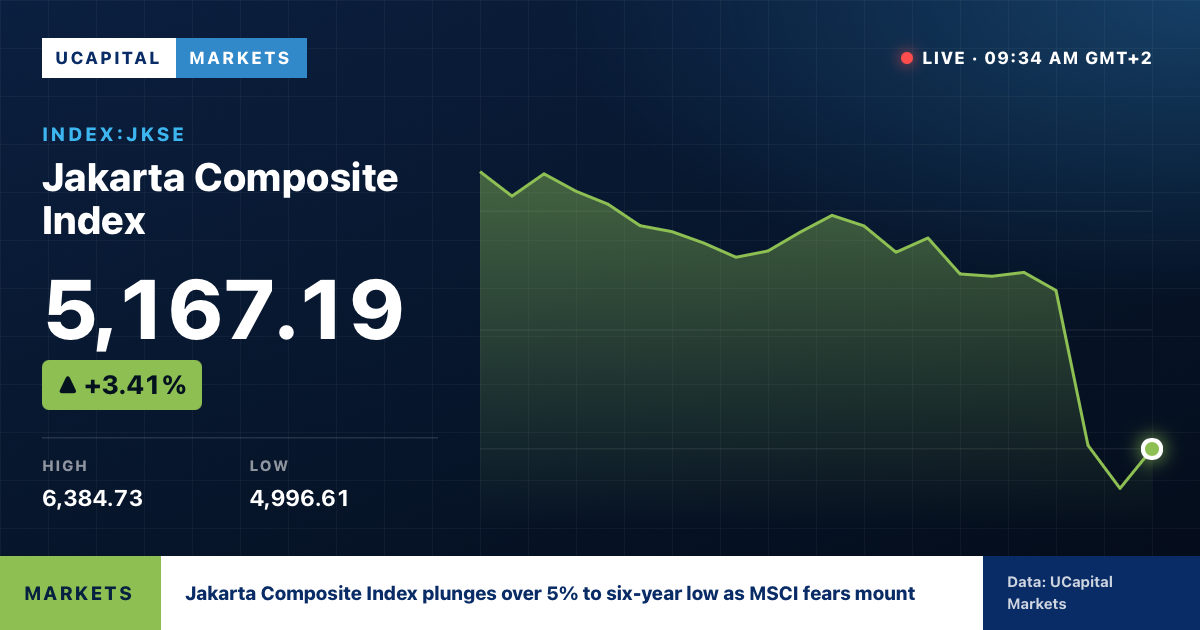
- 01The Jakarta Composite Index fell more than 5% on Monday 19 October 2026 to its lowest level in six years.
- 02Cumulative net foreign outflows from the Indonesia Stock Exchange reached Rp 61.3 trillion ($3.36 billion) in 2026.
- 03Citi expects Bank Indonesia to raise its rate by 50 basis points to 6.25% on Wednesday; Capital Economics and others see 6%.
- 04The Financial Services Authority (OJK) says the domestic market will remain prospective and attractive.
The Jakarta Composite Index (INDEX:JKSE) plunged more than 5% on Monday 19 October 2026 to its lowest level in six years, as concern over a possible MSCI move against Indonesia's market status intensified. The Indonesian rupiah (IDRAUD) came under renewed strain at the same time.
The slide matters because it joins three pressure points: heavy foreign outflows from the Indonesia Stock Exchange, a weak currency and a central bank now expected to tighten policy. Together they test investor confidence in Indonesian assets, a year that has already seen repeated bouts of stress.
What happened
Indonesia's benchmark stock index dropped over 5% on Monday 19 October, closing at its weakest point in six years, as worries about a potential MSCI reclassification grew. Emerging-market currencies, notably the rupiah, were struggling with the same threat, according to market reports on 19 October.
The latest bout of weakness pushed cumulative net foreign outflows from the Indonesia Stock Exchange (IDX) to Rp 61.3 trillion ($3.36 billion) in 2026. Local commentary has described the mood among global desks as a retreat from Indonesia as a whole.
The MSCI issue is not new. On 27 January 2026, Indonesian stocks tumbled about 7% after MSCI Inc. raised concerns about investability and warned of a possible move to frontier-market status. Banks cut their stances on Indonesian equities in the days after, citing transparency issues and the risk of large capital outflows.
Key figures
- Jakarta Composite Index: down more than 5% on 19 October 2026, to a six-year low.
- Net foreign outflows from the IDX in 2026: Rp 61.3 trillion ($3.36 billion).
- Bank Indonesia decision: due Wednesday 21 October.
- Citi forecast: a 50-basis-point increase to 6.25%.
- Capital Economics and others: a smaller increase, to 6%.
How did the market get here?
The Jakarta Composite Index has fallen through much of 2026, with several lows along the way. On 3 June it dropped to 5,855, its lowest level in five years, as the rupiah kept weakening against the dollar and investors reacted to fiscal concerns and new export controls.
The rupiah had weakened about 7.5% in 2026 and breached a historic 18,000-per-dollar level that week, according to the same data.
A partial recovery followed. In the week to 7 August the index rose 2.78%, ending Friday at 6,409.654 from 6,236.126 a week earlier, as investors weighed solid domestic growth and ample foreign-exchange reserves against geopolitical and inflation risks. The October fall has erased that gain and gone beyond it, to a six-year low.
Why are investors uneasy about Indonesia?
Investors cite a mix of policy and market-structure worries. In June, market participants pointed to the more populist and interventionist agenda of President Prabowo Subianto, including expanded state involvement in the economy, funding for the sovereign wealth fund Danantara and a move to take direct control of key commodity exports to curb tax evasion, which hit exporter stocks.
The departure in 2025 of former Finance Minister Sri Mulyani Indrawati was a turning point for many investors, who saw her as a guarantor of fiscal discipline.
Market structure also features. In September of an earlier year, FTSE Russell removed Barito Renewables Energy, then Indonesia's biggest company by market value, from its indexes because of "high shareholder concentration", and the stock fell by its 20% daily limit. Free-float and transparency questions have run through the MSCI debate.
What are the authorities saying?
The Financial Services Authority (OJK) has sought to calm markets, stating its confidence in the domestic market's prospects after the MSCI threat.
“We believe the domestic market will remain prospective and attractive,”
Friderica, of the OJK, said in a statement after the MSCI warning. In a press release dated 29 January 2026, the OJK also affirmed its commitment to strengthening governance, integrity and transparency in the capital market.
In June, Finance Minister Purbaya Yudhi Sadewa defended the economic record at a briefing, saying government bonds and central bank debt securities drew inflows in the second quarter through early June. He said that "optimism about the Indonesian economy remains strong", though stocks saw outflows in the period.
What does it mean for the rupiah and Bank Indonesia?
Bank Indonesia is under pressure to raise its benchmark rate on Wednesday 21 October to stabilise the rupiah, and economists are split on the size of the move. Citi expects a 50-basis-point increase to 6.25%, while Capital Economics and others see a smaller rise to 6%.
The central bank has already intervened in the currency market several times. It stepped in on 25 March 2025 when the rupiah hit its weakest in more than two decades, and again on 7 April 2026 after a record low. By June the rupiah had fallen about 14% since Prabowo took office, ranking as Asia's weakest currency this year.
Bond investors have also shown caution. Foreign holdings of Indonesian sovereign debt were cut by 86 trillion rupiah ($4.8 billion), about 9%, between last August and early June. Bank Indonesia itself held about 27% of sovereign bonds, a share that Gama Asset Management portfolio manager Rajeev De Mello said may have become closer to quantitative easing.
Why it matters
The fall matters because Indonesia has long been a staple allocation in emerging-market portfolios, and a reclassification by MSCI could force index-tracking funds to reduce holdings, as the January warning indicated. Large capital outflows were the risk named at that time.
It also matters for policy. A rate rise would tighten conditions for a government pursuing 8% annual growth, in an economy that had been seen as ready for monetary easing earlier in 2026 before the currency's fall complicated the picture, according to an April analysis.
Not everyone is bearish. Some investors point to bond inflows in the second quarter and ample reserves. Yuxuan Tang of JPMorgan Private Bank said in June that domestic political uncertainty is a typical emerging-market risk that investors respond to by staying on the sidelines until predictability returns.
What to watch next
The next dated catalyst is Bank Indonesia's decision on Wednesday 21 October. Beyond that, the sources point to a handful of variables for markets.
- Size of the Bank Indonesia move: 50 basis points to 6.25% (Citi) or a smaller step to 6% (Capital Economics and others).
- MSCI's decision on Indonesia's market status and any rule changes on transparency or free float.
- Direction of net foreign flows at the IDX, against the Rp 61.3 trillion outflow so far in 2026.
- The rupiah's path after breaching 18,000 per dollar earlier in the year.
- Further OJK and government measures on market integrity.
Sources:cnbc.comjakartaglobe.idjakartaglobe.idcnbc.comfinancialpost.comasia.nikkei.comjakartaglobe.idbloomberg.comreuters.comreuters.comojk.go.idreuters.com
UCapital Asset Management LLP or group companies may have commercial relationships with the companies mentioned. This content is not financial advice.
Sign up for free to ask the AI about this article.
Multiples, financials, sentiment and risks in 60 seconds, with live data.