
Geopolitical Risk Reshapes Global Financial Markets Ahead of Year-End 2026
Escalating tensions across multiple flashpoints are driving volatility in equities, bonds and commodities, with the U.S. Treasury market emerging as a new front in modern economic warfare.

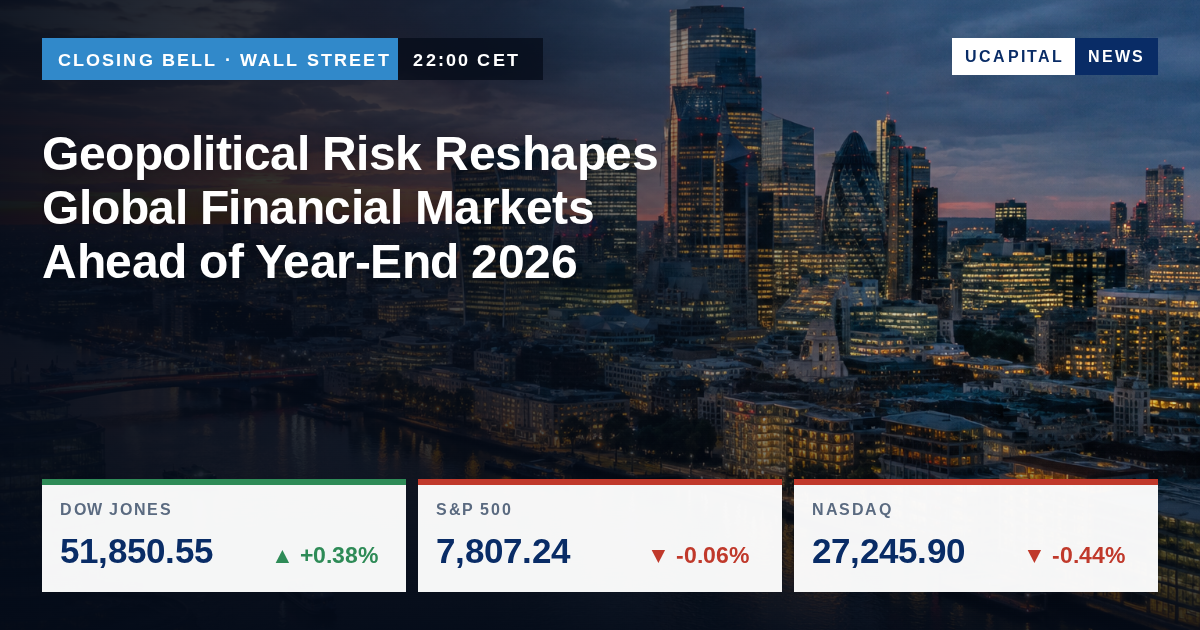
- 01The IMF has flagged rising fiscal deficits, AI disruption and cyber threats as top risks to global financial markets as of October 2026.
- 02Iran's prolonged conflict is embedding inflationary pressure in the system, pushing U.S. Treasury yields higher and tightening financial conditions globally.
- 03Safe-haven assets including gold are drawing increased investor interest as geopolitical uncertainty intensifies through year-end.
- 04Emerging markets face compounded pressure from a stronger U.S. Dollar Index and rising sovereign borrowing costs tied to geopolitical spillovers.
Escalating geopolitical tensions across multiple global flashpoints are reshaping financial markets as investors brace for heightened volatility through the end of 2026, with the U.S. Treasury market — long considered the world's ultimate safe haven — now itself a source of extraordinary instability.
The convergence of Middle East conflict, record sovereign debt levels and a fragile equity market concentrated in a handful of mega-cap technology names has created a self-reinforcing feedback loop that analysts warn could intensify before year-end, pressuring everything from crude oil prices to emerging-market currencies and the U.S. Dollar Index.
What happened
The International Monetary Fund, in its October 2026 assessment, identified rising fiscal deficits, artificial intelligence disruption and cyber threats as the top risks to global financial markets, warning that deteriorating public finances could make it harder for governments to meet their financial obligations and absorb future shocks.
Simultaneously, the conflict involving Iran has introduced a dimension of economic warfare that goes well beyond the traditional focus on crude oil supply disruptions. As one market strategist argued, by prolonging the conflict and refusing to capitulate to U.S. demands, Iran may be exploiting the vulnerabilities of an already heavily indebted global financial system — increasing pressure until it gains leverage at the negotiating table.
The mechanism is direct: every increase in oil prices feeds inflation expectations, pushes bond yields higher and raises the cost of financing already massive fiscal deficits.
The result has been a relentless rise in U.S. Treasury yields at a moment when the U.S. government is carrying record debt levels and facing enormous refinancing requirements — a dynamic that has rippled across asset classes worldwide.
The Treasury market as a geopolitical battlefield
What distinguishes the current episode from past geopolitical crises is the record level of sovereign debt carried by the global economy, which means governments can no longer absorb inflation shocks the way they once could. As one analyst noted, monetary policy cannot produce more oil or reopen disrupted supply chains — as long as conflict continues, inflationary pressure remains embedded in the system.
Modern markets amplify this dynamic. Systematic investors, leveraged hedge funds, commodity trading advisors, volatility-targeting strategies and algorithms respond almost instantly to price trends. Rising yields trigger risk reduction; risk reduction creates selling pressure; additional selling pressure pushes yields even higher. In this environment, geopolitical actors can trigger reactions inside global capital markets that rapidly tighten financial conditions, pressure asset prices and increase borrowing costs — without ever confronting military force directly.
- U.S. Treasury yields: rising relentlessly amid record sovereign debt and large refinancing requirements
- Crude Oil (WTI): every dollar increase in price feeds inflation expectations and pressures bond markets
- CBOE Volatility Index (VIX): systematic and algorithmic strategies amplify volatility spikes as yields rise
- U.S. Dollar Index: safe-haven demand supports the dollar, compounding pressure on emerging markets
- Gold: drawing increased flows as investors seek protection from both inflation and financial instability
How are equity markets responding?
Equity markets have responded with a surface resilience that masks significant underlying damage. While headline indices such as the S&P 500 have remained near their highs, the breadth of the rally has narrowed sharply. Utilities, real estate investment trusts and other interest-rate-sensitive sectors have been hit hard as investors found themselves able to earn more than five per cent with virtually no credit risk in fixed income — a threshold that fundamentally alters the calculus of equity risk premiums.
Large segments of the market have slipped into correction territory even as major indexes remain elevated. Investors have responded by crowding into a small number of mega-cap technology companies tied to the artificial intelligence boom, a concentration that has masked much of the damage taking place beneath the surface.
However, even these companies face a structural vulnerability: the AI investment cycle requires trillions of dollars in capital spending for data centres, power infrastructure, semiconductor facilities and networks — all of which must be financed at precisely the moment yields are elevated and fiscal concerns are acute.
Safe-haven assets and emerging-market pressure
Safe-haven assets have been among the clearest beneficiaries of the current environment. Gold has attracted increased flows from investors seeking protection against both inflation and financial system instability, while the U.S. Dollar Index has drawn support from risk-off positioning — even as the Treasury market's own volatility complicates the dollar's traditional safe-haven role.
Emerging markets face a particularly difficult combination of pressures. A stronger U.S. Dollar Index raises the cost of dollar-denominated debt service, while rising U.S. Treasury yields compress the yield differential that makes emerging-market assets attractive to global investors. Countries carrying elevated fiscal deficits are most exposed, as the IMF's warning about governments' diminished capacity to absorb future shocks applies with particular force to sovereigns with less fiscal space than advanced economies.
The CBOE Volatility Index (VIX) remains a key barometer of market stress. Algorithmic and systematic strategies that dominate modern markets are calibrated to respond to volatility signals, meaning that any fresh escalation at a geopolitical flashpoint — whether in the Middle East, in satellite and technology infrastructure, or in cyber domains — can rapidly translate into broad asset-price moves that go well beyond the direct economic impact of the event itself.
Why it matters
The IMF's identification of fiscal deficits as a top systemic risk underscores a structural shift in how geopolitical shocks transmit through the financial system. In previous cycles, governments could absorb inflationary shocks through fiscal expansion; today, record debt levels mean that higher yields triggered by geopolitical events directly increase the cost of existing obligations, creating a self-reinforcing spiral of fiscal stress and market volatility.
The emergence of the U.S. Treasury market as a geopolitical pressure point — rather than a refuge from it — represents a fundamental change in the architecture of global financial risk. If the world's benchmark risk-free asset is itself a source of volatility, the traditional playbook for portfolio construction and risk management is under challenge across every asset class and every geography.
What to watch next
Several catalysts and decision points will determine how geopolitical risk evolves through the remainder of 2026:
- Middle East conflict trajectory: Any escalation or de-escalation involving Iran will directly affect crude oil prices, inflation expectations and U.S. Treasury yields — the chain reaction that analysts identify as the core transmission mechanism of geopolitical risk into financial markets.
- IMF and central bank communications: Following the IMF's October 2026 risk assessment, statements from major central banks on how they weigh geopolitical inflation against slowing growth will be critical for bond and equity market direction.
- U.S. fiscal and debt ceiling dynamics: With the U.S. government facing record debt levels and large refinancing requirements, any political friction over fiscal policy will amplify the Treasury market volatility already in motion.
- Satellite and technology infrastructure governance: The debate over strategic technology assets — flagged as a geopolitical risk vector by think tanks as recently as 13 October 2026 — is likely to intensify, with potential regulatory decisions in major economies before year-end.
- Emerging-market stress indicators: Sovereign spreads and currency moves in high-deficit emerging economies will serve as early-warning signals of whether the current tightening of global financial conditions is becoming disorderly.
Sources:barrons.comfinancialpost.com
UCapital Asset Management LLP or group companies may have commercial relationships with the companies mentioned. This content is not financial advice.
Sign up for free to ask the AI about this article.
Multiples, financials, sentiment and risks in 60 seconds, with live data.