
China and EU wrap up Beijing trade talks with hybrid-vehicle deal and deficit pledges
The second meeting of the EU-China Trade and Investment Consultations closed on 9 October 2026 with a list of agreed deliverables, including export quotas on Chinese hybrid vehicles, as both sides pledged to manage a record trade imbalance through dialogue.

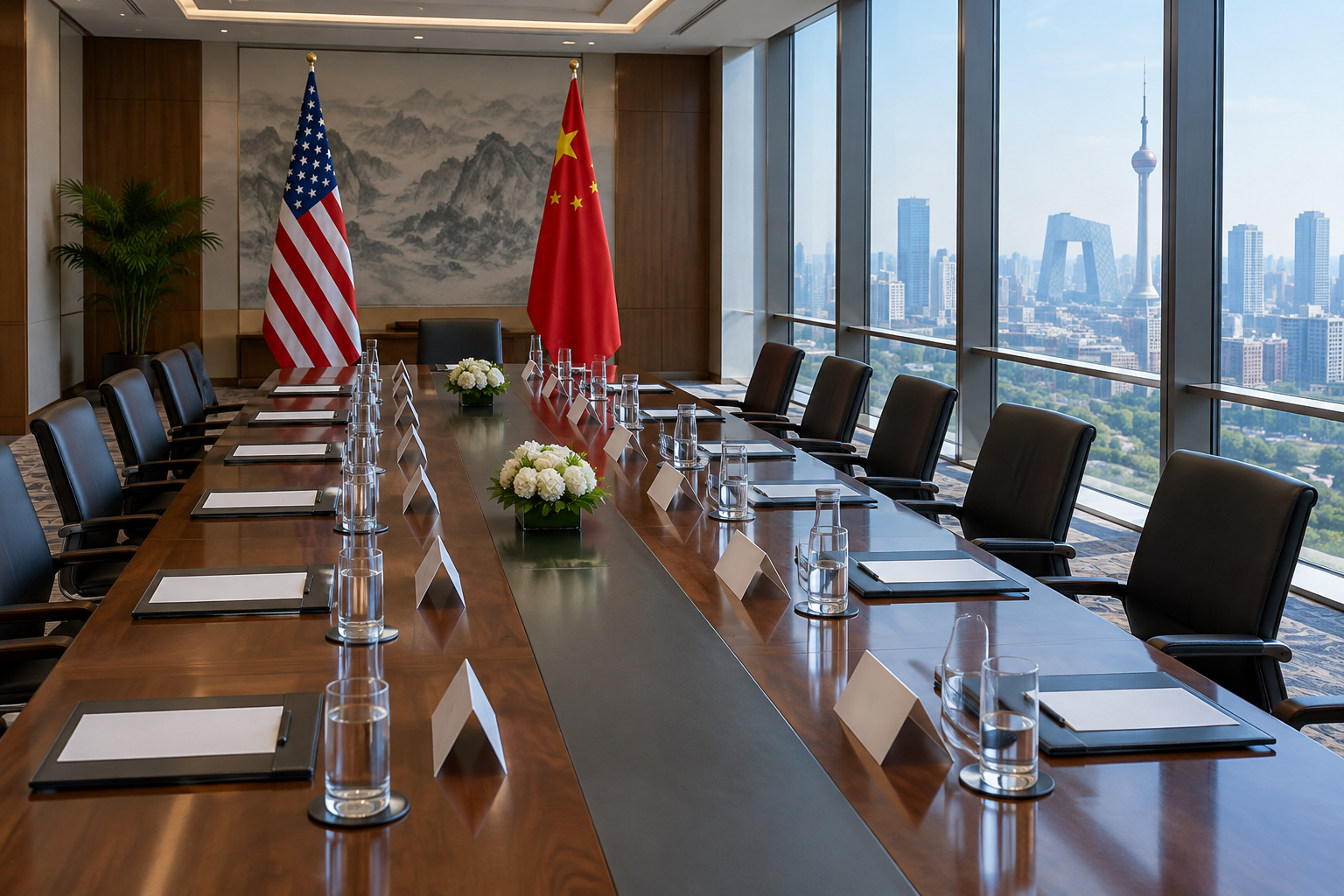
- 01The second EU-China Trade and Investment Consultations meeting was held in Beijing on 8-9 October 2026, co-chaired by China's Commerce Minister Wang Wentao and EU Trade Commissioner Maroš Šefčovič.
- 02Both sides agreed on export quotas for Chinese hybrid vehicles aligned with overall import standards, and agreed to increase the 2025 hybrid vehicle export figure to support stability for Chinese
- 03The EU's trade deficit in goods with China reached €359.9 billion in 2025, up 2.7% year-on-year, equivalent to roughly €1 billion a day.
- 04EU exports to China fell 6.5% year-on-year to €199.5 billion in 2025, while EU imports from China rose 6.4% to €559.5 billion.
China and the European Union concluded two days of high-level trade consultations in Beijing on 9 October 2026, with Commerce Minister Wang Wentao and European Commission Trade Commissioner Maroš Šefčovič agreeing on a list of deliverables — including export quotas for Chinese hybrid vehicles — as both sides sought to arrest a record bilateral trade deficit that has now reached roughly €1 billion a day.
The outcome of the second meeting of the EU-China Trade and Investment Consultations (TIC) carries immediate weight for markets and policymakers on both sides: the European Commission had set October 2026 as a hard deadline to secure tangible results from Beijing, and EU leaders were expected to take stock of the talks at their own summit the following week, with China topping the agenda.
What happened
On 8 and 9 October 2026, Wang Wentao and Šefčovič co-chaired the second TIC meeting in Beijing, holding what the joint statement described as "pragmatic and productive discussions" that produced a list of agreed deliverables and understandings. The two sides reaffirmed their commitment to handling differences within the framework of WTO rules and to deepening mutually beneficial cooperation.
On hybrid and electric vehicles — one of the most contested dossiers — both parties agreed on export quotas for Chinese hybrid vehicles aligned with overall import standards, and reached consensus on increasing the 2025 hybrid vehicle export figure to promote stability for Chinese companies. Discussions also covered medical devices, cosmetics, pharmaceuticals, inverters, and agricultural and food products, with both sides exploring how to expand two-way market access on a reciprocal basis.
The two sides additionally agreed to use the trade monitoring mechanism to explore the possibility of reducing tariffs on certain goods within the WTO framework, and committed to technical dialogue on the EU's Foreign Subsidies Regulation, with the stated aim of creating a fair, transparent and predictable environment for trade and investment cooperation.
How deep is the trade imbalance?
The scale of the deficit underlines why the European Commission treated October as a critical juncture. The EU's trade deficit in goods with China reached €359.9 billion in 2025, a 2.7% increase year-on-year, surpassing the €312.2 billion deficit of 2024, though remaining below the record €397.3 billion posted in 2022. In volume terms, the deficit widened from 44.8 million tonnes in 2024 to 58.1 million tonnes in 2025.
EU exports to China fell 6.5% year-on-year to €199.5 billion in 2025, while EU imports from China rose 6.4% to €559.5 billion. Manufactured goods accounted for 97.3% of EU imports from China, led by machinery and vehicles at 54.4%. Over the decade to 2025, the deficit increased more than fivefold in volume and more than doubled in value. Bilateral trade in goods had reached €732 billion in 2024, a slight decline of 1.6% from 2023.
The EU does maintain a trade surplus in services with China, though it is narrowing: it stood at €21.3 billion in 2025. EU investment stock in China was €239.3 billion in 2024, while EU foreign direct investment into China in Q3 2025 totalled just €1.1 billion — the lowest in eight quarters — as Chinese FDI into the EU rebounded, reaching €10.6 billion in 2024.
What is the broader political context?
The TIC meeting took place against a backdrop of deteriorating EU-China political relations. The European Parliament Research Service noted that the 2025 EU-China summit had failed to produce the results envisaged, prompting the establishment of the joint TIC mechanism with a mandate to deliver results by October 2026. The EU continues to define China simultaneously as a partner for cooperation, an economic competitor, and a systemic rival — a framework set out in its 2019 strategic outlook and reaffirmed by EU member states at the European Council in June 2023.
Geopolitical tensions have compounded the trade friction. The EU has expressed growing concern over China's support for Russia's war of aggression against Ukraine, its assertiveness in the Taiwan Strait and the South and East China Seas, and an ever-widening set of Chinese export controls on critical raw materials and technologies that are disrupting EU supply chains. Beijing's restrictions on rare earth exports in 2025 — imposed amid a trade dispute involving Dutch-based Nexperia — demonstrated the EU's vulnerability; exports eventually resumed, but the truce runs only until 10 January 2027.
Within the EU, member states' positions have been shifting. Germany, which in 2024 opposed EU tariffs on Chinese electric vehicles, moved closer to France's tougher stance in the run-up to the October talks.
German Chancellor Friedrich Merz and French President Emmanuel Macron jointly called on Commission President Ursula von der Leyen for "the full use" of existing trade defence instruments and a "comprehensive framework" with new legal tools, including a mechanism that could allow, in their words, "an immediate cut-off from the internal market if needed," activatable by the Commission unless a qualified majority voted against it.
- EU Industry Commissioner Stéphane Séjourné stated that the EU had lost 250,000 industrial jobs in the prior year, with thousands more at risk weekly.
- The Federation of German Industries (BDI) published a report on 25 September 2026 warning that "systemic competition with China's economy is increasingly calling into question the resilience of the open social market economy."
- The September 2026 G20 finance ministers' meeting called — over China's objection — for countries "to eliminate non-market policies and practices that exacerbate imbalances."
- Spain remained among the most cautious member states, though its domestic political situation — with Prime Minister Pedro Sánchez calling for new elections — could limit Madrid's opposition to a tougher EU strategy.
Why it matters
The TIC deliverables represent the most concrete bilateral progress since the 2025 summit fell short of expectations, and they arrive at a moment when the EU's industrial base is under acute pressure from a wave of low-cost Chinese imports. For Beijing, the agreement preserves access to the EU market — China's largest export destination — at a time when its own economy faces headwinds: Chinese stocks declined on 12 October 2026 as government support measures failed to restore investor confidence amid rising global bond yields and geopolitical tensions.
Analysts have noted that China's confrontation with the United States under the Trump administration has left Beijing less inclined to make concessions to the EU. Agatha Kratz of the Atlantic Council observed that the summit going forward was itself likely to be the biggest deliverable. Alicia García-Herrero noted that China has come away emboldened from its trade confrontation with Washington, reducing its appetite for concessions, but added that the EU retains leverage because China still needs access to the bloc's market of 450 million consumers.
What to watch next
- EU leaders' summit (mid-October 2026): EU heads of state and government were expected to meet the week after the TIC talks, with China at the top of the agenda and concrete results from Šefčovič's Beijing trip under review.
- European Parliament plenary vote (October I part-session): A draft recommendation on EU-China political relations, prepared by the Committee on Foreign Affairs with rapporteur Hilde Vautmans (Renew, Belgium), was scheduled for a plenary vote during the October I part-session.
- Rare earth export truce deadline — 10 January 2027: The temporary resumption of Chinese rare earth exports to the EU expires on that date, making it a critical near-term flashpoint for EU supply chains in the automotive and technology sectors.
Sources:policy.trade.ec.europa.eueuropa.eueuronews.comeprs.europarl.europa.eupolitico.eueconomictimes.indiatimes.commofcom.gov.cneuronews.comcnbc.com
UCapital Asset Management LLP or group companies may have commercial relationships with the companies mentioned. This content is not financial advice.
Sign up for free to ask the AI about this article.
Growth, inflation and rates across the major economies, with the impact on your business.