
Italy's vacant shops reach 460,466, or 16.9% of the total, Confcommercio finds
Confcommercio and Istituto Tagliacarne estimate that vacant shops cost the Italian economy about 4.4 billion euros a year, or 0.2% of GDP. The gap between regions is wide, and clothing and footwear are hit hardest.

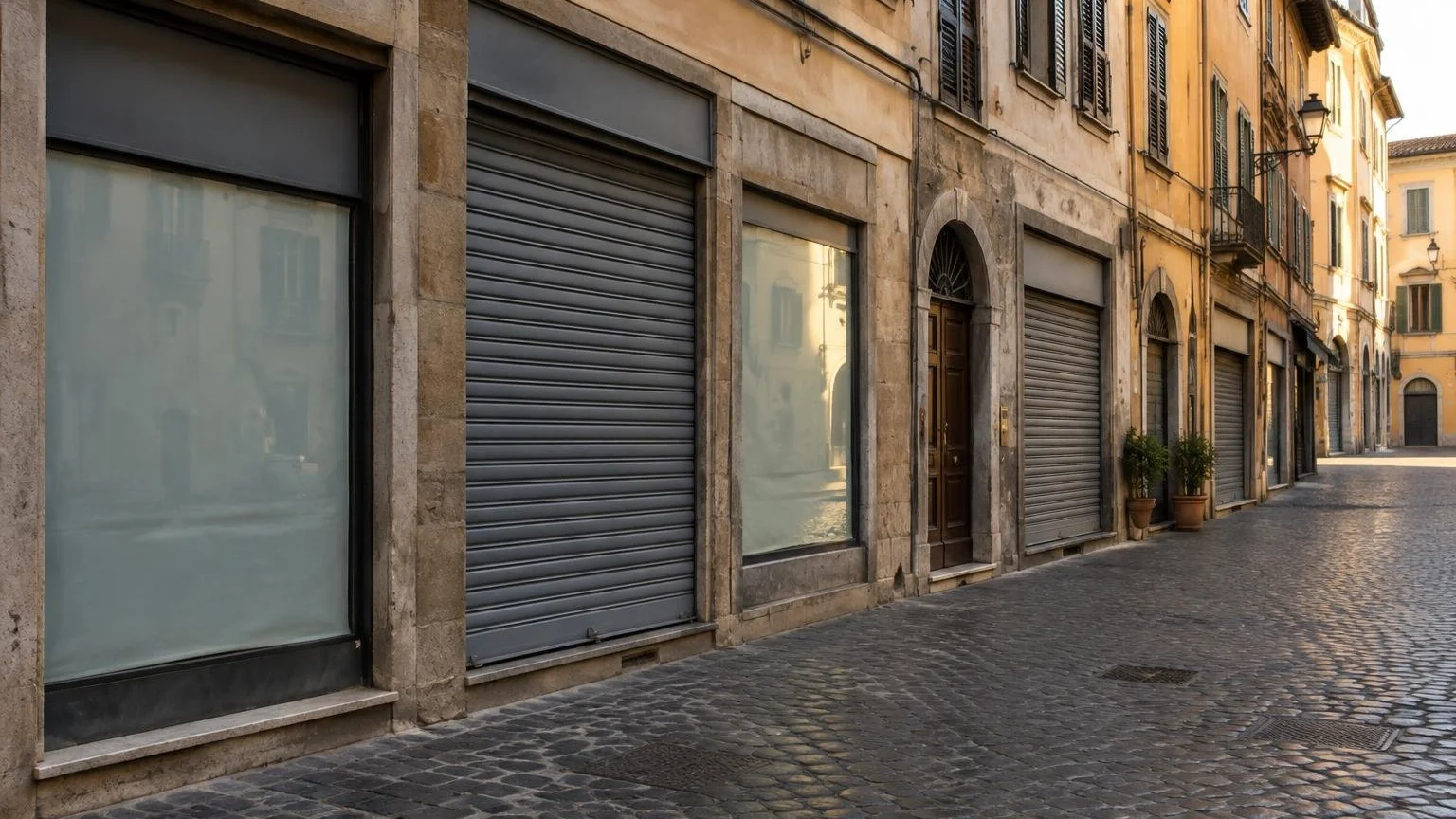
- 01Confcommercio and Istituto Tagliacarne count 460,466 vacant shops in Italy, 16.9% of the total.
- 02The loss to the Italian economy is about 4.4 billion euros a year, equal to 0.2% of GDP, or 53 billion euros overall.
- 03Vacancy reaches 19.4% in the South against 13.8% in the North-East.
- 04Between 2012 and 2025, 156,000 retail and street-trading outlets disappeared, according to Confcommercio.
Italy has 460,466 vacant shops, equal to 16.9% of the total, according to an analysis by Confcommercio with the Istituto Tagliacarne. The commercial desertification they describe costs the Italian economy about 4.4 billion euros a year.
The figures matter for investors and policymakers because the loss is not only about retail. It also touches property rents, urban services and local demand, and the Italian retail sector is still dominated by small businesses. Confcommercio is pressing for resources and powers for municipalities.
What happened
Confcommercio, working with the Istituto Tagliacarne, estimated that vacant shops across Italy reached 460,466 in 2025, or 16.9% of all commercial premises. A summary of the same estimate also rounds the figure to 458,000, or 17% of supply.
The organisations describe a structural crisis that hits the country unevenly, with the deepest problems in small retail and services. Small non-food retail pays the highest price. Among traditional shops, clothing, footwear and household goods show abandonment rates above 20%.
- Vacant shops in 2025: 460,466, or 16.9% of the total.
- Vacancy in the South (Mezzogiorno): 19.4%.
- Vacancy in the North-East, the lowest: 13.8%.
- Average time a commercial unit sat unused between 2012 and 2023: 7.2 years.
- Estimated annual loss: about 4.4 billion euros, or 0.2% of GDP.
How much does commercial desertification cost?
The analysis puts the cost of empty shops at about 4.4 billion euros a year. It bases this on an average annual rent of roughly 16,000 euros at current prices, an estimate from the Osservatorio del mercato immobiliare.
On that basis each empty shop forgoes 116,000 euros over its whole period of vacancy. For the entire Italian economy this adds up to 53 billion euros, which works out at about 4.4 billion a year, or 0.2% of GDP.
What is behind the closures?
Closures are accelerating, according to Mariano Bella, head of the Confcommercio research office. He cited an average annual rate of 3.1% in 2025, against 2.2% in earlier analyses. The finding comes from the study "Città e demografia d'impresa", presented on 12 March 2026 and covering 122 Italian cities. The study excludes large metropolises such as Milan and Rome.
Between 2012 and 2025, 156,000 retail and street-trading outlets disappeared, more than a quarter of the total. Only accommodation and catering grew, by 19,000 businesses. Over the same period 52% of newsstands closed, as did 43% of fuel stations, 37% of clothing and footwear shops and 36% of furniture and hardware stores. Street trading fell 29.7%.
Some activities went the other way. Extra-hotel accommodation rose 184%, restaurants 35%, delicatessens, ice-cream and pastry shops 14.4%, and pharmacies 9.8%.
How big is the role of e-commerce?
Online sales are one factor, according to Confcommercio, though not the only one. In 2025 they represented 11.3% of total consumption of goods that can be bought online and 18.4% of services. Between 2015 and 2025 the total retail sales index rose 14.4%, while small shops were flat at 0.0% and online sales almost tripled, up 187%. Online sales were worth 31.4 billion euros in 2019 and 62.3 billion in 2025.
Bella described a vicious circle. Fewer shops reduce the commercial appeal of urban areas, which feeds further contraction. Another view puts rents at the centre. A Corriere-type analysis of the market argues that the gap between landlords' asking rents and what a business can sustain keeps premises empty. Armando Vitali, founder of Area C1, said shops had long been valued with criteria borrowed from residential property.
Il negozio è una piattaforma economica e sociale prima ancora che un immobile
Armando Vitali, founder of Area C1, in comments on commercial property valuation.
Why it matters
The vacancy rate matters because it signals falling services, security and attractiveness in Italian cities. Carlo Sangalli, president of Confcommercio, said commercial desertification has become an emergency that penalises urban areas, with fewer services and less security.
Bella warned of a risk by 2035 of dimmer cities, dormitory districts, elderly residents struggling to shop and possibly greater urban decay. The sector's weight is also large. Small operators make up 95% of the commercial fabric, and the sector employs more than 1.8 million people.
Other figures point the same way. Confesercenti said that between 2019 and 2025 the fall in physical outlets and the growth of international e-commerce platforms moved about 16.7 billion euros of household spending away from local economies, and that 111,000 shops closed in that period.
What solutions are proposed?
Confcommercio's proposal is its Cities project, to be run with mayors around three priorities. These are regulating the commercial offer in historic centres, reusing vacant premises immediately, and combining economic development with urban planning.
The organisation says municipalities can already use the Decreto Scia 2 and the 2022 Competition law. These let them require authorisation for, or ban, "incongruous" product categories in historic centres and commercial areas. It also proposes active management of empty units through local governance such as commerce districts:
- censuses of vacant spaces for targeted initiatives;
- decoration and digitalisation of empty shop windows;
- alliances between owners and entrepreneurs to revive the rental market;
- temporary stores aimed at redevelopment.
Are there counterpoints?
The picture is not uniform. Milan's main shopping streets show a vacancy rate of 9% in the latest Engel & Völkers Commercial survey for 2025, and rents there are rising in the Quadrilatero. Corso Como and Corso Buenos Aires are struggling.
Online penetration is also put at 14% of consumption in one assessment, with many digital purchases still influenced by a physical store. The estimate for the number of vacant shops differs by source. Another Confcommercio figure cited in the press is over 105,000 vacant shops, about a quarter of them unused for more than a year. The figures use different definitions and should not be compared directly.
What to watch next
The next date is the second edition of the "inCittà 2026" forum in Bari on 29 and 30 October. It will discuss liveability, security, attractiveness and housing quality, and also property pressure, urban depopulation, local-economy policies and the role of institutions.
- 29 and 30 October: "inCittà 2026" forum in Bari.
- Whether mayors adopt the Cities project and use the powers in the Decreto Scia 2 and the 2022 Competition law.
- Whether Confcommercio's call for government resources for municipalities leads to measures.
Sources:ilsole24ore.comilsole24ore.commilanofinanza.itcorriere.itansa.it
UCapital Asset Management LLP or group companies may have commercial relationships with the companies mentioned. This content is not financial advice.
Sign up for free to ask the AI about this article.
Create a free business page: clients, leads and releases in one place.