
Vertical Farming and Mushroom Robotics: How Mycionics Is Reshaping Fungal Cultivation
Controlled-environment agriculture is expanding beyond leafy greens, with agricultural robotics now targeting mushroom cultivation — a segment where Mycionics is pioneering automated harvesting systems.

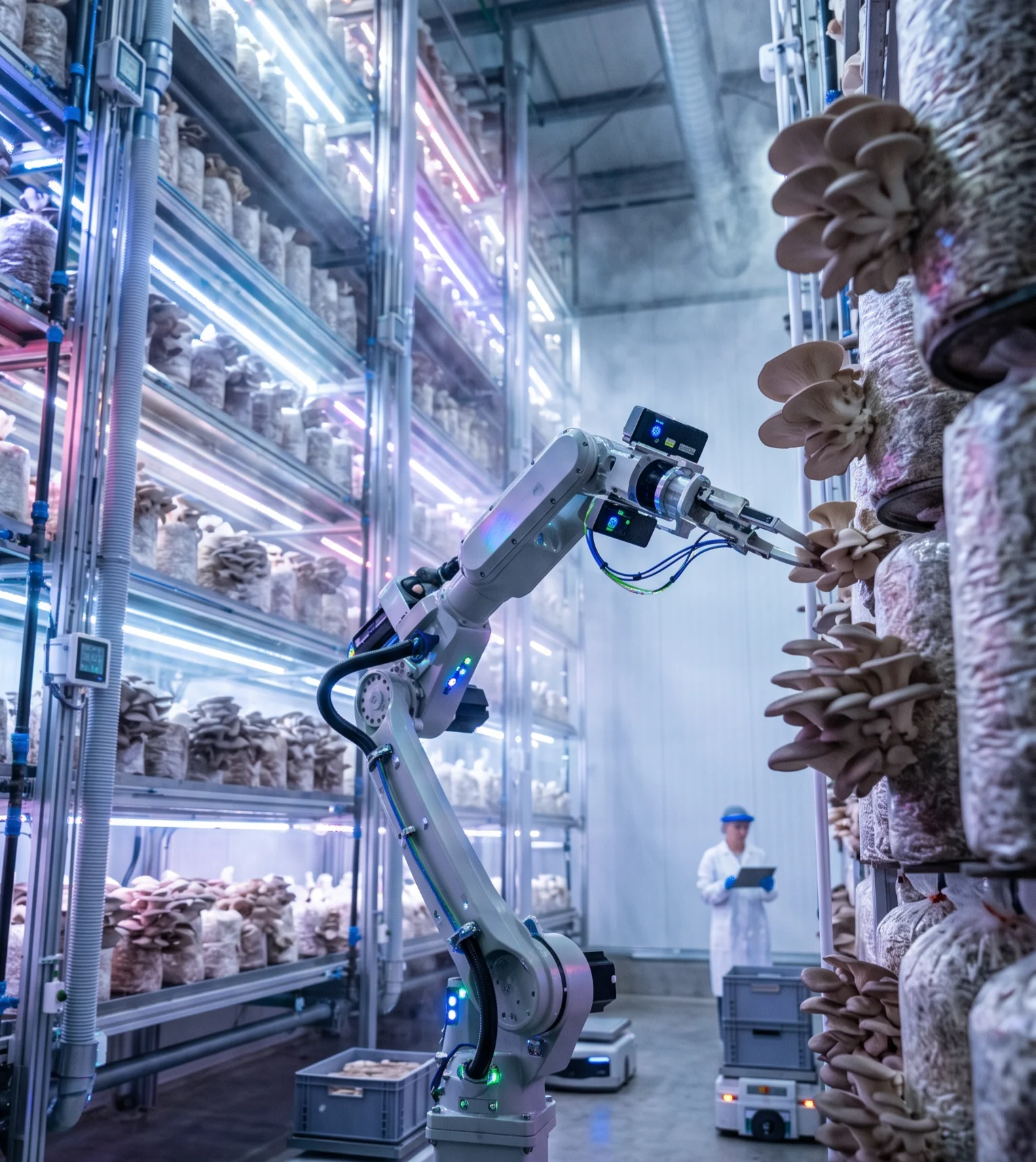
- 01Vertical farming is extending its reach into controlled-environment agriculture beyond traditional crops, encompassing fungal cultivation.
- 02Mushroom harvesting has long resisted automation due to the fragility and irregular growth patterns of fungi.
- 03Mycionics develops robotic systems designed to automate harvesting in commercial mushroom farms, reducing reliance on manual labour.
- 04The company's VP of Sales has outlined how precision robotics can bring consistency and scalability to mushroom cultivation operations.
Vertical farming is no longer confined to towers of lettuce and microgreens. As controlled-environment agriculture matures, a new frontier is emerging in one of the most labour-intensive and technically demanding corners of food production: mushroom cultivation — and robotics is beginning to change the equation.
What happened
The broader vertical farming sector has spent the past decade proving that crops can be grown at scale in tightly managed indoor environments, decoupled from weather, seasons and geography. The model has attracted significant investment and spawned a global industry built on LED lighting, hydroponic systems and data-driven climate control. Yet the conversation has largely centred on fast-growing, flat-leafed plants that lend themselves to conveyor-belt automation.
Mushrooms present an entirely different challenge. Fungi grow in three dimensions, emerge at unpredictable rates, vary in size and shape within a single flush, and bruise easily under mechanical contact. For these reasons, mushroom farms have remained stubbornly dependent on skilled human pickers — a bottleneck that limits throughput, raises costs and introduces variability in product quality.
Mycionics, a company specialising in agricultural robotics for fungal cultivation, is working to close that gap. Its automated harvesting systems are engineered to navigate the irregular geometry of a mushroom block, identify mature specimens and harvest them without damaging the surrounding flush or the substrate. In a recent interview, the company's Vice President of Sales described the core ambition as bringing the same precision and repeatability that robotics has delivered in automotive and electronics manufacturing to the biology-driven world of mushroom farming.
Why it matters
The stakes extend well beyond operational efficiency on individual farms. Mushrooms occupy a structurally important position in the global food system: they are among the most protein-dense crops that can be grown in a small footprint, require no sunlight and can be cultivated on agricultural by-products, making them a natural fit for circular-economy food production models. As demand for alternative proteins and sustainable food sources grows, the ability to scale mushroom output reliably becomes a supply-chain question, not merely an agronomic one.
Labour scarcity is compounding the urgency. Mushroom harvesting is physically demanding, repetitive and time-sensitive — mature caps must be picked within a narrow window before quality degrades. In many markets, finding and retaining workers for this role is increasingly difficult. Automation that can operate continuously, maintain consistent harvest timing and generate data on yield and crop health addresses several of these pressures simultaneously.
For the vertical farming industry as a whole, the emergence of viable mushroom robotics signals a maturation of the sector's technical ambitions. If precision robotics can be made to work reliably in the unstructured, humidity-saturated environment of a mushroom farm, the same underlying capabilities — computer vision, soft-touch end-effectors, adaptive motion planning — become applicable across a far wider range of crops and growing formats.
What to watch next
The key questions for the coming period centre on commercial adoption and technical performance at scale. Pilot deployments in controlled conditions are a necessary first step, but the durability of robotic systems in the wet, spore-rich atmosphere of a production mushroom facility, and their ability to handle the full diversity of commercially grown species, will determine how quickly the technology moves from demonstration to standard practice.
Regulatory frameworks around food-contact robotics and hygiene certification will also shape the pace of uptake, particularly in markets with stringent food-safety requirements. And as more players enter the agricultural robotics space, the competitive dynamics around cost-per-harvest and integration with existing farm-management software will become central to purchasing decisions by growers.
Mycionics and the broader field of mushroom-focused controlled-environment agriculture will be worth tracking as a bellwether for how far vertical farming's technological toolkit can stretch beyond its leafy-green origins.
UCapital Asset Management LLP or group companies may have commercial relationships with the companies mentioned. This content is not financial advice.
Sign up for free to ask the AI about this article.
The companies raising capital on UCapital, open to investors.