
Crusoe AI closes $3.9 bn Series F at $30.9 bn valuation amid AI infrastructure boom
Crusoe has secured a $3.9 billion Series F round, lifting its post-money valuation to $30.9 billion, as the vertically integrated AI infrastructure company deepens ties with OpenAI's Stargate project and heavyweight backers including NVIDIA and Founders Fund.
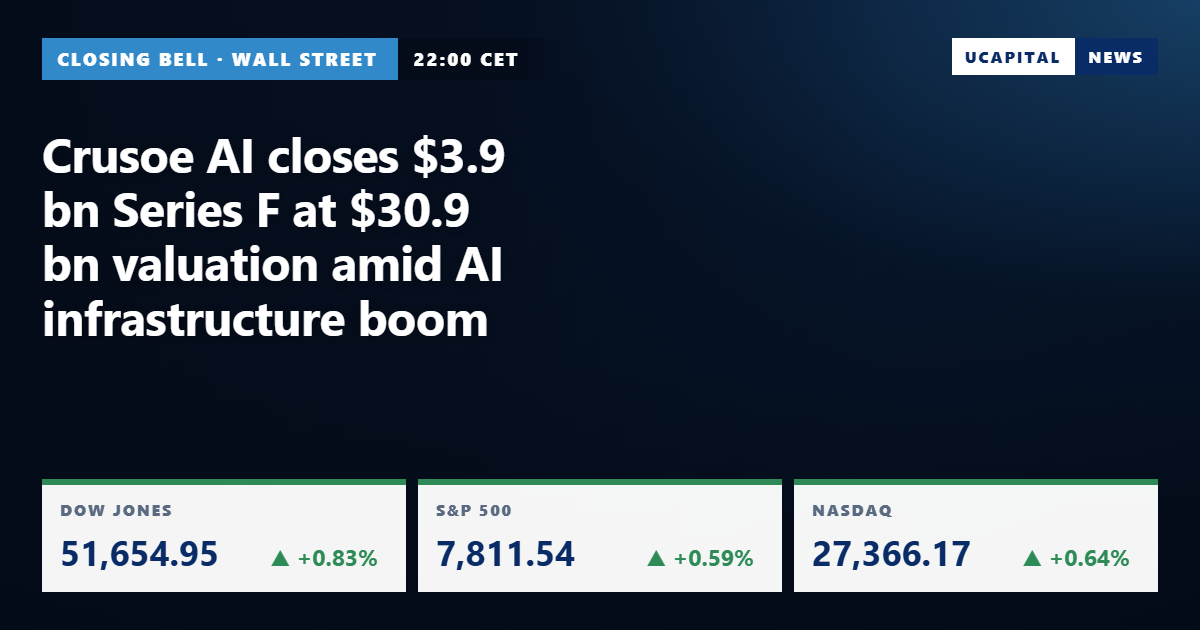
- 01Crusoe closed a $3.9 billion Series F in September 2026, bringing its post-money valuation to $30.9 billion.
- 02Revenue reached an estimated $276 million in 2024 and is projected to climb toward $1 billion.
- 03Key partnerships include data center campuses for OpenAI's Stargate project and a multi-billion-dollar cloud and GPU deal with Jane Street.
- 04Investors and strategic backers include NVIDIA, Founders Fund, Mubadala Capital, and Valor Equity Partners, with a potential IPO under discussion.
Crusoe, the vertically integrated AI infrastructure company formerly known as Crusoe Energy Systems, has closed a $3.9 billion Series F funding round at a post-money valuation of $30.9 billion, cementing its standing as one of the most heavily capitalised private players in the global AI buildout. The round arrives as demand for dedicated AI compute capacity continues to reshape the data-centre landscape.
What happened
The Series F, which closed in September 2026, was backed by a roster of prominent institutional and strategic investors including NVIDIA, Founders Fund, Mubadala Capital, and Valor Equity Partners. The capital injection follows a period of rapid revenue expansion: Crusoe's revenue reached an estimated $276 million in 2024 and is projected to surpass $500 million before approaching $1 billion, according to figures associated with the round. Discussions regarding a potential future IPO are also reported to be underway, though no timeline has been confirmed.
The Crusoe business model
Crusoe's core proposition is vertical integration across the energy-to-compute supply chain. The company originated in stranded and flared natural gas capture, using otherwise wasted energy to power GPU clusters, and has since evolved into a full-scale AI factory operator. Its product portfolio now includes modular Crusoe Spark compute units alongside large campus-scale data centres. This model positions Crusoe as a so-called "neocloud"—an independent, purpose-built alternative to hyperscaler cloud platforms—with direct control over power sourcing, hardware procurement, and facility operations.
Key partnerships and contracts
Crusoe plays a central role in the construction of data centre campuses in Texas for OpenAI's Stargate AI infrastructure initiative. The company has also signed a multi-billion-dollar cloud and GPU contract with Jane Street, illustrating demand from sophisticated financial institutions for dedicated, high-performance AI compute. These long-term agreements underpin the revenue trajectory that has attracted successive large funding rounds.
Why it matters
The scale of the Series F reflects broader institutional conviction that purpose-built AI infrastructure—distinct from general-purpose hyperscaler offerings—will capture a meaningful share of the compute market as model training and inference workloads intensify. Crusoe's ability to secure strategic investment from a chip giant such as NVIDIA, alongside sovereign-linked capital from Mubadala Capital and venture capital from Founders Fund, signals that the company occupies a differentiated position in the AI supply chain rather than competing head-on with established cloud providers.
The vertical integration thesis also carries an energy dimension: by controlling power inputs from the outset, Crusoe aims to sidestep some of the grid-access bottlenecks that constrain conventional data-centre developers, a constraint that has become increasingly acute as multi-gigawatt AI campuses proliferate.
What to watch next
Several factors will determine whether Crusoe's growth trajectory materialises as projected. Capital intensity is the most immediate variable: building out AI data centres and securing multi-gigawatt power capacity requires continuous large-scale debt financing and construction loans alongside equity rounds of the size just completed. Any tightening in credit markets or slowdown in investor appetite for private AI infrastructure could pressure the funding cadence.
Technology risk is a second watchpoint. Rapid improvements in AI model efficiency, the proliferation of custom silicon from chipmakers, and intensifying competition among hyperscalers could compress demand for independent neoclouds or erode the pricing power that underpins Crusoe's projected revenue ramp.
Finally, counterparty concentration warrants attention. A significant portion of Crusoe's growth depends on a small number of large, long-term tenant and power agreements. Any renegotiation, delay, or reduction in end-demand from anchor clients such as those tied to the Stargate project could have an outsized effect on the company's capital structure. The timing and structure of any eventual IPO will be a key milestone for observers tracking the company's path to public markets.
UCapital Asset Management LLP or group companies may have commercial relationships with the companies mentioned. This content is not financial advice.
Sign up for free to ask the AI about this article.
The companies raising capital on UCapital, open to investors.