
Intel CEO Lip-Bu Tan Adds 150,000 Shares Worth $9.7M After 54.5% Slide
Intel's chief executive acquired 150,000 shares on 2 November, lifting his holdings by 11.3% after the stock fell 54.5% from its June record. The move follows a weak outlook, supply setbacks and softer PC demand.
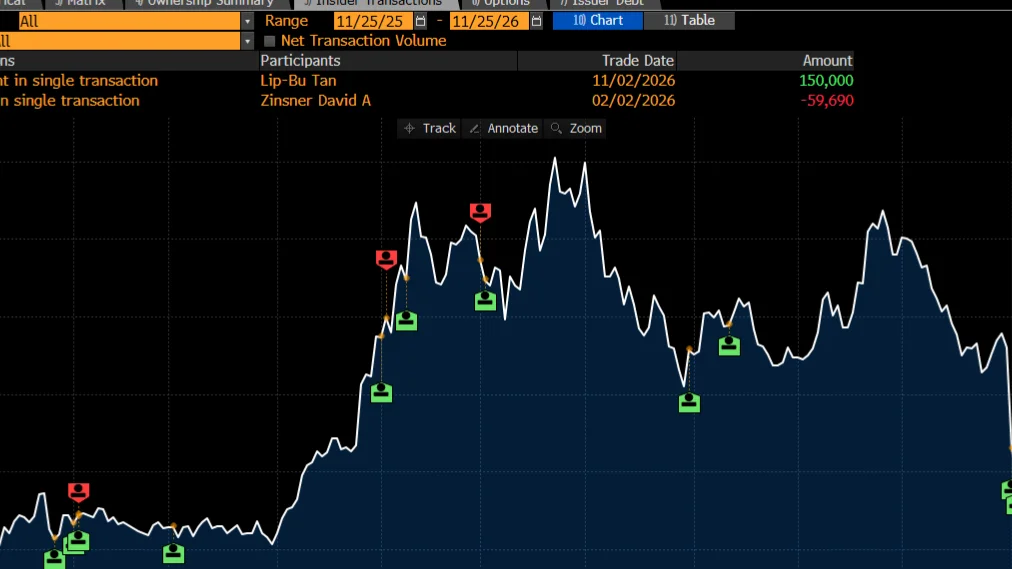
- 01On 2 November 2026, Intel (INTC) CEO Lip-Bu Tan acquired 150,000 shares worth $9.7 million, raising his holdings by 11.3%.
- 02It was the second largest of Tan's four share acquisitions at the company.
- 03Intel shares hit a record $142.35 on 30 June and have since fallen 54.5%.
- 04Intel reported quarterly EPS of 0.52 against an estimate of 0.41 on 29 October, with revenue of 16.51 billion against 16.56 billion expected.
Intel Corp (NASDAQ: INTC) Chief Executive Lip-Bu Tan acquired 150,000 shares of the company on 2 November 2026, a transaction worth $9.7 million. The stock had fallen 54.5% from its all-time high of $142.35, set on 30 June.
Insider buying at a company that has just lost more than half of its peak value draws close attention from investors, because executives rarely put personal money into a falling stock without a view on the business. The decline followed a disappointing fourth-quarter outlook, supply setbacks and a contraction in global PC demand, and the filing gives the market a rare data point on how the person running the company reads that picture.
What happened
Intel's chief executive added to his stake in the company on 2 November. Tan acquired 150,000 shares for about $9.7 million, which increased his holdings by 11.3%.
The transaction was the second largest of four that Tan has made at the computer components company. The earlier acquisitions are not itemised here, but the size ranking places this one just below his biggest.
The timing follows a sharp drop. Intel shares reached a record $142.35 on 30 June and have since lost 54.5%. The late-October announcement of a weaker-than-expected fourth-quarter outlook is cited as one of the main reasons for the slide, alongside supply setbacks and the contraction in global PC demand.
What are the key figures?
Shares acquired by Tan on 2 November 2026: 150,000.
Value of the transaction: $9.7 million.
Increase in Tan's holdings: 11.3%.
Rank among his four share acquisitions at Intel: second largest.
All-time high of the stock: $142.35 on 30 June.
Decline from that high: 54.5%.
What did Intel's latest results show?
Intel's latest reported quarter, published on 29 October 2026, showed earnings that beat the estimate while revenue fell marginally short. Earnings per share came in at 0.52 against an estimate of 0.41.
Revenue was 16.51 billion in the reporting currency against an estimate of 16.56 billion. The shortfall on sales is small, which suggests the sell-off was driven more by the forward guidance than by the quarter just reported.
The trailing price-to-earnings ratio stands at -22.97, a negative figure that reflects losses over the past twelve months rather than a current valuation signal. The same date saw the late-October communication in which the company gave an outlook for the fourth quarter that the market judged disappointing.
How do the drivers of the fall fit together?
Three factors are linked to the stock's decline: the weak fourth-quarter outlook, supply setbacks and a contraction in global PC demand. Each bears on the core business of a company that supplies computer components.
Global PC demand matters for Intel because personal computers are a central end market for its processors. Together they weigh on the outlook that management gave for the fourth quarter.
The United States is the home market of the company and the listing venue of the shares, so the stock's move since June also reflects how US investors have repriced the shares between the 30 June peak and early November.
Why it matters
The share acquisition matters because it is a public signal from the chief executive at a moment of weak sentiment. Executives are required to report transactions in company stock, and the filing makes his personal commitment visible to the market.
It also matters for scale. A 11.3% increase in holdings, worth $9.7 million, is large enough to be notable, and it ranks second among Tan's four acquisitions at Intel. The pattern suggests the executive has added to his stake on more than one occasion.
For investors following the sector, the episode links a company-specific event to a wider backdrop of weaker PC demand. Peers that depend on the same end market face the same softening of volumes, although the information available here concerns Intel alone.
What are the risks and counterpoints?
An insider's share acquisition is not a guarantee of a recovery, and the factors behind the drop remain in place. The fourth-quarter outlook was described as disappointing, supply setbacks have not been reported as resolved, and PC demand is contracting.
The stock has also lost 54.5% from its peak, which shows how far expectations were reset. Revenue of 16.51 billion missed the 16.56 billion estimate even as earnings per share beat, so the latest quarter gave a mixed picture. The negative trailing P/E of -22.97 shows that the company is not yet profitable on a twelve-month basis.
An executive's decision to add shares reflects a personal view, not a company forecast. The filing does not change the fourth-quarter outlook the company has already given.
What to watch next
The next signals will come from the company's own disclosures and from the demand data that drive its sales. No specific dates are given in the available material, so the items below are the catalysts that the facts point to.
Any further filings by Tan or other Intel executives reporting changes in their holdings after the 2 November transaction.
Progress on the supply setbacks that Intel cited as one of the causes of the weak outlook.
Evidence on whether global PC demand continues to contract or stabilises.
Intel's next quarterly report, which will show how results compare with the fourth-quarter outlook issued in late October.
The stock's path relative to the $142.35 record of 30 June and the 54.5% decline since then.
Until then, the 2 November acquisition stands as the clearest statement of the chief executive's confidence, set against a business facing weaker demand and supply constraints.
Sources: Blomberg news. Chart courtesy of Bloomberg
Sources:UCapital Markets (ucapital.com)
UCapital24 S.p.A. or group companies may have commercial relationships with the companies mentioned. This content is not financial advice.
Sign up for free to ask the AI about this article.
Multiples, financials, sentiment and risks in 60 seconds, with live data.