
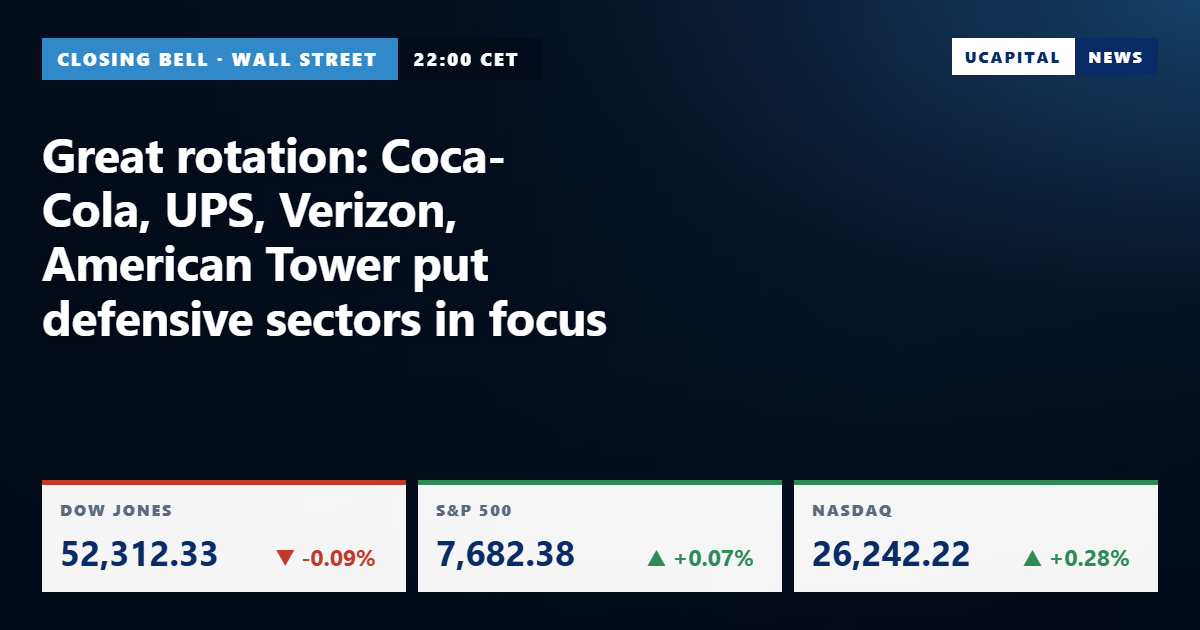
Great rotation: Coca-Cola, UPS, Verizon, American Tower put defensive sectors in focus
Better-than-expected results from Coca-Cola, UPS, Verizon and American Tower have revived debate over a great rotation toward staples, telecom, industrials and real estate. Here is what the debate covers and what to watch.
- 01Coca-Cola, UPS, Verizon and American Tower have all reported results described as better than expected.
- 02The results span consumer staples, industrials, telecommunications and real estate investment trusts.
- 03The angle: a possible rotation away from crowded growth trades toward defensive and value sectors.
- 04Guidance and cash-flow commentary will matter more than a single quarter.
The great rotation, a shift in favourite sectors away from crowded growth trades, is back in the conversation after better-than-expected results from Coca-Cola, UPS, Verizon and American Tower. The four companies span consumer staples, industrials, telecommunications and real estate investment trusts in the United States.
What happened
Four large US companies from different defensive and value-oriented corners of the market have delivered results that beat expectations: Coca-Cola in consumer staples, UPS in logistics and industrials, Verizon in telecommunications, and American Tower in real estate investment trusts.
The common thread is that these businesses are often seen as steadier than the growth names that have dominated recent market leadership. Their results feed the argument that investors may be broadening their preferences beyond a narrow group of crowded growth trades.
Why it matters
A great rotation refers to a change in which sectors lead the market. When defensive and value sectors such as staples, telecom, industrials and real estate gain attention, it can signal that investors are weighing stable earnings, cash generation and dividends more heavily against growth expectations.
Four good reports do not by themselves establish a trend. Each company has its own drivers: consumer demand and pricing for a beverage maker, shipping volumes for a parcel carrier, subscriber and network trends for a wireless operator, and tower leasing for a real estate trust. Still, results arriving together across sectors give the rotation thesis a more concrete footing than a single standout report would.
Value versus growth
The debate is often framed as value against growth, or defensives against cyclicals. Staples and telecom are traditionally defensive, while UPS is tied more closely to the economic cycle. Real estate trusts are sensitive to financing conditions. That mix suggests the signal is about breadth of leadership rather than a single theme.
What to watch next
For now, the rotation is a hypothesis supported by a cluster of results. The coming earnings weeks should show whether it broadens.
UCapital Asset Management LLP or group companies may have commercial relationships with the companies mentioned. This content is not financial advice.
Sign up for free to ask the AI about this article.
Multiples, financials, sentiment and risks in 60 seconds, with live data.