
French real estate investors face 11.2% Paris-region office vacancy as development pipeline shrinks
Office take-up in Île-de-France fell 7% in 2025 and vacancy reached 11.2%, according to the regional state agency's annual note. The data frame the market French real estate investors are navigating.

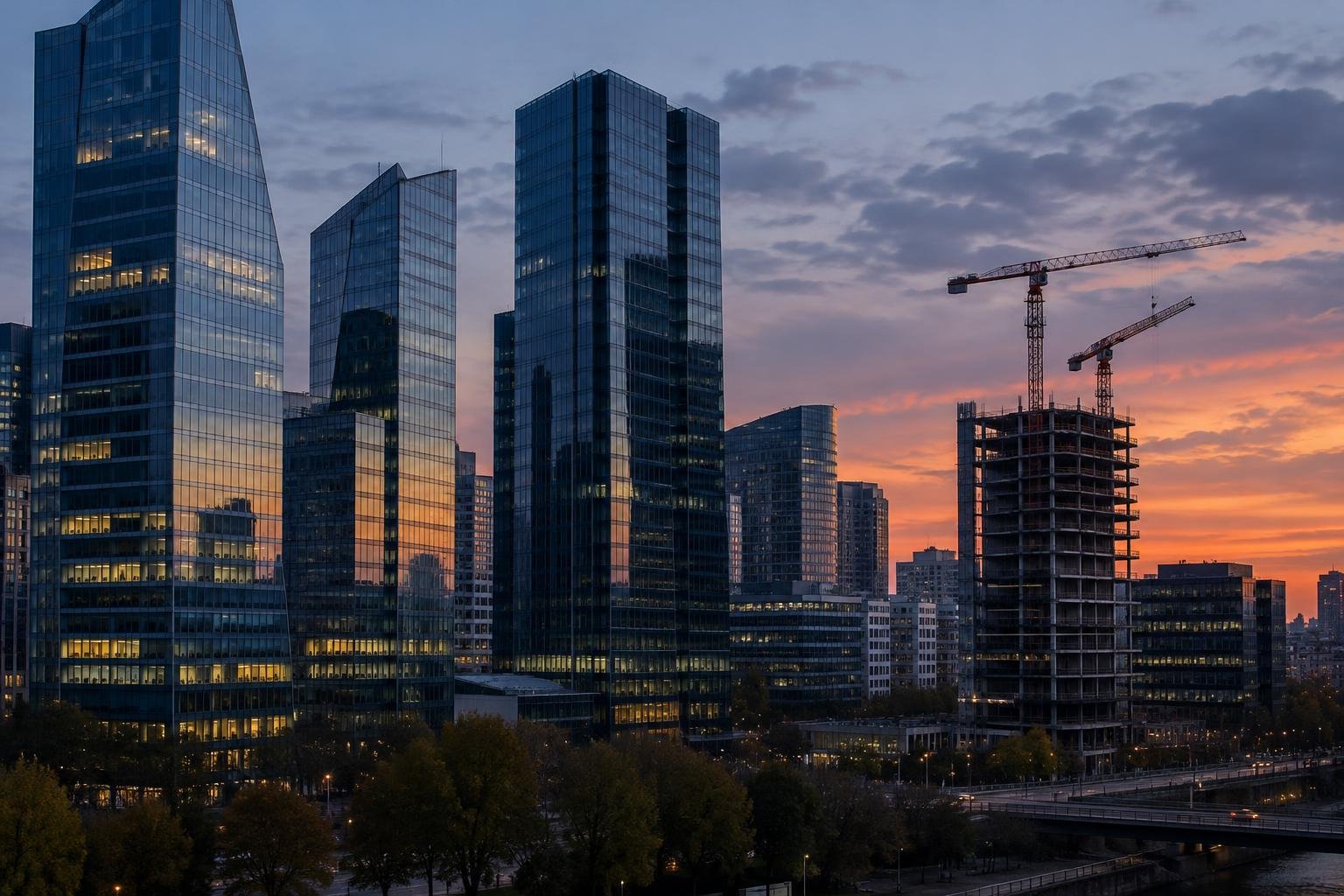
- 01Office take-up in Île-de-France reached 1.7 million m² in 2025, down 7% on a year earlier.
- 02Vacancy stood at 11.2% at end-2025, up 1.1 points, with immediate supply up 12% to 6.4 million m².
- 03Pre-lettings of offices under development fell 90% in 2025, while delivered first-hand space rose 66%.
- 04Office space under construction fell to 1.5 million m² at end-2025 from more than 2 million a year earlier.
French real estate investors are operating in an office market where demand is softening and empty space is rising: take-up in the Île-de-France region fell 7% to 1.7 million m² in 2025, while vacancy reached 11.2% at 31 December 2025, according to the regional state agency DRIEAT's annual market note.
The figures matter because the Paris region is France's largest corporate property market, and the balance between supply and demand shapes how institutional owners price, refurbish and reposition assets. The same note also covers business premises and logistics property, the segments that sit alongside offices in institutional portfolios.
What happened
The DRIEAT, the regional environment and transport directorate for Île-de-France, published its annual market note with results at 31 December 2025. The note was prepared by IDEMm Conseil and BNP Paribas Real Estate, which have been the agency's data providers since 2025 and supply it with market databases every half-year.
According to the note, take-up of offices reached 1.7 million m² in 2025, a fall of 7% on a year earlier. The agency says that level remains below the average seen since the health crisis, reflecting slower activity in an uncertain economic environment.
Second-hand space remains the main driver of the market, with take-up down a limited 6%. Pre-lettings, by contrast, collapsed by 90%, which the note reads as great caution among occupiers toward developments that are not yet built.
Key figures at 31 December 2025
- Office take-up: 1.7 million m², down 7% over the year.
- Vacancy rate in Île-de-France: 11.2%, up 1.1 points.
- Immediate supply: 6.4 million m², up 12%.
- First-hand space delivered: up 66%.
- Pre-lettings: down 90%.
- Office space under construction: 1.5 million m², against more than 2 million a year earlier.
How is supply shaping the market?
Immediate supply in the Paris region rose 12% to 6.4 million m² by the end of 2025, which the agency says confirms an imbalance between supply and demand. The increase affects both new and existing space.
First-hand space accounts for 28% of the stock on offer, up 6%, while second-hand space makes up 72%, up 15%. The agency reads the rise in the second-hand share as limited absorption of existing floor space.
Occupiers appear to favour buildings that are immediately available: delivered first-hand surfaces rose 66% while pre-lettings fell 90%. For owners, that points to competition between recently completed buildings and older stock.
Where is the vacancy concentrated?
Vacancy varies sharply across the region, and Paris itself is the tightest pocket. According to the note, rates among the ORIE sub-markets range from 6.8% in Paris Centre Ouest to 35.9% in the Clichy-Saint-Ouen area.
Delivered supply is mostly located in the Hauts-de-Seine, which holds 43% of the regional volume, ahead of Paris with 22%. Trends differ by area: the note records an unprecedented rise of 32% in Paris and a sharp fall of 24% in the Val-d’Oise.
Long-term vacancy has more than doubled since 2024. More than 1.9 million m² have been empty for over three years, of which more than 850,000 m² are in the Hauts-de-Seine. That stock of long-vacant space is the part of the market where conversion or refurbishment questions are most pressing, although the note itself reports the figures rather than prescribing a response.
Is new development slowing?
Office development in the Paris region is slowing markedly. The note says that, because the market is still in difficulty, production of offices is shrinking significantly: space under construction was 1.5 million m² at the end of 2025, compared with more than 2 million m² a year before.
A smaller pipeline could limit new first-hand supply in future, but the agency does not draw that conclusion in the extract available. What it does report is the collapse in pre-lettings, which removes one of the usual triggers for new construction starts.
The agency also reports on regulatory approvals for business property. A separate bulletin states that 2.14 million m² of business property were approved in 2025, with approvals up for offices and warehouses and down for other activities.
Why it matters
The Île-de-France office market is showing that supply and demand are out of balance, which is central for institutional investors weighing how to hold or reposition Paris-region assets. Take-up below the post-pandemic average, vacancy of 11.2% and more than 1.9 million m² empty for over three years describe a market where location and building condition drive outcomes.
The dispersion of vacancy is the key nuance. A rate of 6.8% in Paris Centre Ouest against 35.9% in the Clichy-Saint-Ouen area means that regional averages hide very different conditions for individual assets.
The preference for immediately available space, shown by the 66% rise in delivered first-hand surfaces alongside the 90% fall in pre-lettings, also indicates that occupiers are reluctant to commit ahead of delivery. Developers and owners therefore carry more of the letting risk on new projects.
What are the risks and caveats?
The data cover offices, business premises and logistics property in Île-de-France only, and are a snapshot at 31 December 2025. They do not describe residential property, retail or other French regions, and the extract available does not give figures on investment volumes, yields or the policies of individual investors.
The agency itself stresses an uncertain economic environment as the backdrop for slower activity. It also notes that the data come from a new database acquired by the DRIEAT, so the series are drawn from a source different from earlier editions.
Second-hand take-up fell only 6%, which suggests demand has not disappeared. The picture is therefore one of selective demand rather than a uniform retreat.
What to watch next
The next reference point is the next half-yearly update of the market databases that IDEMm Conseil and BNP Paribas Real Estate supply to the DRIEAT. The note does not give a date for it.
- Whether vacancy, at 11.2% at end-2025, keeps rising as immediate supply stands at 6.4 million m².
- Whether the 90% fall in pre-lettings reverses.
- Whether office space under construction, 1.5 million m² at end-2025, falls further.
- Whether the more than 1.9 million m² vacant for over three years begins to shrink.
- How vacancy evolves in Paris, where delivered supply rose 32%.
Sources:drieat.ile-de-france.developpement-durable.gouv.fr
UCapital24 S.p.A. or group companies may have commercial relationships with the companies mentioned. This content is not financial advice.
Sign up for free to ask the AI about this article.
Multiples, financials, sentiment and risks in 60 seconds, with live data.