
European stocks open mixed on last trading day of 2025. Defense stocks lead gains

Indices
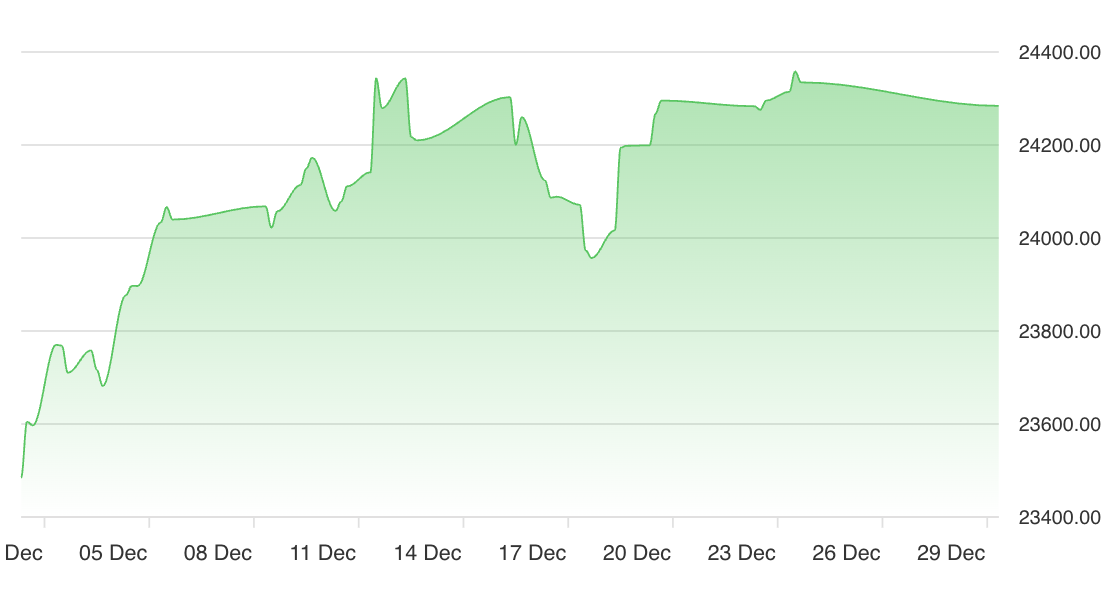
Major European indices are displaying a mixed yet resilient performance, with most benchmarks trading at or near record or multi-year highs. The FTSE MIB Index (FTSEMIB.MI) is quoted at 42.42K, showing a slight decline of -0.13, which suggests a cautious stance among Italian equities. Germany’s DAX (^GDAXI) stands at 23.67K, advancing by 0.23 and signaling potential buying interest.
France’s CAC 40 (^FCHI) is at 7.83K, down -0.57, which may prompt investors to hold off on new positions. The FTSE 100 (^FTSE) trades at 9.25K, up 0.29, indicating a neutral stance in UK equities. Spain’s IBEX 35 (^IBEX) is at 15.19K, posting a moderate gain of 0.24, while the EURO STOXX 50 (^STOXX50E) is stable at 5.72K. These moves reflect a market balancing risk-on flows in select sectors with consolidation in others, and tactical positioning remains crucial.
Stocks
Defense stocks dominate the spotlight with remarkable gains. BAE Systems (BAESY) is up 7.9, Rheinmetall (RHM) has surged 14, Leonardo (LDO) gained 16, and Thales (THLEF) advanced by 17. These movements are driven by heightened expectations for European military spending and strong order books, with the STOXX Europe Total Market Aerospace & Defense Index rising over 65 in 2025.
Despite strong demand, supply chain bottlenecks—especially in raw materials and semiconductors—are limiting output, underscoring the need for caution even amid robust sector momentum. Investors are advised to consider trailing stop-losses to capture gains while guarding against possible reversals.
Economic News
Recent geopolitical tensions, especially developments at the Munich Security Conference and the ongoing Ukraine-Russia conflict, are the primary catalysts behind the surge in defense stocks and the sector's outperformance. Barclays projects that European defense expenditure could rise by $200–$300 billion, translating to between 3% and 3.5% of GDP, a powerful tailwind for the sector.
There are no major economic data releases scheduled for today, as the holiday season has resulted in a quieter macroeconomic calendar. The focus remains on geopolitical developments and sector-specific news rather than broad macro releases.
Economic Events
With today marking December 31, 2025, no high-impact economic events are on the calendar, and markets will be closed tomorrow for New Year’s Day. The absence of fresh macroeconomic catalysts means that sector rotation and news-driven momentum, especially in defense, are likely to continue driving short-term volatility.
Market Sentiment
Overall, European market sentiment is mixed, with pronounced optimism in defense and select cyclical sectors, but caution prevailing elsewhere due to geopolitical uncertainties and ongoing supply chain constraints. The strong inflows into defense indicate investor preference for sectors benefiting from structural policy shifts and geopolitical realities, while the broader indices reflect a wait-and-see approach as markets approach the new year.
Please note that the analysis is for informational purposes only and does not constitute financial advice. Users should conduct their own research.
UCapital Asset Management LLP or group companies may have commercial relationships with the companies mentioned. This content is not financial advice.
Sign up for free to ask the AI about this article.
Multiples, financials, sentiment and risks in 60 seconds, with live data.