
Asian markets close lower as South Korea’s Kospi leads losses following Wall Street tech rout
The main Asian indices are exhibiting pronounced volatility driven by shifting sentiment around artificial intelligence advancements and macroeconomic uncertainties.
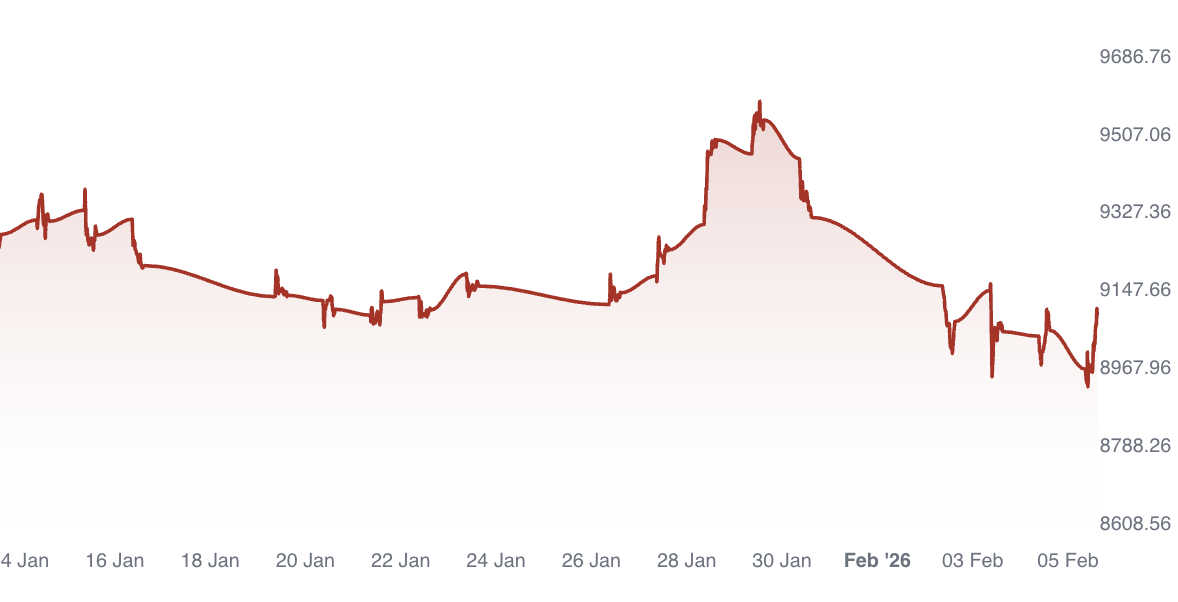
Indices
The KOSPI (KOSPI) experienced a notable decline of 3.7, retreating from its recent record highs, largely due to investor concerns over the rapid pace of AI innovation impacting traditional business models. In contrast, the Nikkei 225 (NIKKEI225) surged by 1.7, buoyed by optimism surrounding AI and nearing its all-time high of 42.43K. The Hang Seng Index (HSI) advanced for a fifth consecutive session, growing by 0.4, reflecting resilient sentiment in Hong Kong. The Shanghai Composite Index (SSECOMP) posted a gain of 0.88, indicating stability amid regional turmoil. These divergent performances suggest that while some markets are retreating in the face of uncertainty, others are capitalizing on optimism around technological growth.
Stocks
Specific data on top gainers and losers across the main indices is not available. However, the technology sector remains at the forefront of market movements. Notably, major South Korean tech stocks such as Samsung Electronics and SK Hynix saw declines exceeding 5 each, reflecting deep-seated concerns about AI-driven disruptions. In Japan, technology optimism continues to drive the Nikkei 225 higher, as investors position for anticipated breakthroughs. Hong Kong's Hang Seng has been supported by gains in technology and health-tech stocks during recent sessions. This sectoral focus underscores that technology and AI-related equities remain both a source of volatility and opportunity.
Economic News
Recent economic news has centered on the disruptive potential of artificial intelligence and the uncertainty surrounding global interest rate trends. These factors have led to a retreat from record levels in certain Asian markets, most notably the KOSPI, as investors reassess risk. Conversely, optimism about AI advancements and positive signals from U.S.-EU trade negotiations have buoyed Japanese and Hong Kong equities. The interplay of these forces is causing sharp sectoral rotation and heightened sensitivity to news flow, particularly in the tech and export-driven sectors.
Economic Events
A key upcoming event is the release of U.S. consumer price inflation data, which is expected to have significant influence on global financial markets, including those in Asia. The anticipation of this data is contributing to short-term market caution, as the outcome will inform expectations for U.S. monetary policy and, by extension, global liquidity and risk appetite. Investors are closely monitoring for potential volatility spikes in reaction to these macroeconomic catalysts.
Market Sentiment
Market sentiment across Asia is currently mixed. While the Nikkei 225 and Hang Seng Index are supported by optimism around AI innovation and improving trade prospects, the KOSPI's sharp retreat signals caution and anxiety about the pace of technological change and interest rate trajectories. The Shanghai Composite is displaying relative stability, suggesting a more balanced outlook in China. Overall, sentiment is fragile and subject to rapid shifts, with investors recommended to remain agile and attentive to news-driven swings.
Please note that the analysis is for informational purposes only and does not constitute financial advice. Users should conduct their own research.
UCapital Asset Management LLP or group companies may have commercial relationships with the companies mentioned. This content is not financial advice.
Sign up for free to ask the AI about this article.
Multiples, financials, sentiment and risks in 60 seconds, with live data.