
Amazon to acquire Decart AI technology and founders in reported $7.5 billion deal
Amazon.com Inc. will take Decart's optimization software and its founding and research teams, a reported $7.5 billion deal. The software could ease moves of AI workloads between Nvidia, Amazon and Google chips.

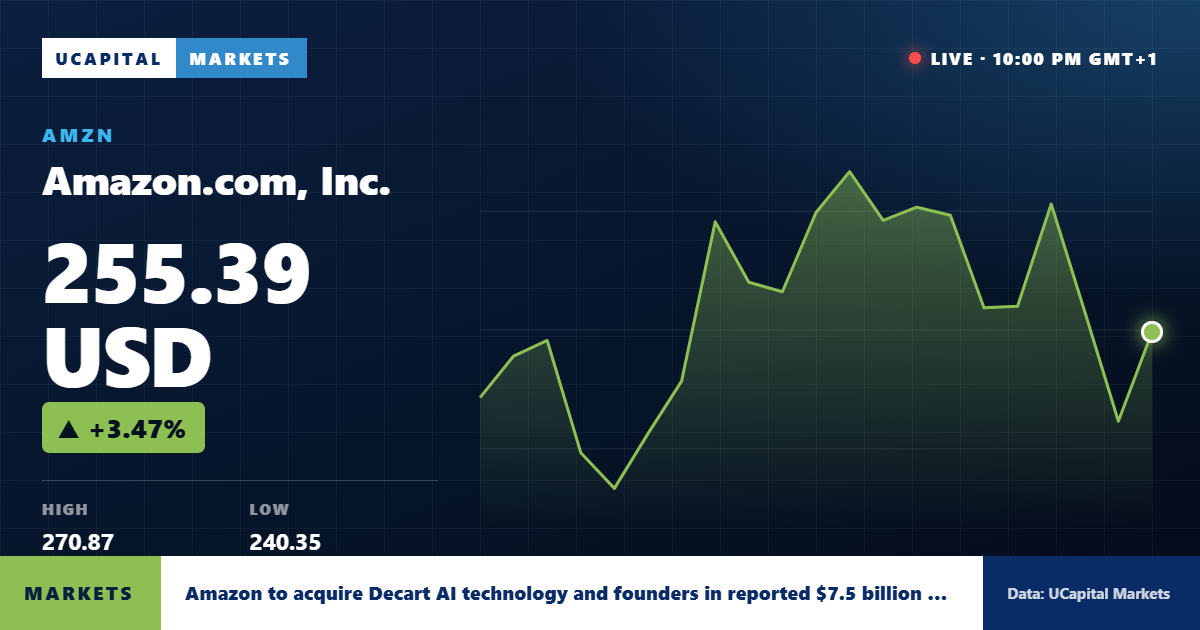
- 01Amazon agreed on 24 November 2026 to acquire the technology behind the Decart Optimization Stack plus Decart's founders, researchers and engineers, per Amazon's blog post.
- 02The reported price is $7.5 billion, according to people familiar with the matter cited by several outlets.
- 03Decart's software is designed to make AI models run smoothly across a range of hardware, including Nvidia, Amazon and Google chips.
- 04Amazon reported third-quarter EPS of 1.89 against an estimate of 1.97 on 29 October 2026.
Amazon.com Inc. (AMZN) has agreed to acquire the technology behind the Decart Optimization Stack, together with the founding team and researchers of Israeli startup Decart, in a deal reported at $7.5 billion. The company announced the agreement in a blog post on Monday 23 November 2026.
The deal matters for markets because Decart's software is designed to make AI models run across different hardware, which could make it easier for customers to shift workloads away from Nvidia Corp. (NVDA) chips toward Amazon's Trainium AI chips as Amazon widens their availability.
What happened
Amazon agreed to acquire much of Decart AI, buying tools meant to strengthen its cloud AI infrastructure. According to the company's blog post, Amazon gets the technology behind the Decart Optimization Stack, software built to make AI models run smoothly across a range of hardware, plus Decart's founders, AI researchers and engineers.
Several outlets reported that Amazon will pay $7.5 billion for Decart's assets, citing people familiar with the matter. The figure was not part of the excerpts of Amazon's own announcement available for this report. Israeli press reported that the signing followed about two months of negotiation.
The transaction is structured around technology and talent rather than a full corporate takeover, which is why reports describe Amazon as acquiring much of the startup. The founders and their teams are expected to join Amazon, in what one report called the company's latest AI talent grab.
What does Decart do?
Decart is an Israeli AI company. Its optimization software aims to help AI models run more efficiently on different chips, among them hardware from Nvidia, Amazon and Alphabet Inc. (GOOGL) Google.
Why does the deal matter for Trainium and Nvidia?
The deal gives Amazon software that could lower the friction of moving AI workloads between chip families, which is central to its push to offer Trainium more broadly. Reports say the tools could make it easier for customers to move work away from Nvidia hardware.
One analyst quoted in a market commentary on 23 November said the reported $7.5 billion price may be a relatively inexpensive way to raise the speed and efficiency of Amazon's custom chips. That is the analyst's view, and the companies have not published performance figures for the combined technology.
The logic is that hardware choice often depends on how much work it takes to adapt a model to a given chip. Software that runs the same model across Nvidia, Amazon and Google hardware narrows that gap, which is the point of the Decart Optimization Stack as described in the announcement.
- Price: $7.5 billion, as reported by several outlets citing people familiar with the matter.
- Assets: the Decart Optimization Stack technology, plus founders, researchers and engineers.
- Negotiation: about two months, according to Israeli press.
- Announcement: a company blog post on 23 November 2026.
- Hardware covered: chips from Nvidia, Amazon and Google.
How do the three chip companies compare?
The latest quarterly reports show different positions among the companies named. Amazon reported on 29 October 2026 earnings per share of 1.89 against an estimate of 1.97, and revenue of 201.94 billion against an estimate of 202.22 billion. Its trailing price-to-earnings ratio is 20.51 and its forward ratio 20.8.
Nvidia reported on 17 November 2026 earnings per share of 2.68 against an estimate of 2.49, and revenue of 115.84 billion against an estimate of 109.28 billion. Its trailing price-to-earnings ratio is 17.78.
Alphabet reported on 28 October 2026 earnings per share of 2.12 against an estimate of 3.02, and revenue of 127.58 billion against an estimate of 128 billion. Its trailing price-to-earnings ratio is 14.62 and its forward ratio 13.4.
Read together, Amazon and Alphabet each came in below earnings estimates in their latest quarters, while Nvidia beat on both profit and revenue. Revenue at Amazon and Alphabet was within a fraction of expectations, so the profit gap was the larger miss, especially at Alphabet.
Why it matters
The deal shows how hyperscalers are competing for AI talent and tooling, not only for chips. Amazon is paying for engineers and software that make its own silicon easier to adopt, rather than relying on hardware alone.
For Nvidia, whose latest quarter beat estimates on both profit and revenue, the relevance is the software layer: tools that make workloads portable reduce the cost of switching suppliers. For Alphabet, whose chips are also supported by Decart's software, the effect is not described in the reports.
Amazon faces other operational headlines in the same week. The Federal Aviation Administration said it will investigate an Amazon Prime Air drone that struck a fiber-optic cable on takeoff and crashed into a garage in Huntington Woods, Michigan; no one was injured. A separate report published on 24 November said Amazon's satellite arm, Leo, is facing setbacks against SpaceX's Starlink.
What are the risks and open questions?
Several points remain unclear. The reported price comes from unnamed sources and not from a company disclosure, and it is not known how much of Decart's team will stay or how quickly the technology will be integrated into Amazon's cloud.
It is also uncertain whether easier portability will in practice move customers off Nvidia hardware. The reports describe it as a potential effect, and Nvidia has not commented in the available material. Regulatory review of the transaction has not been described in the sources.
The analyst's view that the price is inexpensive is also an opinion, not a measured result. Because Decart's software works across hardware from several vendors, it could in principle help customers on any platform, not only Trainium, and the sources do not say how Amazon will prioritise it.
What to watch next
The next steps depend on Amazon's disclosures and on customer adoption of Trainium. The sources give no closing date, so the items below are open points rather than scheduled events.
- Whether Amazon confirms the $7.5 billion price or discloses terms.
- The closing timetable and any regulatory review of the transaction.
- How Amazon integrates the Decart Optimization Stack with Trainium and whether it publishes performance results.
- Any response from Nvidia and Alphabet on workload portability.
- The outcome of the FAA investigation into the Michigan drone crash, with the NTSB gathering information.
Sources:UCapital Markets (ucapital.com)UCapital Markets (ucapital.com)UCapital Markets (ucapital.com)en.globes.co.ilcnbc.commarketwatch.comcnbc.combloomberg.comlivemint.comwsj.comreuters.com
UCapital24 S.p.A. or group companies may have commercial relationships with the companies mentioned. This content is not financial advice.
Sign up for free to ask the AI about this article.
Multiples, financials, sentiment and risks in 60 seconds, with live data.