
Climate and Agrifood: Italy's summer 2026 bill comes due as agritech steps up
Record agrifood exports mask a deepening crisis: drought, heat and extreme weather have cost Italian agriculture an estimated €20 billion over four years, forcing producers and startups to rethink how food is grown and sold.

- 01Italian agrifood exports reached a new record of over €72 billion in 2026, according to the CREA report published in September 2026.
- 02Climate-related damage to Italian agriculture totalled an estimated €20 billion over four years, according to Coldiretti estimates published on 30 June 2026.
- 03The Po River fell to 8.59 metres below hydrometric zero at Cremona on 30 July 2026 — 1 cm below the previous record set during the 2022 drought — with flow reduced to less than a third of the
- 04The European Commission adopted a new Strategic Approach to Research and Innovation for agri-food (AgRI 2040 / Food 2040) on 8 September 2026, to be deployed under Horizon Europe 2028–2034.
Italian agrifood exports surpassed €72 billion in 2026, a new all-time high according to the CREA report on foreign trade in agrifood products published in September 2026 — yet behind that record lies a sector under acute climate stress, with an estimated €20 billion in weather-related damage accumulated over the previous four years, according to Coldiretti estimates released on 30 June 2026.
The tension between record export performance and mounting climate disruption defines the central challenge for Made in Italy agrifood: the same supply chains that have made Italy one of the largest food exporters in the European Union are now the most exposed to drought, extreme heat and erratic rainfall. Producers, technology startups and policymakers are being pushed toward a structural rethink of how Italian food is grown, processed and protected.
What happened
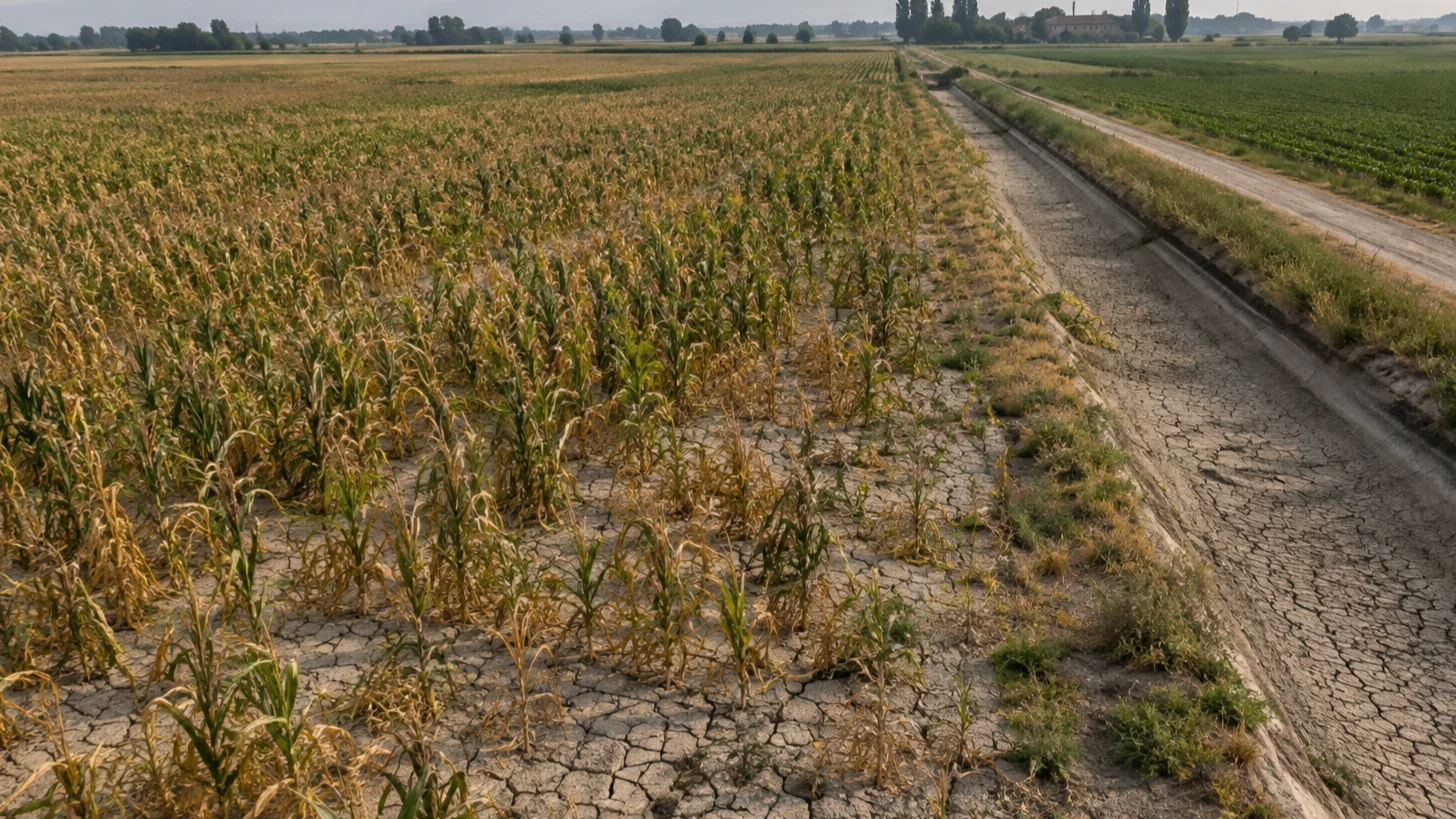
The summer of 2026 brought Italy's worst drought conditions in decades. The Po River — Italy's longest river at 405 miles, rising in the Alps and emptying into the Adriatic south of Venice — fell to 8.59 metres below hydrometric zero at Cremona on 30 July 2026, 1 centimetre below the previous record low set during the severe drought of 2022, according to the Po River Basin District Authority. Flow was reduced to less than a third of the historical norm for that time of year.
The Po River district accounts for approximately 41% of Italy's gross domestic product and 32% of its agricultural production, according to the basin authority, making the river's condition a direct economic indicator. Farmers across the Po Valley faced a stark choice: adapt or lose harvests.
Massimo Salvagnin, who runs a 600-hectare farm near the Po delta, described the dilemma of sowing green beans in extreme heat: "The sand gets so hot that the risk of cooking — boiling — the seed when it touches the soil is extremely high," he said in early August 2026.
The damage extended well beyond cereals. According to a report published on 4 August 2026, milk production fell 10%, while fruit, vegetable and olive oil harvests were all under pressure from heat and water shortages. Coldiretti's estimates, published on 30 June 2026, put cumulative climate-related damage to Italian agriculture at €20 billion over four years, driven by droughts, flash floods, late frosts and disrupted growing calendars.
How deep is the structural exposure?
Italy's agricultural geography amplifies the risk. The country's northern regions — centred on the Po Valley — specialise in grains, soybeans, meat and dairy, while the south focuses on fruits, vegetables, olive oil, wine and durum wheat, according to the European Commission's overview of Italian agriculture. Italy also holds the largest number of agrifood products with Protected Designation of Origin in the EU, meaning that many of its highest-value exports cannot simply be relocated to cooler or wetter regions without losing their legal identity and market premium.
The water management infrastructure is struggling to keep pace. Stefano Calderoni, chairman of the Consorzio di Bonifica Pianura di Ferrara — which operates roughly 4,200 kilometres of canals and 160 pumping facilities near Ferrara — described a system built for a different climate: "We have two great challenges: managing too much water and too little water," he said.
Alessandro Delpiano, chairman of the Po River Basin District Authority, noted that intense, localised storms do little to rebuild water reserves, while higher temperatures melt Alpine snow earlier and urbanisation diminishes groundwater replenishment.
- Po River flow at less than one-third of historical norm for late July 2026
- Milk production down 10% amid the summer 2026 heat wave
- €20 billion in cumulative climate damage to Italian agriculture over four years (Coldiretti, 30 June 2026)
- 41% of Italian GDP and 32% of agricultural output generated in the Po River district
- European farmers facing an "unprecedented crisis" after successive heatwaves, with France's maize harvest estimated down 35% on 2025 levels by the French agriculture ministry
How is the sector responding?
Technological adaptation is already under way on the ground. Salvagnin's Porto Felloni farm, founded roughly 50 years ago, now uses buried soil-moisture sensors, weather stations, satellite data and crop models to estimate water consumption, with irrigation adjustable by individual field sections.
The techniques were partly borrowed from Italy's hotter, drier south: Nicola Gherardi, a national executive board member of Confagricoltura, one of Italy's main farming associations, described learning drip irrigation for tomatoes from farmers in the Puglian area of Foggia. "I went to those who had faced these problems before us and developed techniques and know-how that we simply didn't have," Gherardi said.
The foodtech and precision-agriculture startup ecosystem is being drawn into this adaptation imperative. The European Commission's new Strategic Approach to Research and Innovation — adopted on 8 September 2026 and transmitted to the Council of the EU — explicitly targets startups, scaleups and SMEs, aiming to move promising innovations closer to market. The framework, structured around two pillars — AgRI 2040 for agriculture, forestry and rural areas, and Food 2040 for food systems — will be deployed under Horizon Europe 2028–2034 and the European Competitiveness Fund.
Christophe Hansen, Commissioner for Agriculture and Food, framed the ambition in the Commission's communication: "Research and innovation can make a real difference to how we farm and manage our rural areas: from crops that can better withstand drought and extreme temperatures, to faster ways of detecting plant diseases, more sustainable crop protection and digital tools for smarter use of resources like water. Our task is to make sure these ideas do not stay in the laboratory, but are tested, adapted to local conditions and turned into practical solutions."
Why it matters
The stakes for Made in Italy are measurable in export figures. Italian agrifood exports reached €69.1 billion in 2024, a record at the time, according to a Coldiretti elaboration of Istat data published in March 2025, with extra-virgin olive oil leading value growth at +45%, followed by cured meats at +10% and cheeses and dairy at +9%.
Wine remained the single largest category at €8.1 billion. By 2026, the CREA report confirmed exports had surpassed €72 billion, and Ismea estimated 2025 exports at around €73 billion — a trajectory that Coldiretti has said puts the sector on course for a €100 billion annual target by 2030.
That trajectory is now contingent on climate resilience. A sector that accounts for around 15% of Italian GDP when the full agri-food system is included, according to the European Commission, cannot absorb repeated seasons of the kind seen in summer 2026 without structural investment in water infrastructure, crop diversification and digital agriculture tools. The risk is not only to volumes but to the geographic and varietal integrity of products whose value depends on their origin.
What to watch next
- EU AgRI 2040 Conference — "Future-proofing EU Agri-Food through research and innovation" — scheduled in Brussels on 24 and 25 September, bringing together stakeholders from across the agri-food sector and the research and innovation community to shape future EU R&I priorities.
- Horizon Europe 2028–2034 work programmes under the AgRI 2040 and Food 2040 frameworks, which will determine funding flows to precision agriculture, drought-resistant crops and foodtech startups.
- Italy's PNRR agri-food measures, with the 2026 deadline for deployment of resources under the national recovery plan — the largest PNRR allocation in Europe at €194.4 billion — including investments in digitalisation and ecological transition relevant to the sector.
- Autumn harvest assessments for wine, olive oil and cereals across the Po Valley and southern Italy, which will provide the first full-season measure of 2026 climate damage to Made in Italy supply chains.
Sources:en.ilsole24ore.comfinancialpost.comagriculture.ec.europa.euopportunitaly.gov.iten.ilsole24ore.comcrea.gov.itreuters.comwsj.comtheguardian.comagriculture.ec.europa.euen.ilsole24ore.comdata.consilium.europa.eucrea.gov.it
UCapital Asset Management LLP or group companies may have commercial relationships with the companies mentioned. This content is not financial advice.
Sign up for free to ask the AI about this article.
Growth, inflation and rates across the major economies, with the impact on your business.