
Italy's Industrial Output Stuck in Prolonged Decline Since 2022 Peak
Italian manufacturing has contracted steadily since its post-pandemic high, with the seasonally adjusted index falling month after month and calendar-adjusted output still negative year-on-year as of mid-2026.

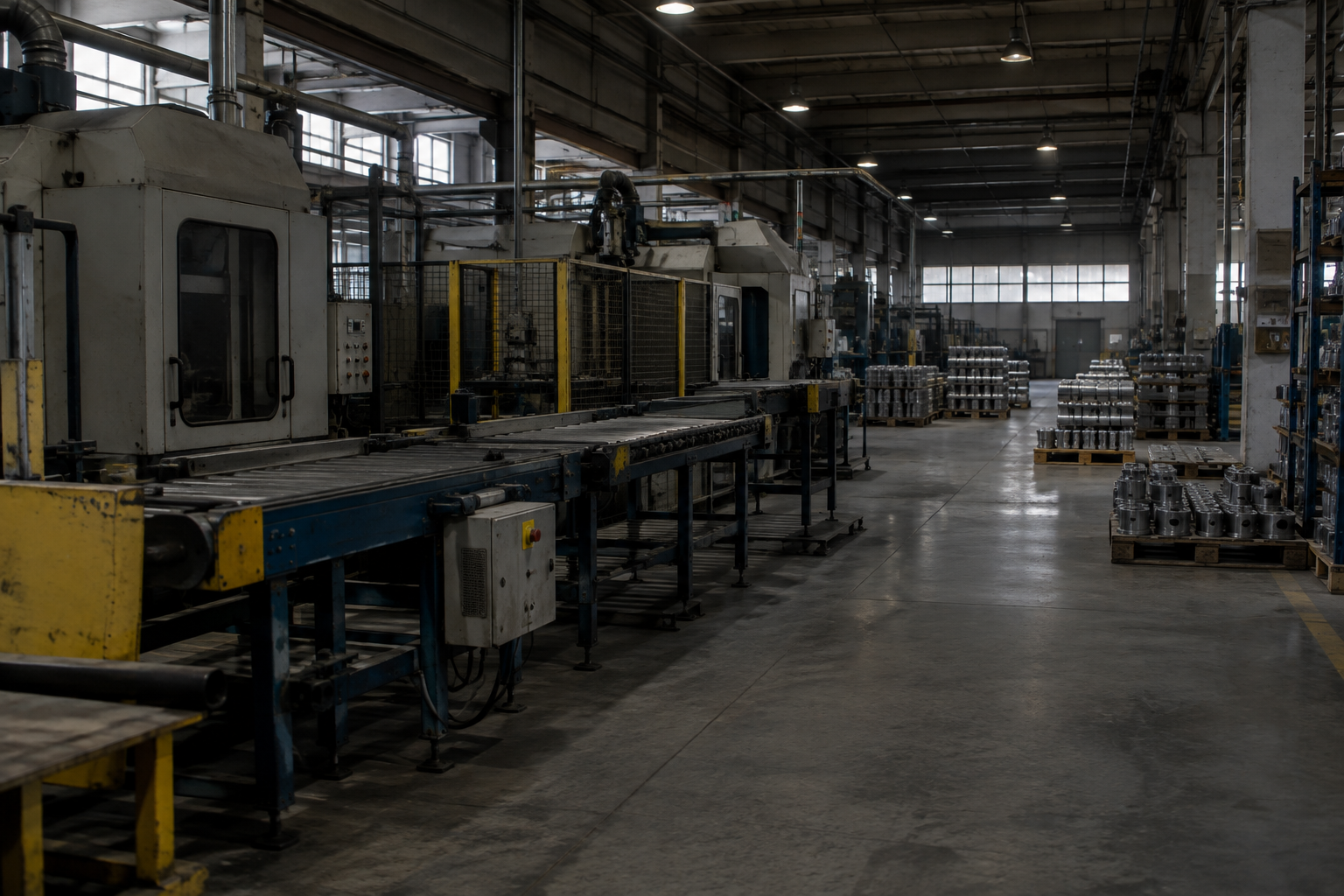
- 01Italy's seasonally adjusted industrial production index fell 1.0% month-on-month in June 2026, with the calendar-adjusted reading down 0.6% year-on-year.
- 02A partial rebound of +0.7% was recorded in July 2026 on a monthly basis, though the calendar-adjusted index was flat versus July 2025.
- 03The second quarter of 2026 showed a quarterly gain of +0.4%, but the three-month moving average through July was still -0.1% versus the prior three months.
- 04ISTAT's 2026 Competitiveness Report flags new U.S. tariff policies — comparable in scope to 1930s measures — as a fresh external shock on top of the pandemic and the energy crisis.
Italy's industrial production has been mired in a prolonged contraction since its post-pandemic peak in 2022, with the seasonally adjusted index recorded by the Istituto Nazionale di Statistica (ISTAT) falling 1.0% month-on-month in June 2026 — the latest in a sequence of readings that underscores the structural fragility of the country's manufacturing base. A modest recovery of +0.7% in July 2026 offered only partial relief, leaving the calendar-adjusted index flat versus July 2025.
The persistence of the downturn matters well beyond Italy's borders: manufacturing accounts for a significant share of the country's value added, and the FTSE MIB (INDEX:FTSEMIB) — home to several large industrial and capital-goods groups — remains sensitive to shifts in the sector's output trajectory. For investors tracking the EUR/USD (EURUSD) pair, a weakening Italian industrial base adds to the broader euro-area growth concerns that have weighed on the single currency.
What happened
ISTAT's monthly industrial production survey shows that Italian manufacturing output has been on a downward trend since the cyclical high reached in 2022, following the sharp post-pandemic rebound of 2021. The index is published on a base of 2021=100, a rebasing introduced in March 2024 that also updated the calculation methodology to annual chain-linked indices, with 2023 as the weighting reference year.
The most recent data points paint a mixed but still-weak picture:
- June 2026: seasonally adjusted index −1.0% month-on-month; calendar-adjusted index −0.6% year-on-year (21 working days vs. 20 in June 2025); unadjusted index +2.4% year-on-year.
- May 2026: seasonally adjusted index −0.3% month-on-month; calendar-adjusted index +1.1% year-on-year (20 working days vs. 21 in May 2025); unadjusted index −1.9% year-on-year.
- April 2026: seasonally adjusted index +0.5% month-on-month; calendar-adjusted index +1.3% year-on-year.
- July 2026: seasonally adjusted index +0.7% month-on-month; calendar-adjusted index unchanged year-on-year; unadjusted index unchanged year-on-year.
- Q2 2026 vs. Q1 2026: average quarterly change +0.4%, a first positive quarterly reading after several quarters of contraction.
- Three-month average May–July 2026 vs. prior three months: −0.1%, confirming that the recovery remains fragile.
How did output break down by category?
The June 2026 breakdown by end-use category reveals that the weakness was broad-based. According to ISTAT's release, the seasonally adjusted monthly index rose only for energy (+0.8%), while it fell for consumer goods (−0.7%), intermediate goods (−0.9%) and — most sharply — capital goods (−2.1%). The decline in capital goods is particularly significant because it signals that Italian firms are pulling back on investment in productive capacity.
July 2026 showed a reversal of that pattern: energy was the only category to contract (−0.9%), while consumer goods (+2.1%), intermediate goods (+0.5%) and capital goods (+0.2%) all posted monthly gains — though the gains were modest and the three-month trend remained slightly negative.
The longer arc: from post-pandemic peak to structural concern
ISTAT's sector-level data, covering the period from 2013 to 2025 on a seasonally adjusted basis, show that Italian manufacturing entered a recessionary phase — marked by shaded areas in the institute's own charts — after the 2022 peak. The series, which also covers 2010–2022, illustrates how the sector never fully recovered to pre-2008 levels before the pandemic struck, making the post-2022 slide a compounding of two incomplete recoveries.
The 2026 edition of ISTAT's Report on the Competitiveness of Productive Sectors — the fourteenth edition — places the current weakness in a broader context of successive external shocks: the pandemic, the Russian energy crisis, and now new U.S. tariff policies that the report describes as comparable in scope and intensity to the measures adopted in the 1930s. The report notes that these shocks have "increasingly affected the Italian production system in recent years," compressing margins and dampening investment.
Why it matters
Italian manufacturing is not a peripheral concern for European markets. The sector's structural health feeds directly into the country's fiscal trajectory, its export competitiveness and the earnings of the large industrial groups listed on the FTSE MIB. A prolonged contraction in output — even one punctuated by occasional monthly rebounds — erodes the tax base, pressures employment and reduces the economy's capacity to grow out of its debt burden.
For the euro area as a whole, Italy's industrial weakness adds to similar signals from Germany, reinforcing the narrative of a manufacturing bloc under structural stress. That narrative has been a persistent drag on the EUR/USD exchange rate, as markets price in a wider growth differential between the euro area and the United States.
ISTAT's competitiveness report underlines that the new U.S. tariff regime represents a fresh headwind for Italian exporters, whose goods — from machinery to fashion to food — face a more hostile trade environment than at any point since the interwar period.
Risks and counterpoints
The data are not uniformly negative. The quarterly gain of +0.4% in Q2 2026 versus Q1 2026 is the first positive quarterly reading in several quarters and could mark the beginning of a stabilisation. April's monthly rise of +0.5% and July's +0.7% suggest that the index is not in free fall, and the calendar-adjusted year-on-year readings for April and May were both positive.
However, the three-month moving average through July — still slightly negative at −0.1% — cautions against reading too much into individual monthly prints. Working-day distortions also complicate year-on-year comparisons: June's unadjusted index rose 2.4% year-on-year partly because June 2026 had one more working day than June 2025, while May's unadjusted index fell 1.9% year-on-year partly for the opposite reason. The calendar-adjusted figures, which strip out this effect, remain the more reliable guide to underlying momentum.
On the structural side, ISTAT's competitiveness report points to the energy intensity of Italian manufacturing — particularly in chemicals, pharmaceuticals, rubber and plastics, and non-metallic minerals — as a persistent vulnerability in an era of elevated and volatile energy costs. The vertical integration ratio (value added as a share of turnover) and the concentration ratio (CR5) vary significantly across sub-sectors, meaning that the aggregate index masks divergent fortunes at the industry level.
What to watch next
The following releases and events will be key to assessing whether Italian industrial production is stabilising or resuming its downward trend:
- 30 September 2026: ISTAT is scheduled to publish the industrial production data for August 2026, which will provide the first reading of Q3 2026 and a cleaner year-on-year comparison given the flat July base.
- Q3 2026 quarterly average: the three-month change for July–September versus April–June will be the decisive test of whether the Q2 stabilisation is holding.
- U.S. tariff developments: any escalation or de-escalation of the tariff measures flagged in ISTAT's competitiveness report will directly affect Italian export orders, particularly in machinery and consumer goods.
- Energy prices: given the high energy intensity of key Italian manufacturing sub-sectors, movements in European gas and electricity prices remain a primary cost driver to monitor.
- ISTAT methodology updates: the institute updates its calculation base periodically; the next methodological revision could affect the comparability of the series.
Sources:istat.itistat.itistat.itistat.itistat.itistat.itistat.itistat.itistat.itistat.itistat.it
UCapital Asset Management LLP or group companies may have commercial relationships with the companies mentioned. This content is not financial advice.
Sign up for free to ask the AI about this article.
Growth, inflation and rates across the major economies, with the impact on your business.