
China property crisis: Vanke nears restructuring as Country Garden and Sunac rework debt
China's property sector is moving from default to restructuring, with developers' debt deals, softer home-price declines and policy easing reshaping the outlook for growth, iron ore and investors.

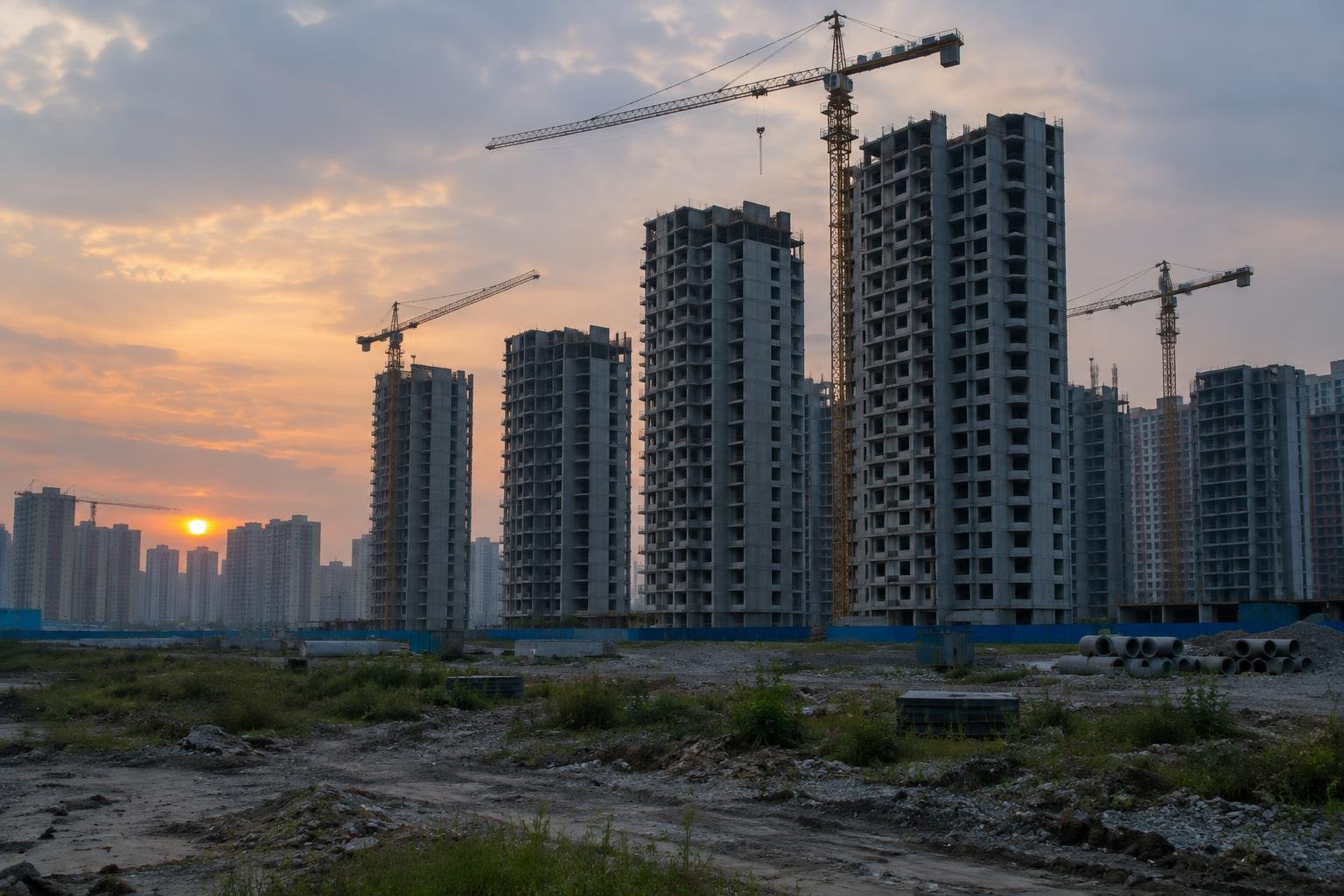
- 01China Vanke (000002.SHE) was preparing a debt restructuring plan at the request of authorities, according to a Bloomberg-reported account dated 8 January 2026; its next report is due on 29 October
- 02Country Garden (2007.HK) said on 14 November 2025 it would issue about US$13 billion of bonds in its offshore restructuring, which could cut more than US$11 billion of debt.
- 03New home prices in 70 cities fell 0.14% from August, after a 0.17% slide in August, according to National Bureau of Statistics figures.
- 04China's iron ore stockpiles hit a record 163.3 million tonnes, up 25% since August, as property demand cooled, according to a report dated 8 March 2026.
China Vanke (000002.SHE), one of the country's largest developers, was preparing a debt restructuring plan at the request of authorities as of 8 January 2026, pushing it closer to default. Its latest reported quarter showed EPS of -0.76 and revenue of 45.25 billion against an estimate of 45.76 billion.
The China property crisis is now a restructuring story rather than a single-default story. Country Garden (2007.HK) and Sunac have reworked offshore debt, while home-price declines have eased, but weak demand is still reaching commodities such as iron ore and the wider outlook for Chinese growth and global investors.
What happened
China Vanke Co. (000002.SHE), one of the country's largest developers, is preparing a debt restructuring plan at the request of authorities, according to people familiar with the matter cited in a report dated 8 January 2026. The request pushes the company closer to default. Vanke had been one of the few major Chinese property companies to avoid a debt failure until then.
Authorities recently asked Vanke to accelerate its overhaul and submit the plan as soon as possible. The step shows that pressure on the sector has reached a developer that had so far held back from default.
What else changed in the sector?
On 14 November 2025, Country Garden, once China's largest homebuilder, said it would issue bonds worth about US$13 billion as part of its offshore debt restructuring. According to the company, the plan could cut more than US$11 billion in debt if fully implemented. It follows creditor approval earlier that month.
The two cases point to a sector where restructuring has become the main route for troubled developers. Country Garden's plan relies on instruments that convert into equity over time, which the company's filing says will significantly dilute existing shareholders while giving creditors a path to recovery.
Which figures define the latest developments?
- Vanke: restructuring plan being prepared at the request of authorities, as of 8 January 2026.
- Vanke's latest reported quarter: EPS of -0.76, in line with the estimate of -0.76, and revenue of 45.25 billion against an estimate of 45.76 billion.
- Country Garden: bonds of about US$13 billion announced on 14 November 2025.
- Country Garden: potential debt reduction of more than US$11 billion if the plan is fully implemented, according to the company.
- Country Garden: shareholder and regulatory approvals pending, with completion targeted by the year-end.
Vanke's revenue came in below the published estimate in its latest quarter, while its loss per share matched expectations. Its trailing price-to-earnings ratio stands at -0.48, reflecting the negative earnings.
How did the China property crisis begin and evolve?
The China property crisis began in 2021, when an unprecedented liquidity crisis hit the sector after the collapse of China Evergrande Group, and it has since evolved from a wave of defaults into a long process of debt restructuring. A string of Chinese developers defaulted on offshore payment obligations, a shock that roiled global markets.
Country Garden (2007.HK), once China's largest homebuilder, then came under mounting liquidity stress as home sales weakened and funding channels tightened. The sector's turmoil, triggered by Evergrande's collapse, set the pattern for the years that followed.
What were the key restructuring milestones?
Sunac China Holdings (1918.HK) became the first major developer to win creditor approval for an offshore restructuring. Creditors holding 98.3% of the total value of the voting scheme backed its US$9 billion plan, according to the company's filing with the Hong Kong Stock Exchange. Under the plan, part of the debt would be exchanged into convertible bonds backed by its Hong Kong-listed shares, along with new notes maturing in two to nine years.
Sunac's interim results showed first-half revenue up 20.5% to 58.5 billion yuan, while losses narrowed 18.1% to 15.4 billion yuan. Shortly after the approval, the company filed for Chapter 15 protection in the United States, on 19 September 2023.
The first deal did not close the chapter. On 17 April, Sunac said it had reached an agreement with key creditors on an offshore debt restructuring plan, becoming the only Chinese developer to pursue a second such overhaul.
How do the milestones line up?
- 2021: an unprecedented liquidity crisis hits the sector, with Evergrande's collapse at its centre.
- March 2023: Sunac agrees with a group of offshore creditors to restructure US$9 billion of debt.
- 18 September 2023: creditors holding 98.3% of the voting value approve the plan; a Hong Kong court hearing was scheduled for 5 October.
- 19 September 2023: Sunac files for Chapter 15 protection in New York.
- 17 April: Sunac announces a second offshore restructuring agreement with key creditors.
The pattern is that approvals brought respite but not a recovery. As Reuters-reported analysis from September 2023 put it in substance, the outlook remained clouded by uncertainty over home sales, even as Sunac shares surged as much as 14% on the day of the approval.
How are Country Garden, Sunac and other developers restructuring debt?
Chinese developers are restructuring debt mainly by swapping offshore claims into longer-dated or equity-linked instruments, with Country Garden Holdings (2007.HK) the largest example. On 14 November 2025 the company said it would issue bonds worth about US$13 billion as part of its offshore debt restructuring. According to its filing, the plan could cut more than US$11 billion in debt if fully implemented.
What does Country Garden's plan contain?
The package is built around zero-coupon mandatory convertible bonds in three tranches:
- MCB A: US$7.5 billion, for scheme consideration payments;
- MCB B: US$5.4 billion, for additional creditor settlements;
- MCB C: US$39.5 million, to resolve a bilateral loan.
The restructuring also includes warrants and new shares. The conversion price is set well above the current share price, and the instruments convert into equity over time, which would significantly dilute existing shareholders while giving creditors a path to recovery. Shareholder and regulatory approvals were pending, with completion targeted by the end of 2025.
How do Sunac, Shimao and Sino-Ocean compare?
Sunac China Holdings (1918.HK) set the template in 2023. Creditors holding 98.3% of the voting value approved its US$9 billion offshore plan on 18 September 2023, under which part of the debt was exchanged into convertible bonds backed by its Hong Kong-listed shares, along with new notes maturing in two to nine years. It later became the only Chinese developer to pursue a second such overhaul, after reaching an agreement with key creditors on 17 April.
Shimao Group, on 25 March 2024, laid out a proposal to restructure all of its debt, around US$11.7 billion in offshore notes, bonds and other credit facilities.
Not every plan gathers support quickly. On 21 August 2024, two sources with direct knowledge said the US$5.64 billion offshore plan of state-backed Sino-Ocean Group (3377.HK) had backing from less than 30% of creditors, and the company faced a liquidation hearing the following month.
The pattern is consistent: creditors are offered equity-linked paper and extended maturities rather than cash. The cost falls on shareholders through dilution, and the outcome still depends on a recovery in home sales that has yet to be confirmed.
Are home prices still falling?
Home prices in China are still falling, but the pace of decline has eased. New home prices in 70 cities, excluding state-subsidized housing, dropped 0.14% from August, according to figures from the National Bureau of Statistics, after sliding 0.17% in August.
The narrower fall is what prompted talk of recovery. The data show a market that is still contracting month on month, only more slowly, and a slowdown in the decline is not a return to growth.
What do the latest price figures show?
- New home prices in 70 cities, excluding state-subsidized housing: -0.14% from August.
- The previous reading, for August: -0.17%.
The gap between the two readings is only 0.03 percentage points. That is a small improvement against a long run of declines, and the sources do not say whether it marks a turning point.
How are developers' results reflecting the weak market?
Developer earnings show the same pressure. Country Garden (2007.HK) reported EPS of -0.43 and revenue of 50.86 billion (reporting currency) for its latest reported quarter, with a trailing price-to-earnings ratio of 0.33. The loss comes even as the company moves forward with the offshore debt restructuring announced on 14 November 2025.
China Vanke (000002.SHE) shows a similar picture. Its latest reported quarter had EPS of -0.76, in line with the estimate of -0.76, and revenue of 45.25 billion against an estimate of 45.76 billion. Its trailing P/E is -0.48, a sign that the company is loss-making.
What are the risks to a price recovery?
Easing price declines do not by themselves repair developers' finances. Restructured private developers face a fresh liquidity squeeze this year as the property market remains weak, according to the sector reporting on their position. Weak home sales reduce the cash that developers need to repay creditors and finish projects.
The next data point for Vanke is its report due on 29 October 2026, which will show whether losses and revenue are moving in the same direction as the price figures. Until monthly price readings turn positive, the evidence points to a market that is stabilising in pace rather than in level.
What has Beijing done to support the market?
Beijing has answered the property slump mainly with cheaper credit and looser mortgage rules, aimed at reviving demand rather than rescuing individual developers. The measures that the sources document are a relaxation of mortgage-rate floors and a cut in the benchmark lending rate.
Which mortgage measures has the central bank allowed?
The People's Bank of China said on 30 September that Chinese local governments may relax the floor on mortgage rates for first-time home buyers in some cities, in phases. The stated aim was to prop up property prices and revive what the report called a flagging engine of the world's second-largest economy. The decision leaves the choice to city authorities, so the effect depends on how many of them use the room they were given.
How far has monetary policy been eased?
On 22 July 2024, China cut its market-based benchmark lending rate, in line with market expectations, as authorities stepped up monetary support to shore up the economy. According to the National Interbank Funding Center, the one-year loan prime rate (LPR) fell to 3.35% from 3.45%. The over-five-year LPR, on which many lenders base their mortgage rates, was lowered by 10 basis points to 3.85%.
- 30 September: mortgage-rate floor for first-time buyers may be relaxed by local governments, in phases.
- 22 July 2024: one-year LPR cut to 3.35% from 3.45%.
- 22 July 2024: over-five-year LPR cut by 10 basis points to 3.85%.
Has support been enough?
The sources show that policy has coincided with a slower decline in prices rather than a clear turnaround. New home prices in 70 cities, excluding state-subsidized housing, fell 0.14% from August, after a 0.17% slide in August, according to the National Bureau of Statistics. That is a smaller drop, but still a decline.
Developers also remain under pressure. Private companies that have already restructured their debt are facing a fresh liquidity squeeze this year as the property market stays weak, and authorities asked China Vanke in early 2026 to accelerate its own restructuring plan. Rate cuts lower the cost of buying a home, yet the sources do not show that they have restored sales volumes.
What does it mean for iron ore and growth?
China's property slump is reaching iron ore and the wider growth outlook mainly through weaker steel-making demand, with stockpiles of the raw material at a record. The amount of iron ore awaiting processing in China has jumped 25% since August to a record 163.3 million tonnes, as cooling property sector demand flows through to miners, according to a report updated on 8 March 2026.
The build-up matters beyond Beijing. Iron ore is Australia's biggest export earner, and the record stockpiles have stoked concerns about the budget revenues that flow from it. The same report notes that Beijing has revived its dispute over pricing with mining giant BHP.
Is this a new pattern for iron ore?
The weakness is not new. On 28 February 2024, iron ore prices, long resilient despite China's gloomy economic outlook, had tumbled since the end of the Lunar New Year holiday, sparking concerns about faltering demand.
The two data points, two years apart, show a market that held up for a long time and then began to register the property downturn:
- 28 February 2024: prices fell after the Lunar New Year holiday on demand concerns.
- 8 March 2026: stockpiles at a record 163.3 million tonnes, up 25% since August.
What does it mean for Chinese growth?
The sources give no growth forecast, so the link to the broader economy rests on the sector's role as a demand engine. In September 2021, China's central bank described housing as a flagging engine of the world's second-largest economy when it said local governments could relax mortgage-rate floors for first-time buyers in some cities. Stockpiles piling up at ports and mills indicate that construction activity is not absorbing raw materials at the pace it once did.
Easing price declines offer a partial counterweight: new home prices in 70 cities fell 0.14% from August, after a 0.17% slide in August, which feeds hopes of a recovery. A stabilising housing market would eventually be needed to reduce the inventory overhang, but the sources do not say when that could happen.
Why it matters
The China property crisis matters because restructuring has not ended the strain on the sector: Chinese private developers that have already reworked their debt are facing a fresh liquidity squeeze this year as the property market stays weak. That finding undercuts the idea that a completed debt deal marks the bottom, and it shapes how creditors, shareholders and exporters of raw materials assess the sector.
Who bears the cost of the restructurings?
Creditors and shareholders carry the first burden. Country Garden's plan, set out in a filing on 14 November 2025, could cut more than US$11 billion of debt if fully implemented, according to the company. Its zero-coupon mandatory convertible bonds convert into equity over time, which the company's own terms show will significantly dilute existing shareholders while offering creditors a path to recovery.
The terms also show how recovery depends on future share values. The conversion price for the bonds is set well above the share price at the time of the filing, so creditors' outcome rests on a rebound that weak home sales have yet to deliver.
Why do commodity exporters feel it?
The effects reach beyond developers. China's iron ore stockpiles hit a record 163.3 million tonnes, up 25% since August, as cooling property demand flowed through to miners, according to data reported on 8 March 2026. That build-up has raised concerns about the budget revenues Australia draws from its largest export earner, with Beijing also reviving a pricing dispute with mining group BHP.
What are the risks to the picture?
Several uncertainties remain:
- Country Garden still needs shareholder and regulatory approvals, with completion targeted by the end of the year.
- Developers that have restructured once can return to stress, as the renewed liquidity squeeze among private builders shows.
- Home-price declines have eased, but a slower fall is not yet a recovery in demand.
For global investors, the lesson of the current phase is that debt relief and demand recovery are separate steps. The first has advanced through creditor agreements; the second, as stockpiles and developer liquidity indicate, has not yet arrived.
What to watch next
The next dated catalyst for China's property restructuring is the earnings report of China Vanke (000002.SHE), scheduled for 29 October 2026. The release will show whether the developer's losses are narrowing while authorities push it to overhaul its debt.
What will the Vanke results show?
In its latest reported quarter, Vanke posted EPS of -0.76, in line with the estimate of -0.76, and revenue of 45.25 billion against an estimate of 45.76 billion. Its trailing price-to-earnings ratio stands at -0.48, reflecting the losses. The report will be read against the restructuring plan that, as of 8 January 2026, Vanke was preparing at the request of authorities, according to people familiar with the matter.
Which approvals are still pending at Country Garden?
Country Garden (2007.HK) still needs shareholder and regulatory approvals for its offshore debt restructuring, with completion targeted by the end of the year, according to the company's filing of 14 November 2025. The plan could cut more than US$11 billion in debt if fully implemented, the company said. Its mandatory convertible bonds are set to convert into equity over time, which would significantly dilute existing shareholders.
- 29 October 2026: next Vanke earnings report.
- Vanke's latest quarter: revenue of 45.25 billion versus an estimate of 45.76 billion.
- Year-end target: completion of Country Garden's restructuring, subject to shareholder and regulatory approvals.
- Country Garden's latest quarter: EPS of -0.43 and revenue of 50.86 billion.
What are the risks around these dates?
Restructuring has not ended the strain on the sector. Private developers that have already restructured their debt are facing a fresh liquidity squeeze as the property market stays weak, according to a report from Shanghai. Any delay in approvals, or a weaker-than-expected Vanke quarter, would show how fragile that recovery remains.
The monthly price data for 70 cities is the other indicator to follow. The latest reading showed new home prices falling 0.14% from August, after a 0.17% decline in August, a slowdown that has fed hopes of a recovery but not yet a clear reversal.
Sources:UCapital Markets (ucapital.com)UCapital Markets (ucapital.com)asia.nikkei.combloomberg.comreuters.combloomberg.combusinesstimes.com.sgbusinesstimes.com.sgreuters.combusinesstimes.com.sgreuters.comenglish.www.gov.cnreuters.comafr.comcnn.comreuters.com
UCapital Asset Management LLP or group companies may have commercial relationships with the companies mentioned. This content is not financial advice.
Sign up for free to ask the AI about this article.
Multiples, financials, sentiment and risks in 60 seconds, with live data.