
Urban megaprojects investment: Xiong'an tops 670 billion yuan as Saudi giga-projects face a funding squeeze
State-backed city projects from Xiong'an to NEOM are being financed in very different ways, and the gap between announced and delivered money is now a central risk. Saudi Arabia is turning to private capital as China builds a fund ecosystem.

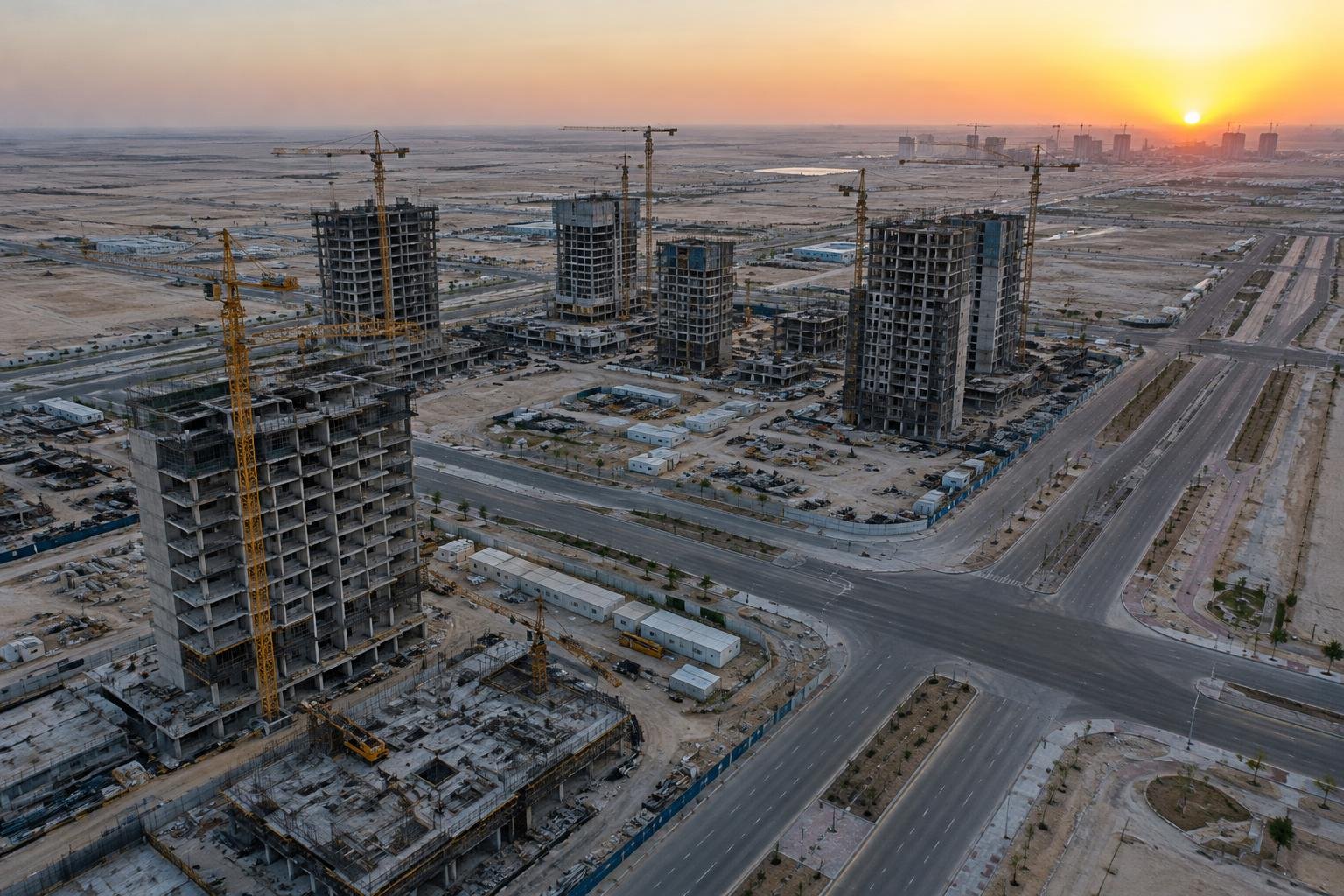
- 01Xiong'an New Area in China has drawn total investment of over 670 billion yuan ($92.62 billion) in seven years, according to a Hebei government statement.
- 02A 2017 estimate put potential Xiong'an investment at as much as 2.4 trillion yuan ($348 billion) over a decade, a projection rather than spending.
- 03Saudi Arabia's Investment Minister Khalid Al Falih said on 28 October 2025 that the government and the Public Investment Fund intend to step back and let private capital fund giga-projects, aiming
- 04Xiong'an has set up a 10 billion yuan industrial fund and a 10 billion yuan venture fund, which have invested in 27 companies as of May 2026.
China's Xiong'an New Area has attracted total investment of more than 670 billion yuan ($92.62 billion) in seven years, according to a Hebei government statement, while Saudi Arabia is moving to bring private money into its giga-projects, including NEOM, as the state steps back.
The two cases show how differently governments and sovereign wealth funds now finance new districts. For investors, the key question is the distance between what is announced, what is allocated and what is actually built, because that gap drives financial risk.
What happened
Two financing models for new urban districts emerged in the same news cycle: Xiong'an New Area in China reported cumulative investment of more than 670 billion yuan ($92.62 billion) after seven years, while Saudi Arabia said it wants private capital to carry more of its giga-projects. The first is a state-driven build-out that has already moved from blueprint to reality, according to the Hebei government. The second is a shift in who pays.
What did Xiong'an report?
According to the Hebei provincial government, Xiong'an has gone from a plan to a functioning district over the past seven years. The figure it cites is total investment, and the statement does not break that sum down into public and private money. That distinction matters when comparing the amount spent with the amounts announced for the area.
What did Saudi Arabia say?
Saudi Arabia's Investment Minister Khalid Al Falih, speaking at the Future Investment Initiative summit in Riyadh on 28 October 2025, said the government and the Public Investment Fund (PIF), the kingdom's sovereign wealth fund, intend to step back and let private-sector funding take a larger role in the giga-projects. The stated aim is completion by 2030, in line with the Vision 2030 plan.
The two announcements point in different directions. Beijing is reporting capital already deployed, while Riyadh is describing how it expects future funding to be sourced.
The key facts at a glance
- Xiong'an: total investment above 670 billion yuan ($92.62 billion) over seven years, per the Hebei government.
- Saudi Arabia: the government and PIF to step back and open the giga-projects to private funding, per Investment Minister Khalid Al Falih on 28 October 2025.
- Saudi timeline: completion of the giga-projects targeted by 2030.
- Common thread: both cases concern state-initiated districts whose financing is now being rebalanced toward other sources of capital.
Details of how much private money Saudi Arabia expects, and on what terms, were not given in the minister's remarks as reported. Nor does the Xiong'an statement say how much of the 670 billion yuan came from the private sector.
How big is Xiong'an and how is it financed?
Xiong'an New Area, the Chinese government's planned city in Hebei province, is one of the largest state-led urban projects in the world, financed through a mix of public capital and government-backed investment funds. Its scale was flagged early: a 2017 estimate said the project could draw as much as 2.4 trillion yuan ($348 billion) of investment over a decade.
How large were the original projections?
The 2017 estimate also said Xiong'an could add as much as 0.4 percentage point to China's economic growth. It described the project as potentially the largest infrastructure undertaking in the history of modern China. These were projections of potential investment, not committed or spent funds, and they should be kept apart from the 670 billion yuan the Hebei government reports as total investment over seven years.
Which funds back the area's industries?
Xiong'an's own funding vehicles are small next to the headline totals, but they are aimed at specific industries. According to an announcement from the area's authorities on 24 May 2026, a batch of 10 fund-backed projects was signed on 23 May at the fourth Science, Talent and Innovation Week. The projects focus on aerospace information and satellite internet, artificial intelligence, and modern life sciences and biotechnology.
The area uses a "parent fund plus direct investment" model, according to the same announcement. It aims to attract domestic and foreign capital into strategic emerging industries.
- 2.4 trillion yuan ($348 billion): the 2017 estimate of potential investment over a decade, a projection.
- 10 billion yuan: the Xiong'an industrial investment fund.
- 10 billion yuan: the Xiong'an venture capital fund.
- 27 companies: the cumulative number of firms the funds had invested in as of 23 May 2026.
- 10 billion yuan: the first-phase size of the fund set up in February 2023 to support the relocation of central state-owned enterprises.
What is the central-enterprise fund for?
The Hebei Xiong'an central-enterprise relocation investment fund was established in February 2023 by the Hebei Xiong'an industrial investment guide fund and China Xiong'an Group's fund management company. According to the announcement, it backs equity diversification and mixed-ownership reform at central state-owned enterprises and their subsidiaries that fit the area's industrial plans. Its stated purpose is to help Xiong'an become the main destination for functions relocated from Beijing.
What is Beijing doing to attract private capital?
Beijing is trying to draw private capital into Xiong'an New Area by using government money as leverage: an implementation plan dated 20 April 2026 sets out a system built on the principle of "government-guided, market-run, diversified supply" of funds and resources. The plan comes from the area's reform and development bureau and aims to strengthen confidence among private investors.
How do special bonds and guide funds fit in?
The plan's first measure relies on the area's special government bonds, which Xiong'an can review and issue on its own. It explores a mechanism linking those bonds to private investment, so that private firms can take part in projects with cash, technology or equipment, in construction and in operation. The plan says this must respect the revenue-balance rule for bond financing and keep debt-repayment risk under tight control.
The second measure rests on the area's industrial investment guide fund and its technology-innovation equity fund, described as a "dual-engine" approach. Private capital is encouraged to join in setting up sub-funds covering the seed, start-up and growth stages. These are meant to target the three leading industries named in the plan: aerospace information and satellite internet, artificial intelligence, and new materials. Low-altitude economy, computing networks and green energy are also listed.
Is Xiong'an open to foreign capital?
Xiong'an has also opened a door to foreign investors. Interim measures published on 26 April 2021 and effective the same day created a pilot for foreign-invested equity investment enterprises in the area. They cover both management firms and the funds themselves, which may raise foreign-currency or yuan money privately from investors. Such funds may invest in unlisted domestic companies, privately placed shares, convertible bonds and market-based debt-for-equity swaps.
The measures cite central government guidance on deepening reform and opening up Xiong'an, and say the aim is to promote international capital's participation in building the area and to protect investors' legal rights.
What is still unclear?
The documents describe mechanisms rather than amounts. The April 2026 plan, as presented, gives no figure for how much private money the bonds or sub-funds are expected to attract. Nor do the sources show how much foreign capital has entered under the 2021 pilot, so the results of these channels cannot yet be measured.
Are Saudi giga-projects being scaled back?
Saudi Arabia's giga-projects are being scaled back in ambition and funding, according to reports on the kingdom's spending, although the government frames the shift as a change in who pays rather than a retreat. The reported picture combines lower-than-requested budgets, a writedown at the sovereign wealth fund and a stated plan to bring in private capital.
What do the reports say about funding?
A Bloomberg-reported theme, under the headline on the kingdom's trillion-dollar makeover, was that projects such as NEOM were said to receive lower funding than they had requested. The same material pointed to a scaled-back Trojena ski resort, one of the NEOM components. It also noted that Saudi Arabia had forecast budget deficits until at least 2026.
A separate report referred to an $8 billion writedown in megaprojects at the Public Investment Fund (PIF), the sovereign wealth fund that anchors the programme. The material available does not detail which projects the writedown covers, nor the period in which it was booked, so the figure should be read as a reported loss in value rather than money spent.
Is the state stepping back by design?
On 28 October 2025, Saudi Arabia's Investment Minister Khalid Al Falih told the Future Investment Initiative conference in Riyadh that the government and the PIF intend to step back and let private sector funding finance the giga-projects. The stated aim is completion by 2030, in line with the Vision 2030 plan.
The sequence matters for how risk is read. Reduced public allocations, a reported writedown and an invitation to private investors all point the same way: the share of the bill carried by the state is meant to fall. What the sources do not show is how much private money has been committed, on what return terms, or how much of the announced total has been delivered.
What remains uncertain?
- The gap between requested and allocated funding for NEOM, which the reports describe only as lower than requested.
- The scope and timing of the $8 billion writedown.
- Whether private capital arrives at the scale needed to meet the 2030 completion aim.
Those open points are where the distinction between announced, allocated and delivered spending bears most directly on financial risk in the kingdom's new districts.
How does Singapore's model differ?
Singapore's Urban Redevelopment Authority (URA) differs from Xiong'an and the Saudi giga-projects in one respect the sources make explicit: it works as the main government land sales agent, selling sites to attract and channel private capital into development that supports planning, economic and social goals. The state sets the plan and releases the land, and private developers put up the money for the sites.
That is a different division of labour from the models described elsewhere in this piece. In Xiong'an, public funds and guide funds lead; in Saudi Arabia, the Public Investment Fund has carried the giga-projects until now. In Singapore, the authority's stated role is to channel private capital to planned sites.
How long does Singapore plan its districts?
Singapore plans on horizons of one to two decades. On 13 March 2004, the Minister for National Development, Mah Bow Tan, announced in Parliament that the Downtown at Marina Bay would be the country's key focus for development in the next 15 to 20 years. The announcement set a long timeline for the district and named the authority as the body to implement the plans.
The same approach reaches into existing neighbourhoods. In a parliamentary speech on 3 March 2011, Mah Bow Tan described the estate renewal programmes meant to keep Singapore's heartlands relevant and sustainable, and called the Remaking Our Heartland programme the most comprehensive of them.
What does the model mean for risk?
The sources do not give figures on how much private capital the land sales have raised, so the scale of the model cannot be measured here. What they do show is the structure: a public agency plans, sells land and sets the pace, while investors commit capital site by site.
- Planning and land release: the state, through the URA
- Site development funding: private capital attracted through land sales
- Horizon for Marina Bay: 15 to 20 years from March 2004
Compared with funds that finance whole districts directly, this structure places the cost of building on the buyers of each site rather than on a central fund. That is the contrast with the funding squeeze reported for the Saudi projects.
What are the risks and counterpoints?
The main risk in urban megaprojects is the gap between what is announced and what is actually funded and built, and the sources show that gap in both Xiong'an and Saudi Arabia. Headline numbers describe ambition, not cash already spent, so each figure needs its date and its origin.
Is a projection the same as spending?
No. A 2017 estimate said Xiong'an New Area could attract as much as 2.4 trillion yuan ($348 billion) over a decade and add up to 0.4 percentage point to China's economic growth. That was a forecast of potential investment. The figure later reported by the Hebei government, over 670 billion yuan ($92.62 billion) after seven years, is a statement of total investment received, and it is a different kind of number.
The two figures should not be set side by side as if they measured the same thing. The sources do not say how much of the 2017 estimate has been met, nor how the 670 billion yuan splits between public and private money.
What do funding cutbacks mean for Saudi giga-projects?
Saudi funding has been reported below what projects requested. Projects such as NEOM were said to receive lower-than-requested funding, and Saudi Arabia had forecast budget deficits until at least 2026. A separate report referred to an $8 billion writedown in megaprojects at the Public Investment Fund.
Against that background, the investment minister's call on 28 October 2025 for the state and the fund to step back and let private capital in, with completion aimed for 2030, shifts part of the financing burden. Whether it also shifts the risk depends on the terms on which private investors take part.
Will private capital fill the gap?
That remains unproven. Xiong'an's April 2026 plan seeks to use special bonds to draw in private investment, while stressing that debt-repayment risk must be tightly controlled and that bond-funded projects must balance their revenue. The wording acknowledges that leverage cuts both ways.
The sources do not quantify the returns that private investors would require in either country, nor the share of projects that have been completed. Without those data, any claim about the pace of delivery rests on official aims, not on results.
Why it matters
The financing mix behind a new district, whether state-led or privately funded, decides who absorbs cost overruns and debt risk when plans slip. Xiong'an New Area and Saudi Arabia's giga-projects sit at opposite ends of that spectrum, and the sources show how each is shifting.
In Saudi Arabia, Investment Minister Khalid Al Falih said at the Future Investment Institute conference in Riyadh on 28 October 2025 that the government and the Public Investment Fund (PIF) intend to step back and let private sector funding into the giga-projects, aiming for completion by 2030. If that shift happens, part of the construction and revenue risk moves from the state to private backers. Whether investors accept it depends on returns that the sources do not quantify.
How does Xiong'an handle the same risk?
Xiong'an keeps the state at the centre while seeking private money alongside it. An implementation plan published on 20 April 2026 describes a system built on government guidance, market operation and diversified supply. It uses special bonds, which it says must respect revenue-and-cost balance and keep repayment risk under strict control, to draw in private investment.
The same document points to guide funds that encourage social capital to set up sub-funds. In this model public money acts as a lever, but the debt behind special bonds remains a public liability.
Why the announced-allocated-built gap matters
The sources give three different kinds of figures, and they are not interchangeable:
- Estimated: a 2017 projection that Xiong'an could attract as much as 2.4 trillion yuan ($348 billion) over a decade.
- Reported as invested: more than 670 billion yuan ($92.62 billion) over seven years, according to a Hebei government statement.
- Committed to funds: 10 billion yuan each in the industrial and venture funds, which had invested in 27 companies as of May 2026.
Set side by side, the figures show why an investor reading a headline number needs to know whether it is a forecast, a commitment or money already spent. Saudi Arabia illustrates the same point: projects such as NEOM were said to receive less funding than requested, while the kingdom had forecast budget deficits until at least 2026. Tighter public funding makes the private-capital pivot a matter of financial necessity as well as strategy.
What to watch next
The next markers for urban megaproject financing are Saudi Arabia's 2030 completion aim for its giga-projects and the pace of fund and bond deployment in China's Xiong'an New Area. Both will show how much of the announced money turns into delivered districts.
Will Saudi Arabia hit its 2030 target with private money?
Saudi Arabia's Investment Minister Khalid Al Falih said on 28 October 2025, at the Future Investment Institute conference in Riyadh, that the government and the Public Investment Fund (PIF) intend to step back and let private sector funding finance the giga-projects, aiming for completion by 2030. The test is whether private investors commit capital on that timetable.
Pressure on public funding is part of the backdrop. A Bloomberg-reported theme held that projects such as NEOM were said to receive lower funding than requested, while Saudi Arabia had forecast budget deficits until at least 2026. A separate report referred to an $8 billion writedown in megaprojects at the PIF.
What should be tracked in Xiong'an?
In Xiong'an, the Hebei area's government has set out two channels to follow: fund investments in strategic industries and a plan to lever private capital through special bonds. The plan, published on 20 April 2026, describes a government-guided, market-run model and says it will keep debt-repayment risk under strict control.
- Xiong'an's 10 billion yuan industrial investment fund and 10 billion yuan venture fund had invested in 27 companies, as stated in May 2026.
- On 23 May 2026, 10 funded projects were signed, focused on aerospace information and satellite internet, artificial intelligence, and life sciences and biotechnology.
- The 20 April 2026 plan links special bonds to private investment in sectors such as the digital economy, low-altitude economy and smart cities.
- The area's total investment stood above 670 billion yuan after seven years, against a 2017 estimate of up to 2.4 trillion yuan over a decade.
The gap between that 2017 projection and reported investment is the figure to monitor. Projections are not spending, and the sources do not give a date by which the estimate is expected to be met.
The sources set no further dated catalysts, so progress in Saudi private-sector commitments and in Xiong'an's fund and bond deployment remains the main benchmark against 2030.
Sources:leekuanyewworldcityprize.gov.sghebei.gov.cnxiongan.gov.cnbloomberg.comura.gov.sgscmp.comxiongan.gov.cnthenationalnews.comxiongan.gov.cncnbc.comxiongan.gov.cnxiongan.gov.cnnas.gov.sg
UCapital Asset Management LLP or group companies may have commercial relationships with the companies mentioned. This content is not financial advice.
Sign up for free to ask the AI about this article.
Create a free business page: clients, leads and releases in one place.