
Street Fighter and Whalefall Face Off at the Mid-October Box Office
Paramount's Street Fighter is forecast to open at $22-40 million in North America, ahead of Disney's 20th Century Studios thriller Whalefall at $10-15 million. Both are pre-release projections.

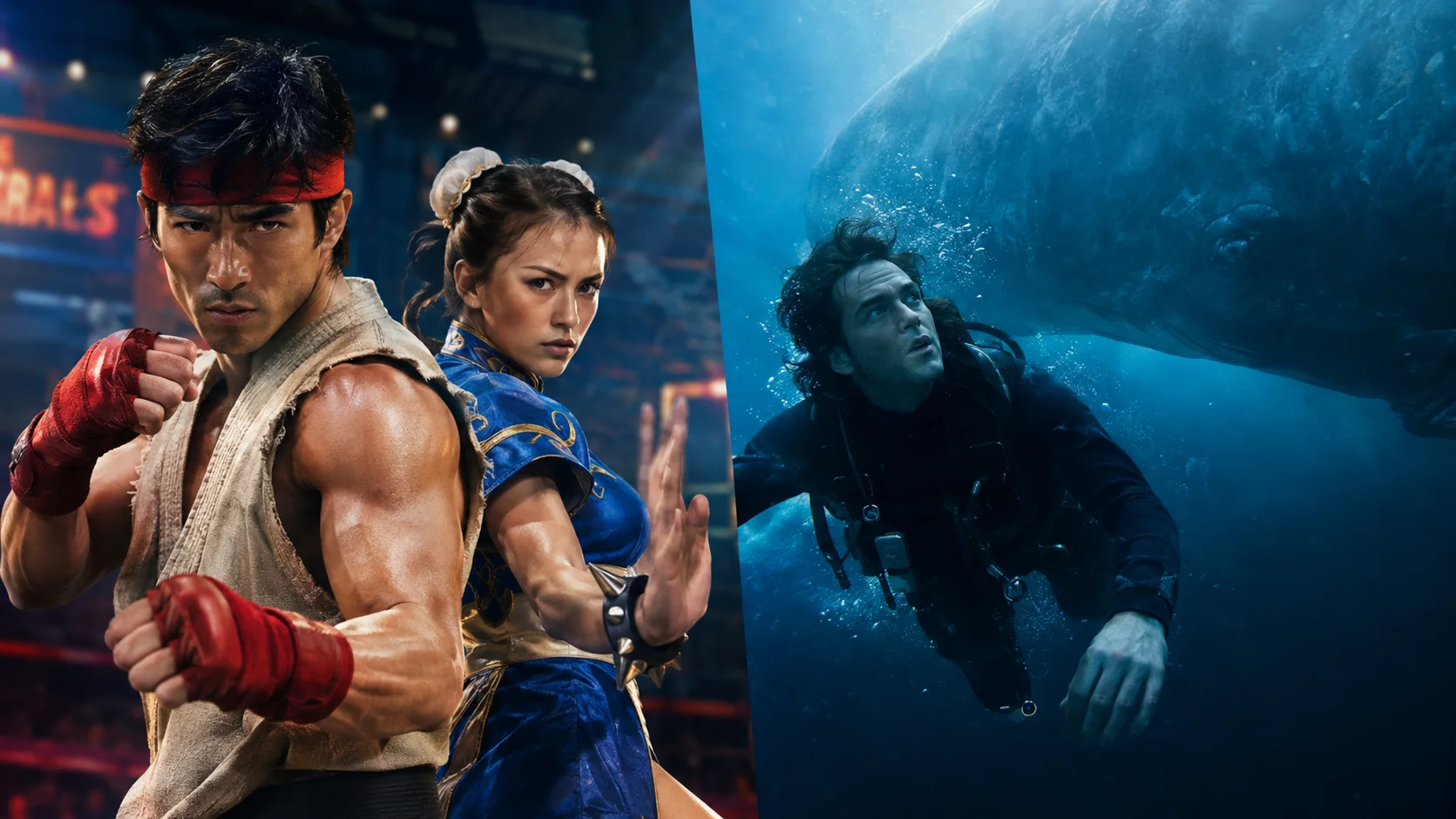
- 01Boxoffice Pro forecasts a $30-40 million US and Canada opening for Street Fighter; other projections range from $22 million to $32 million.
- 02Whalefall is projected to open at $10-15 million, with other analyses more modest.
- 03Reported production budgets are about $82 million for Street Fighter and about $60 million for Whalefall.
- 04All figures are pre-release forecasts, not actual box office results.
The October 16-18 movie weekend puts two business models in the audiovisual industry to the test. On one side is Street Fighter, the live-action adaptation of Capcom’s iconic video game franchise, backed by Paramount Pictures and Legendary Entertainment. On the other is Whalefall, a survival thriller distributed by 20th Century Studios that builds on a visually striking story based on Daniel Kraus’s novel of the same name.
The competition is not just about which title will emerge as the box office winner. For studios, the results will also test their ability to reach different audiences, capitalize on existing intellectual property and support productions requiring significant investment in a market where initial visibility does not necessarily guarantee a long theatrical run.
Street Fighter: The Commercial Power of a Global Brand
With Street Fighter, Hollywood is once again investing in an internationally recognizable intellectual property. Over the years, Capcom’s video game series has built a dedicated fan base and a rich universe of characters, rivalries and cultural references that the film industry can leverage to lower the barriers to audience engagement.
Directed by Kitao Sakurai, the film brings Ryu, Ken Masters and Chun-Li back to the screen, placing them in a new competition among fighters. The cast includes Andrew Koji, Noah Centineo, Callina Liang and Jason Momoa, alongside performers from the worlds of sports and entertainment. Paramount Pictures is handling international distribution, while Legendary Entertainment and Capcom are involved in the production.
According to forecasts published by Boxoffice Pro, the film could generate between $30 million and $40 million in its opening weekend in the United States and Canada. Other projections are more cautious, placing its debut in the $22 million to $32 million range, highlighting the significant uncertainty that remains. These are pre-release forecasts, not actual box office results.
Industry sources put the production budget at approximately $82 million. Based on the current projections, the film could therefore deliver a solid opening, although its commercial performance will ultimately depend on its ability to sustain audience interest beyond its first weekend.
Street Fighter’s main advantage is its brand recognition, combined with its potential to attract both video game fans and a broader audience drawn to action films. The adaptation must nevertheless appeal to viewers who have no direct connection to the franchise and distinguish itself in a market where video game adaptations have become increasingly common.
Whalefall: An Unusual Story Competing with Major Franchises
Whalefall follows a very different strategy. Directed by Brian Duffield and starring Austin Abrams and Josh Brolin, the film tells the story of a young scuba diver who is swallowed by a massive sperm whale while searching for his father’s remains. With approximately one hour of oxygen left, he must find a way out, while the story also explores the complicated relationship between father and son.
Here, the central draw is an extreme, visually powerful situation capable of generating curiosity beyond the usual thriller audience. The film is based on Daniel Kraus’s novel and is distributed by 20th Century Studios, the film label owned by Disney.
Forecasts for its North American debut are lower than those for Street Fighter. Boxoffice Pro projects an opening weekend of between $10 million and $15 million, while other analyses anticipate more modest results. The gap between forecasts illustrates how difficult it can be to predict audience demand for a title without the same level of recognition as an established video game franchise.
Industry sources put the production budget at approximately $60 million. For a thriller that still needs to build its own audience awareness, this is not an insignificant investment. In this case, the opening weekend could be more subdued, making a stronger-than-expected result particularly important.
Nevertheless, Whalefall’s positioning could prove to be an asset. A high-impact story supported by an effective marketing campaign can stand out in a release calendar dominated by sequels, remakes and familiar characters. The challenge is to turn the curiosity generated by its premise into sustained audience interest over the following weeks.
Budgets and Box Office: Why Opening Weekend Is Not Enough
Street Fighter enters the race with a commercial advantage linked to its brand recognition and higher box office expectations. However, a production investment of approximately $82 million, before marketing and distribution expenses, requires a strong performance in international markets and beyond the opening weekend.
Whalefall faces a different kind of risk. The audience’s lower familiarity with the title makes demand harder to predict, but the film could benefit from its distinctive narrative positioning and a marketing campaign built around its central concept. Its performance will need to be assessed against the actual cost of the project and the staying power of its box office, rather than solely in comparison with its competitor.
In both cases, competition for audiences’ time and spending extends well beyond films opening on the same weekend. Streaming platforms, ticket prices and the availability of at-home entertainment all contribute to making cinema demand more selective. Distribution strategies must therefore focus on attracting audiences, encouraging them to choose the theatrical experience and keeping each title visible after launch.
Hollywood’s Bet: Brand Recognition or Differentiation?
The contest between Street Fighter and Whalefall captures two complementary approaches. The first seeks to capitalize on an established intellectual property, hoping to turn brand recognition into a global audience. The second aims to carve out a place in the market through a story that stands out and generates interest with an easily communicated premise.
This is not an absolute opposition between franchises and original storytelling. Whalefall is itself based on a novel, while Street Fighter must renew an existing brand to remain relevant on the big screen. The key difference lies in the level of initial recognition and the tools available to reach potential moviegoers.
For studios, the real measure of success will be their ability to turn an opening weekend into a sustainable commercial run. Early forecasts position Street Fighter as the box office favorite, but the comparison with Whalefall offers a broader lesson: in an industry that demands substantial investment, brand recognition can reduce some of the uncertainty, but it cannot eliminate it. And an unusual story can still find an audience, provided it succeeds in turning attention into actual demand.
UCapital Asset Management LLP or group companies may have commercial relationships with the companies mentioned. This content is not financial advice.
Sign up for free to ask the AI about this article.
Create a free business page: clients, leads and releases in one place.