
Partners Group splits €6.6bn evergreen fund into accumulation and distribution share classes
The Swiss private markets giant restructures its flagship retail vehicle to offer investors a choice between reinvesting returns or receiving regular income, deepening access to private markets across Europe.

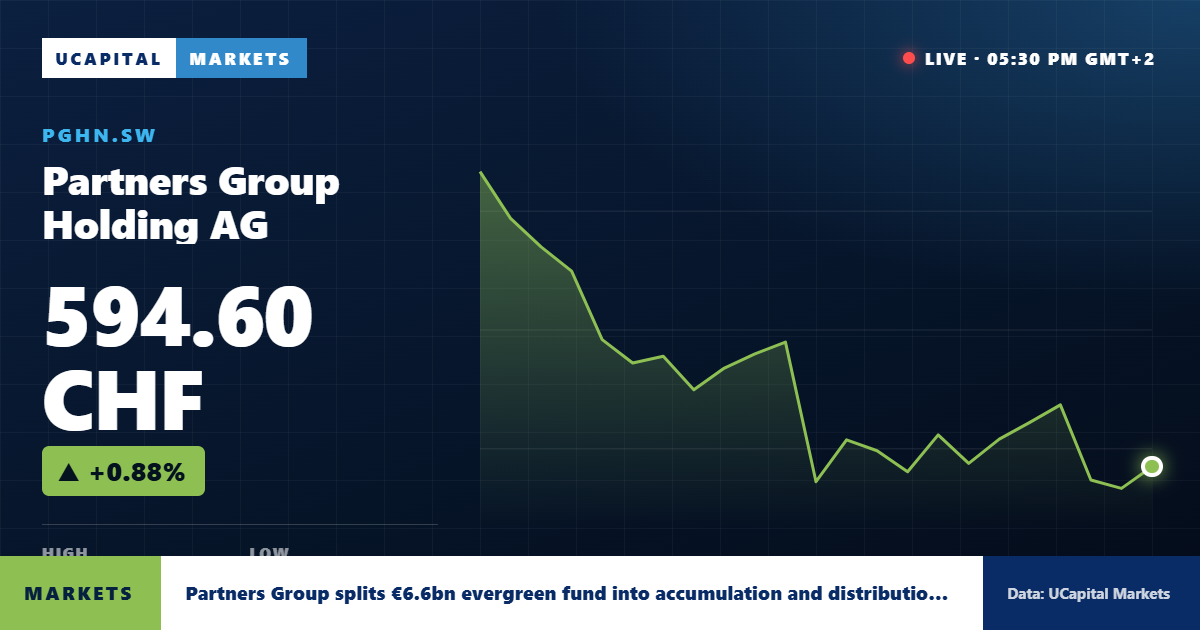
- 01Partners Group (PGHN.SW) is splitting its €6.6 billion Partners Group Evergreen Fund into two share classes: accumulation and distribution.
- 02The restructuring broadens retail investor access to private markets in Europe, addressing growing demand for liquidity solutions in evergreen and ELTIF structures.
- 03Partners Group reported assets under management of $185 billion, up 21% last year, and expects $26–32 billion in new client assets for 2026.
- 04The move reflects a wider European trend of adapting evergreen and ELTIF vehicles to meet the income and liquidity needs of individual investors.
Partners Group Holding AG (PGHN.SW) is restructuring its €6.6 billion Partners Group Evergreen Fund by splitting it into two distinct share classes — one that reinvests returns (accumulation) and one that pays them out (distribution) — in a move designed to widen retail access to private markets across Europe.
The decision touches one of the most actively debated questions in European asset management: how to make private markets genuinely accessible to individual investors while providing the liquidity and income features they expect. As regulators and fund managers push the European Long-Term Investment Fund (ELTIF) framework as the primary vehicle for democratising private markets, the structural choices made by large evergreen managers like Partners Group are setting a template for the industry.
What happened
Partners Group is dividing the Partners Group Evergreen Fund — currently one of the largest retail-oriented private markets vehicles in Europe at €6.6 billion — into an accumulation share class and a distribution share class. The accumulation class will reinvest any income and gains back into the fund, compounding returns over time in the manner familiar to long-term private markets investors. The distribution class will pay out returns to investors on a regular basis, catering to those who seek a recurring income stream from their private markets allocation.
The split does not alter the fund's underlying investment strategy or its exposure to private equity, private debt, real estate and infrastructure. What changes is the way economic returns flow back to investors, giving intermediaries and their clients a meaningful structural choice when allocating to the vehicle.
Why does the accumulation/distribution split matter for private markets?
Evergreen funds — open-ended structures that offer periodic liquidity windows rather than fixed maturities — have become the dominant format for bringing private markets to retail and semi-institutional investors in Europe. Unlike traditional closed-end funds, they do not return capital automatically at the end of a fixed life, which means investors must rely on the fund's own distribution policy or secondary-market liquidity mechanisms to access their money.
By introducing a dedicated distribution share class, Partners Group is addressing a structural gap: many retail investors, particularly those in or near retirement, need regular income rather than compounding growth. Without a formal distribution mechanism, income-oriented investors have historically been poorly served by evergreen structures, which were designed primarily with wealth accumulation in mind.
- €6.6 billion — current size of the Partners Group Evergreen Fund being restructured
- Two share classes — accumulation (returns reinvested) and distribution (returns paid out)
- $185 billion — Partners Group total assets under management, up 21% last year
- $26–32 billion — new client assets the company expects to attract in 2026, according to the company's statement
The ELTIF connection: Europe's push to democratise private markets
The restructuring arrives as the revised ELTIF 2.0 framework — which came into force in 2024 — is actively encouraging asset managers to design private markets products that are accessible to retail investors across the European Union. ELTIF 2.0 relaxed minimum investment thresholds, broadened the eligible asset universe and eased liquidity requirements, explicitly inviting evergreen-style structures into the retail distribution channel.
Partners Group's Evergreen Fund sits at the intersection of these regulatory tailwinds. By offering both accumulation and distribution options within the same vehicle, the fund can serve a wider spectrum of investor profiles — from younger investors building long-term wealth to older investors drawing down savings — without requiring separate fund launches for each segment. This structural flexibility is increasingly seen as a competitive necessity as more managers enter the European retail private markets space.
The liquidity question remains central to the debate. Evergreen funds typically offer quarterly or semi-annual redemption windows, subject to gates that can be activated in periods of market stress. Investors in the distribution share class will receive income without needing to redeem units, potentially reducing pressure on liquidity mechanisms during volatile periods — a feature that fund selectors and regulators alike have flagged as important for the long-term credibility of the ELTIF ecosystem.
Partners Group's broader growth context
Partners Group reported that its assets under management grew 21% last year to $185 billion, according to the company's statement. For 2026, the company expects new client assets of between $26 billion and $32 billion, reflecting continued confidence in inflows across its platform. The Evergreen Fund restructuring fits within a broader strategy of deepening retail and semi-institutional distribution, which has been a key driver of AUM growth for the Zug-based firm.
In its latest reported quarter, Partners Group posted earnings per share of 19.48 against an estimate of 21.79, with revenue of 1.12 billion in reporting currency versus an estimate of 1.14 billion. The stock trades at a trailing price-to-earnings ratio of 12.86 and a forward price-to-earnings ratio of 12.8, according to market data.
Why it matters
The Partners Group Evergreen Fund restructuring is significant beyond the firm itself because it signals a maturation of the European retail private markets market. When a €6.6 billion vehicle introduces income distribution as a structural feature, it validates the demand from retail investors for private markets exposure that behaves more like a traditional multi-asset fund — with regular payouts — rather than a locked-up institutional vehicle.
For the broader ELTIF market, the move raises the bar on product design. Distributors — banks, wealth managers and independent financial advisers — have consistently cited the absence of income distribution as a barrier to recommending private markets funds to retail clients. A large, established vehicle demonstrating that distribution mechanics can coexist with the illiquidity premium of private markets may accelerate adoption across the industry.
- Retail investors gain a choice between compounding growth and regular income within the same private markets vehicle
- Distributors can match client income needs without steering them away from private markets allocations
- Liquidity pressure on the fund may ease as distribution-class investors receive income without triggering redemptions
- The structure could become a reference model for ELTIF product design across European asset managers
What to watch next
Several developments will determine how significant this restructuring proves for the European private markets landscape in the months ahead.
- Distribution class uptake — the pace at which existing and new investors migrate to or select the distribution share class will indicate whether income demand in private markets is as strong as distributors have suggested.
- Regulatory response — European Securities and Markets Authority (ESMA) guidance on ELTIF liquidity management and distribution policies, expected to evolve through 2026, could further shape how evergreen funds structure their share classes.
- Competitor moves — other large evergreen managers operating in Europe are likely to face pressure to offer comparable structural flexibility; announcements from peers would confirm whether Partners Group's move triggers an industry-wide shift.
- Partners Group 2026 inflow targets — the company's stated expectation of $26–32 billion in new client assets for 2026 will be tested against actual inflow data in forthcoming quarterly updates, with the Evergreen Fund's restructuring a potential contributor to retail channel growth.
- Liquidity gate performance — how the fund's redemption mechanisms perform across both share classes during any periods of market stress will be closely watched by regulators and investors as a test of the evergreen model's resilience.
Sources:UCapital Markets (ucapital.com)bloomberg.com
UCapital Asset Management LLP or group companies may have commercial relationships with the companies mentioned. This content is not financial advice.
Sign up for free to ask the AI about this article.
Portfolios, flows and scenarios with UCapital AI.