
China Builds Island on Disputed South China Sea Reef
China completes the first phase of a man-made island on Antelope Reef, deepening its military footprint and escalating tensions across the South China…
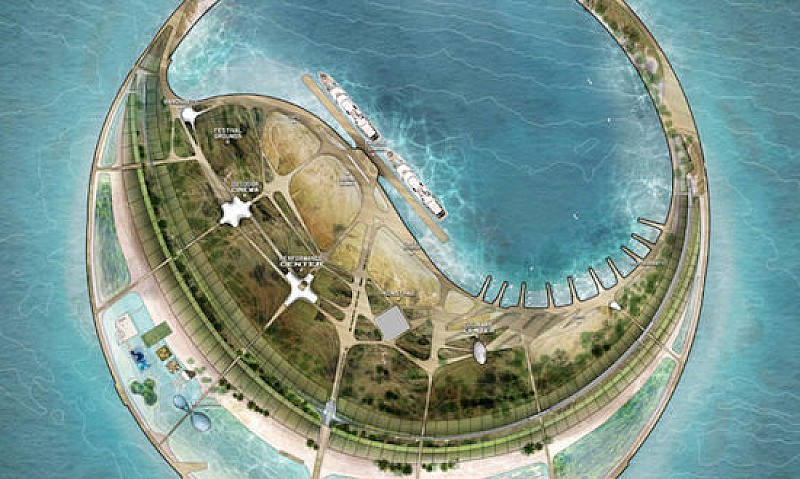
China Completes First Phase at Antelope Reef
Satellite imagery published on August 19, 2026, confirms that China has completed the initial phase of man-made island construction on Antelope Reef in the South China Sea. The images document substantial land reclamation activity and the sustained presence of Chinese Coast Guard vessels at the site, marking a concrete and measurable escalation in Beijing's physical footprint at a disputed maritime feature. The development represents the most significant expansion of China's island-building campaign since the large-scale militarization of the Spratly Islands, and it is expected to generate formal diplomatic protests from multiple claimant states.
What the Satellite Images Reveal
Imagery captured as recently as July 8, 2026, shows a Chinese Coast Guard vessel stationed at Antelope Reef alongside visible reclamation infrastructure, including dredging equipment and the early formation of a stable land platform. Successive frames document the rapid progression of construction activity over a matter of weeks, culminating in the emergence of a consolidated artificial landmass. The imagery is consistent with methodologies employed at earlier Chinese reclamation sites, where dredged sand and coral material were used to raise submerged or semi-submerged features above sea level and stabilize them with concrete reinforcement.
Timeline of Construction Activity
Construction activity at Antelope Reef appears to have accelerated markedly in mid-2026, with the first phase now assessed as complete. The pace mirrors China's earlier island-building campaigns in the Spratly Islands, which commenced around 2013 and produced several fully operational military outposts within a compressed timeframe. The speed of the Antelope Reef project suggests that China has refined its reclamation logistics and is capable of deploying the necessary infrastructure with greater efficiency than in earlier phases of its broader South China Sea strategy.
Strategic Significance of Antelope Reef in the South China Sea Dispute
Antelope Reef occupies a strategically sensitive position within the South China Sea, a waterway through which an estimated $3 to $5 trillion in global trade transits annually. Control of the reef would meaningfully extend China's operational reach and surveillance capabilities across a critical and heavily contested stretch of maritime space. Independent security analysts regard the location as a key node in Beijing's broader effort to establish de facto dominance over the region, irrespective of the unresolved legal questions that surround its sovereignty claims.
Geographic and Maritime Context
The South China Sea is one of the world's most heavily trafficked and resource-rich bodies of water, with overlapping territorial claims advanced by China, Vietnam, the Philippines, Malaysia, Brunei, and Taiwan. The sea is estimated to contain significant hydrocarbon reserves, and its fisheries represent a critical food-security resource for hundreds of millions of people across Southeast Asia. Antelope Reef sits within an area subject to competing sovereignty assertions, rendering any permanent Chinese installation there legally contentious under international law and diplomatically provocative to neighboring claimant states.
Military Implications of a Permanent Outpost
A completed island platform at Antelope Reef could support radar and signals-intelligence installations, logistics and resupply facilities, and potentially airstrips or berthing infrastructure for naval vessels — capabilities consistent with those developed on other Chinese-held features in the Spratly Islands. Such infrastructure would meaningfully extend China's area-denial and power-projection envelope into the southern reaches of the sea, compressing the response time available to rival claimants and complicating the operational planning of allied naval forces. Analysts note that even ostensibly modest installations can be rapidly upgraded once a stable land platform is in place, as the Spratly precedents demonstrate.
China's Justification vs. Analyst Assessments
Chinese state commentators and official sources have characterized the Antelope Reef development as serving civilian and humanitarian purposes, citing maritime search-and-rescue coordination and fisheries management as the primary rationales. This framing is consistent with the communications strategy Beijing has employed at each stage of its island-building campaign, presenting reclamation activity as benign and regionally beneficial before the military character of completed installations becomes undeniable.
Independent security analysts, however, assess that the dual-use nature of such infrastructure invariably confers a primary military advantage. Radar arrays, hardened shelters, and deep-water berthing facilities serve strategic functions regardless of the civilian justifications offered at the time of construction. The divergence between official Chinese framing and independent assessment reflects a well-established and recurring pattern in Beijing's management of its South China Sea communications, one that regional governments and external partners have grown increasingly skeptical of over the past decade.
Regional and International Reactions
The completion of the first construction phase at Antelope Reef is expected to draw formal diplomatic protests from claimant states, particularly the Philippines and Vietnam, both of which have previously lodged objections to Chinese reclamation activities through bilateral and multilateral channels. Manila, which has grown increasingly assertive in contesting Chinese encroachments under its exclusive economic zone, is likely to raise the matter through the Association of Southeast Asian Nations as well as in direct communications with Beijing.
The United States and allied navies have consistently conducted freedom-of-navigation operations throughout the South China Sea to challenge what Washington describes as excessive and unlawful maritime claims. Such operations are expected to continue in the vicinity of Antelope Reef as the installation develops. The 2016 ruling by the Permanent Court of Arbitration, which invalidated China's broad nine-dash line claim under the United Nations Convention on the Law of the Sea, remains the central legal reference point for claimant states and their partners — and a ruling that Beijing continues to categorically reject as null and void.
China's Island-Building Strategy: Broader Pattern
The Antelope Reef development is the latest episode in a sustained Chinese strategy of converting low-tide elevations and submerged reefs into permanent, militarized outposts across the South China Sea. Beginning with large-scale dredging operations in the Spratly Islands from approximately 2013 onward, China has created thousands of acres of artificial land, hosting runways, aircraft hangars, missile batteries, and port facilities across multiple features. The Antelope Reef project signals unambiguously that this strategy remains active and is expanding to additional disputed features beyond those already consolidated.
Precedents: The Spratly Islands Build-Up
China's reclamation of features including Fiery Cross Reef, Subi Reef, and Mischief Reef in the Spratly Islands established the operational template now being applied at Antelope Reef. Those outposts evolved rapidly from bare reclaimed land into fully equipped military installations capable of hosting long-range aircraft, surface-to-air missile systems, and electronic warfare equipment. The speed and scale of that transformation caught regional governments and external observers off guard, and the Antelope Reef project suggests that Beijing has drawn lessons from that experience — streamlining the construction process and reducing the window during which diplomatic pressure might interrupt progress.
Implications for Regional Security Architecture
Each new Chinese outpost incrementally shifts the balance of power in the South China Sea, complicating the security calculus for ASEAN claimant states and their external partners, including the United States, Japan, and Australia. The cumulative effect of China's island-building campaign is a transformed strategic environment in which Beijing exercises growing practical control over disputed waters, regardless of unresolved legal questions. For regional states, the Antelope Reef development reinforces the urgency of coordinating diplomatic, legal, and security responses before additional features are similarly converted into permanent Chinese installations.
Disclaimer: This article is intended for informational purposes only and does not constitute financial, investment, or legal advice. Readers should conduct their own due diligence before making any decisions based on the geopolitical developments described herein.
UCapital Asset Management LLP or group companies may have commercial relationships with the companies mentioned. This content is not financial advice.
Sign up for free to ask the AI about this article.
Elections, tariffs, sanctions and reforms: what changes for markets, countries and supply chains.