
Iran War Fuels China's Electric Truck Export Surge
How geopolitical conflict in the Middle East is accelerating China's e-truck dominance across South and Southeast Asia, reshaping global oil demand and freight…
Iran Conflict Drives Global Demand for China's E-Trucks
The ongoing war involving Iran has introduced sustained disruption to Middle Eastern oil supply routes, elevating global fuel prices and fundamentally altering the economics of diesel-powered freight. As Strait of Hormuz transit risks persist, fleet operators across South and Southeast Asia are accelerating their transition to electric heavy trucks — and Chinese original equipment manufacturers are the primary beneficiaries. The convergence of geopolitical instability, fuel price volatility, and China's formidable industrial capacity has produced one of the most consequential shifts in global freight logistics in a generation.
Oil Price Volatility and the TCO Tipping Point
Sustained elevated oil prices — materially influenced by Strait of Hormuz disruption risks — have compressed the total cost of ownership (TCO) payback period for electric trucks relative to diesel equivalents. In price-sensitive emerging markets, where fuel expenditure can represent 35 to 45 percent of fleet operating costs, even a modest and persistent increase in diesel prices meaningfully accelerates the financial case for electrification. Analysts tracking the sector note that in several Southeast Asian markets, the TCO crossover point — the mileage threshold at which an electric truck becomes cheaper to operate than a diesel counterpart — has shortened by an estimated 18 to 24 months compared with pre-conflict projections. For fleet operators managing thin logistics margins, this shift is not merely theoretical; it is driving procurement decisions in real time.
China's E-Truck Makers Positioned to Capitalize
Chinese OEMs including Sany Heavy Industry, FAW Group, and XCMG have rapidly scaled their export operations to meet surging international demand. These manufacturers benefit from vertically integrated battery supply chains — encompassing lithium, cathode materials, cell production, and pack assembly — that afford them cost structures largely inaccessible to Western or Japanese competitors. Strong state backing, in the form of export credit facilities and preferential financing terms, further enhances their competitive positioning in markets where upfront capital cost remains the dominant adoption barrier. The result is a cohort of Chinese truckmakers that can deliver electric heavy trucks at price points that make electrification viable for mid-sized fleet operators, not merely large logistics conglomerates.
South and Southeast Asia: The Engine of Export Growth
South and Southeast Asia now account for approximately half of all Chinese electric truck exports, establishing the region as the single most important growth frontier for China's e-truck industry. Vietnam, Thailand, Indonesia, and Malaysia have emerged as the leading destination markets, each driven by a distinct but reinforcing combination of policy incentives, infrastructure investment, fuel subsidy reform, and logistics modernization. The regional dynamic reflects a broader structural shift: as domestic EV competition within China intensifies and margins compress, internationalization has become a strategic imperative for Chinese OEMs.
Key Import Markets and Adoption Drivers
Each major Southeast Asian market presents a distinct set of adoption catalysts. Thailand, which has positioned itself as the EV manufacturing hub of ASEAN, offers purchase incentives and import duty reductions for electric commercial vehicles, creating a policy environment that directly subsidizes fleet electrification. Indonesia, home to the world's largest nickel reserves — a critical battery input — is pursuing an integrated EV supply chain strategy that makes electric truck adoption both a commercial and a national industrial priority. Vietnam's booming manufacturing logistics sector, driven by supply chain diversification away from China by multinational corporations, has generated surging freight demand that fleet operators are increasingly meeting with electric vehicles. Malaysia, meanwhile, has undertaken a phased rationalization of fuel subsidies that has materially raised the effective cost of diesel, directly improving the relative economics of electric alternatives.
Charging Infrastructure and Fleet Depot Expansion
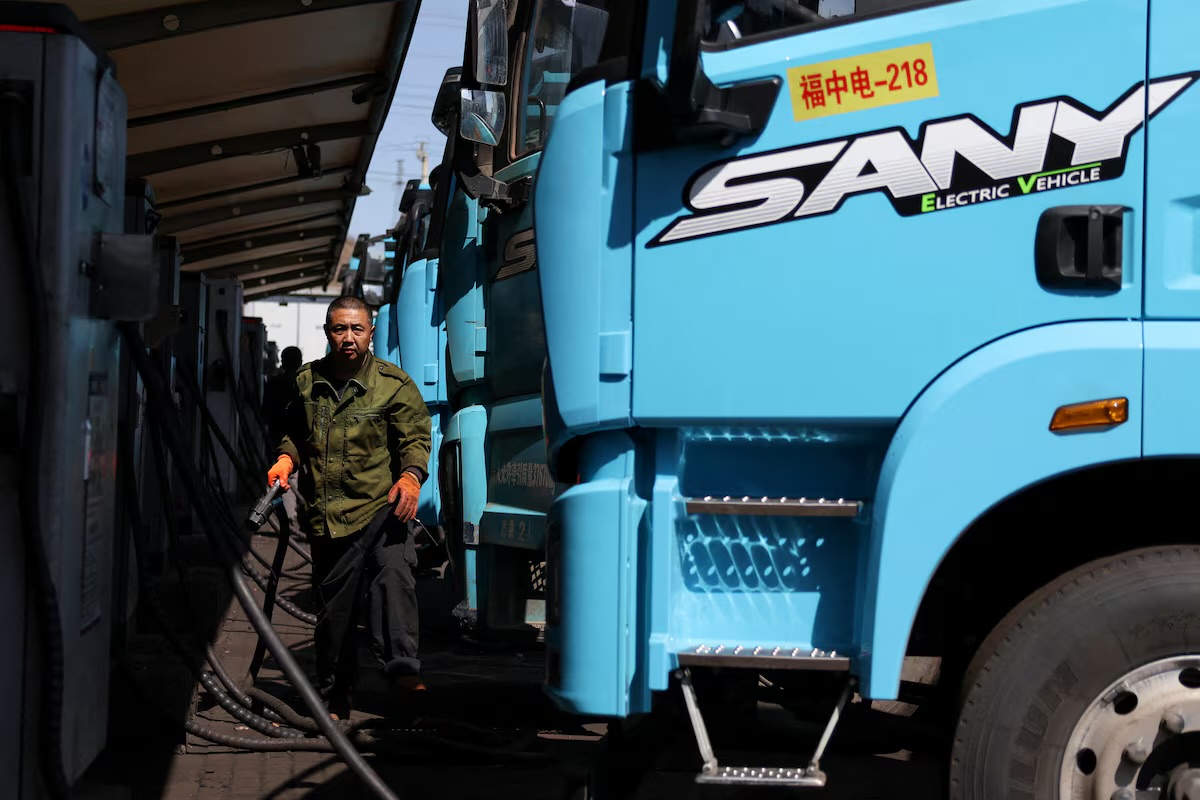
Large-scale electric truck adoption is contingent on the availability of high-capacity charging infrastructure at fleet depots — a prerequisite that Chinese OEMs are increasingly addressing directly. Mirroring the integrated depot-charging model visible at Sany's Tangshan operations in China, leading manufacturers are bundling charging equipment, installation services, and energy management software with vehicle sales packages. This approach reduces the infrastructure barrier that has historically deterred fleet operators from committing to electrification at scale. Across Southeast Asia, logistics parks and industrial zones are incorporating dedicated e-truck charging corridors into new construction, a development that reflects growing confidence among developers and operators that electric freight is a durable, not transitional, technology choice.
Export Surge Expected to Sustain for at Least One More Year
Leading Chinese truckmakers have publicly projected that the current pace of export growth will be maintained for a minimum of twelve additional months, underpinned by a robust forward order pipeline and the continued expansion of dealer and service networks across Asia, Africa, and Latin America. The internationalization push reflects a deliberate strategic response to intensifying domestic competition: as China's home market for electric trucks matures and price competition among domestic OEMs sharpens, export markets offer both volume growth and margin preservation opportunities unavailable in the saturated domestic landscape.
Dealer network expansion is proceeding rapidly across target markets, with Chinese OEMs establishing after-sales service infrastructure — parts depots, certified technician training programs, and remote diagnostics capabilities — that addresses one of the historically significant concerns of international fleet buyers: the availability of reliable maintenance support for vehicles from non-incumbent manufacturers. The resolution of this concern is accelerating procurement decisions among fleet operators who had previously deferred electrification pending greater service certainty.
141 Million Barrels: E-Trucks' Impact on Global Oil Demand
Analysts estimate that China's electric truck fleet — encompassing both domestically operated vehicles and exported units — will displace approximately 141 million barrels of oil demand in 2026 alone. This figure represents one of the most significant single-sector contributions to the global energy transition currently underway, and its implications extend well beyond the freight industry to encompass OPEC production strategy, sovereign energy security planning, and the long-term trajectory of global crude markets.
Methodology Behind the Oil Displacement Estimate
The 141-million-barrel displacement figure is derived from a composite methodology incorporating fleet size projections, average annual vehicle mileage, and comparative energy consumption data between electric and diesel heavy trucks. A standard diesel heavy truck operating approximately 100,000 kilometres annually consumes roughly 35,000 to 40,000 litres of diesel fuel — equivalent to approximately 220 to 250 barrels of oil per vehicle per year. Applied across a fleet of several hundred thousand electric trucks operating domestically and internationally, the aggregate displacement figure reaches the order of magnitude cited by analysts. The methodology provides a credible quantitative framework for assessing the sector's structural impact on fossil fuel demand, though precise figures will vary with fleet utilization rates and regional operating conditions.
Implications for OPEC and Global Energy Markets
As electric truck adoption accelerates in high-growth emerging markets, OPEC member states face compounding demand headwinds that are structurally distinct from the cyclical demand fluctuations they have historically managed through production adjustments. The dynamic carries a notable paradox: the geopolitical instability involving Iran — itself an OPEC member — has contributed to the oil price elevation that is driving fleet electrification, which in turn erodes the long-term demand base that sustains OPEC's collective revenue. This self-reinforcing cycle, in which elevated oil prices accelerate the adoption of oil-displacing technologies, represents a structural challenge to the cartel's medium-term production and pricing strategy that cannot be resolved through conventional supply management tools alone.
China's Strategic Edge: Supply Chain, Policy, and Belt and Road
China's dominance in electric heavy trucking is not incidental. It reflects decades of deliberate industrial policy, the systematic development of vertically integrated lithium-ion battery supply chains, and the strategic leverage of Belt and Road Initiative trade corridors that are expanding freight demand in precisely the markets where Chinese OEMs hold the strongest commercial positions. The structural competitive advantages underpinning China's e-truck export leadership are durable and, in several respects, self-reinforcing.
Government Subsidies and Industrial Policy
State-backed financing mechanisms, purchase subsidies, and preferential export credit terms administered through institutions including the China Export-Import Bank and the China Development Bank have enabled Chinese truckmakers to price electric heavy trucks competitively against diesel alternatives in markets where upfront capital cost remains the primary adoption barrier. Beyond direct financial support, China's industrial policy framework has prioritized the domestic development of battery raw material processing, cell manufacturing, and power electronics — creating a supply chain depth that insulates Chinese OEMs from the input cost volatility that constrains competitors reliant on international commodity markets. The cumulative effect is a cost structure that allows Chinese manufacturers to offer electric heavy trucks at price points that are, in many target markets, at or below the acquisition cost of comparable diesel vehicles.
Belt and Road Corridors as Export Highways
BRI infrastructure projects — spanning road networks, port facilities, and industrial zones across South Asia, Southeast Asia, Africa, and Central Asia — are generating sustained freight demand along corridors where Chinese electric trucks are already the preferred supplier. The commercial logic is mutually reinforcing: BRI-financed infrastructure creates the physical conditions for freight growth; freight growth creates demand for heavy trucks; and Chinese OEMs, already embedded in these markets through financing relationships and dealer networks, are positioned to capture the resulting procurement. This virtuous cycle of logistics growth, fleet electrification, and deepening commercial relationships between China and BRI partner nations constitutes a structural competitive moat that rivals will find difficult to breach in the near to medium term.
Disclaimer: This article is intended for informational purposes only and does not constitute investment advice. Data cited reflects analyst estimates and publicly available projections, which are subject to revision. Readers should conduct independent due diligence before making any investment or commercial decisions related to the sectors or companies discussed herein.
UCapital Asset Management LLP or group companies may have commercial relationships with the companies mentioned. This content is not financial advice.
Sign up for free to ask the AI about this article.
Elections, tariffs, sanctions and reforms: what changes for markets, countries and supply chains.